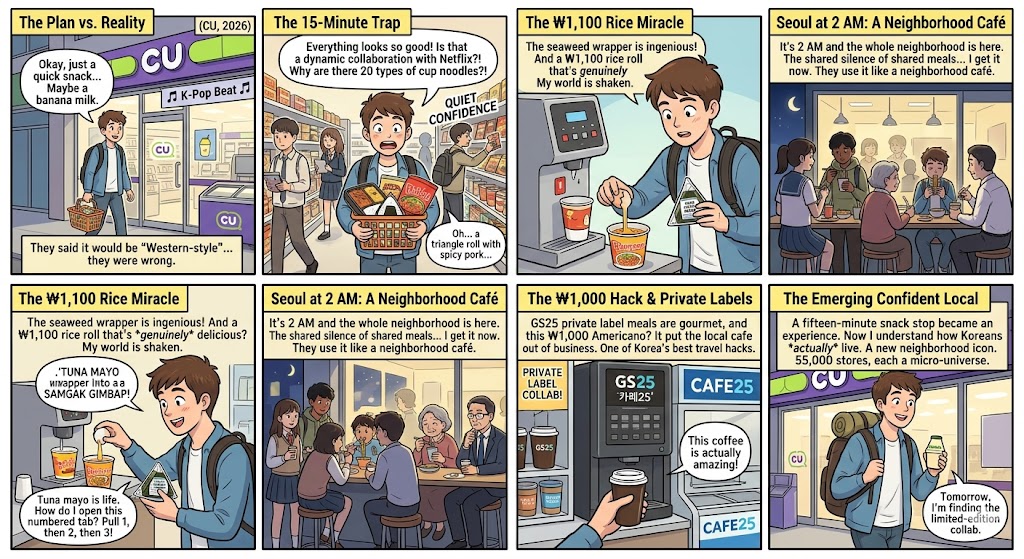
There is a moment that happens to almost every first-time visitor to Korea — usually within the first twenty-four hours — when they walk into a GS25 or CU for what they expect to be a quick snack stop and emerge fifteen minutes later carrying a bag of things they never intended to buy, having eaten standing at a counter while watching Korean office workers, students, and elderly grandmothers do the exact same thing with the comfortable ease of people at a neighborhood café.
This is the Korean convenience store experience, and it has almost nothing in common with its Western equivalent.
There are roughly 55,000 convenience stores in South Korea as of early 2026 — approximately one for every 927 residents. That density produces something unusual: a retail environment so saturated that competition forces constant quality improvement, where a ₩1,100 triangle rice roll is genuinely good because it has to be, where the self-serve coffee machine produces an Americano that has put nearby cafés out of business, and where the seating area at 2 AM contains a cross-section of Korean life that no restaurant or bar could replicate. Discover Real Korea
Understanding Korean convenience stores is one of the fastest ways to understand how Koreans actually live. This guide covers everything — the chains, the food, the services, the etiquette, and exactly what to eat and buy in 2026.
For the wider food picture before your trip, read our Korean BBQ Guide and our Korean Street Food Guide — the convenience store fits into a much richer culinary ecosystem than most visitors expect.
Korean Convenience Store Guide: The Four Chains
The four largest convenience store chains in Korea are GS25, CU, 7-Eleven Korea, and Emart24. You will encounter all four, but GS25 and CU dominate to a degree that makes the others feel like supporting cast. South Korea Hallyu
GS25 (지에스25)
GS25 leads with approximately 18,800 locations. GS25 leads in exclusive food collaborations — often with pop-culture brands, webtoons, and even Netflix shows — and its private-label products are consistently ranked highest in quality. If you are looking for the most Instagram-worthy limited-edition item of the season, GS25 is your first stop. Discover Real KoreaSeoulFul
GS25 is also the chain most associated with premium ready-to-eat meals. A GS25 dosirak with rice, soy sauce bulgogi, kimchi, fried egg, and spinach — seven side dishes — costs around ₩5,000 as of April 2026. That is a complete meal at a price that Seoul restaurants cannot approach. Discover Real Korea
GS25 releases new collaboration items on Tuesdays and Thursdays. If you’re chasing a limited-edition product you saw on Instagram, timing your visit around these days matters. Discover Real Korea
CU (씨유)
CU sits right behind GS25 at about 18,700 locations, having added 253 net new stores in 2025 alone. CU is the chain most associated with Korean street food classics. Its hot snack bar (핫스낵 코너) is legendary, and CU’s triangle gimbap lineup leans toward bolder, richer flavors. CU also has the most aggressive loyalty app, offering frequent coupons and buy-one-get-one deals that loyal customers swear by. Discover Real KoreaSeoulFul
CU stores usually stand out for their comfort and layout — many locations have designated seating areas, microwaves, and even small cooking counters where you can heat up ramen, toast sandwiches, or enjoy hot odeng right on the spot. Hungry Pursuit
CU uses the Pocket CU app for weekly limited drops. Download it before your trip if you want first access to seasonal products. Discover Real Korea
7-Eleven Korea
7-Eleven comes third with around 12,100 locations. 7-Eleven Korea, though sharing a name with the American chain, operates almost completely differently. Its prepared meals and sandwich lineup are strong, and it has built a reputation for collaborations with premium food brands. Do not expect it to feel anything like the 7-Eleven in your home country. Discover Real KoreaSeoulFul
The local verdict: A common sentiment on Reddit’s Living in Korea community is “GS25 for kimbap, CU for desserts, 7-Eleven for hot fried snacks.” All three are worth visiting — they carry different exclusive products, and part of the joy of Korean convenience stores is discovering what you can only find at each chain. Discover Real Korea
Korean Convenience Store Guide: What to Eat
Samgak Gimbap (삼각김밥) — Triangle Rice Roll
The single most iconic Korean convenience store item — a compact triangle of rice wrapped in seaweed, filled with tuna mayo, bulgogi, kimchi, spam, or dozens of other fillings, sealed in a clever three-step plastic wrapper that keeps the seaweed crisp until you open it.
CU cut samgak kimbap to ₩1,100 in a March 2026 renewal — less than $1 USD for something that is genuinely satisfying. The tuna mayo filling is the classic starting point. The spicy pork and cream cheese versions are worth trying once the basics are covered. Discover Real Korea
How to open it: numbered tabs on the packaging — pull 1, then 2, then 3. The seaweed stays perfectly crisp.
Dosirak (도시락) — Lunchbox
The Korean convenience store lunchbox is the item that consistently surprises Western visitors most. For ₩4,000–₩6,000, you get a compartmentalized container with rice, a protein (bulgogi, chicken, pork cutlet), and four to seven side dishes including kimchi, pickled radish, a soft-boiled egg, and vegetables. Heat it in the store microwave for 90 seconds.
GS25 is particularly famous for its dosirak lunchboxes — huge boxes with a huge assortment of sides like pickles, soft boiled eggs, fishcakes, and kimchi plus loads of rice. South Korea Hallyu
Cup Ramyeon (컵라면) — Instant Noodles
Korean cup noodles are significantly better than their Western counterparts — the broth is more complex, the noodles are better textured, and the range of flavors available at any given store runs to twenty or more options. The hot water dispenser is free and always available next to the ramyeon section.
The standard move: add a boiled egg (sold near the ramyeon section) cracked directly into your cup. Stir. Instant upgrade. KoreaPeek
Top picks: Shin Ramyun (신라면) for classic spicy beef, Buldak Bokkeum Myeon (불닭볶음면) for intense heat, Yukgaejang Cup (육개장) for a milder, more traditional flavor.
Odeng / Eomuk (어묵) — Fish Cake Skewer
Long skewers of soft fish cake simmered in a mild, savory broth kept warm in a pot at the counter — one of the most distinctly Korean convenience store experiences available. You pay per skewer (₩700–₩1,000) and drink the broth from small cups provided free at the stand. Best in winter, when the warmth of the cup against cold hands becomes part of the appeal.
Hot Snacks (핫바) — Fried Counter Items
The hot snack section near the register — corn dogs, fried chicken, fish sausages, potato wedges — is where 7-Eleven and CU compete most aggressively. Prices run ₩1,000–₩2,000 per item. The quality varies by location and time of day; items sitting in the warmer for hours are less compelling than freshly fried. Ask for fresh items if the display looks old.
Gimbap Roll (김밥) — Full Seaweed Rice Roll
The full-size gimbap roll — rice, vegetables, egg, and protein wrapped in seaweed and sliced into rounds — is sold refrigerated and eaten at room temperature or briefly microwaved. Cheaper and more filling than the triangle version. Classic tuna and vegetable versions cost ₩2,000–₩3,500.
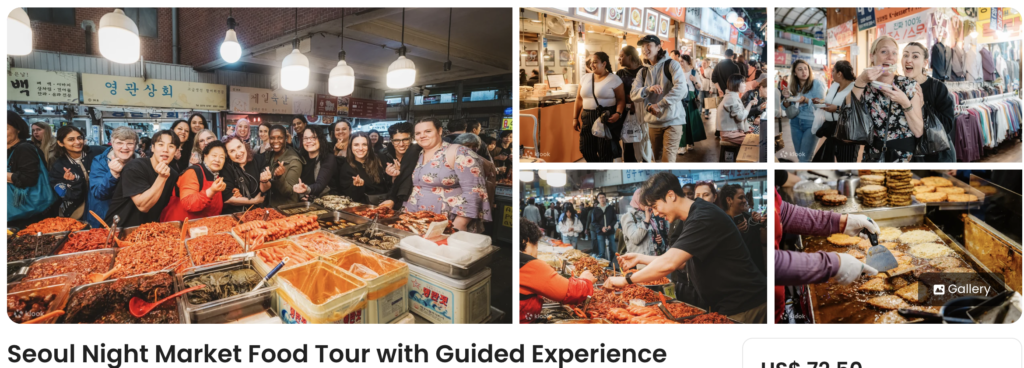
Want to experience Korean food culture beyond the convenience store with a local guide? A Seoul street food tour on Klook covers the convenience store run, Myeongdong street food alley, and local pojangmacha tents in a single evening — with an English-speaking host who explains what you’re eating and why it matters.
Korean Convenience Store Guide: What to Drink
Self-serve coffee (카페25 / HEYROO)
Korean convenience stores have quietly dismantled the café market from below. The self-serve coffee machines (GS25’s “카페25” and CU’s “HEYROO”) produce espresso-based drinks — Americanos, lattes, cappuccinos — for ₩1,000 to ₩1,500. They are genuinely good. Many Koreans have stopped going to cafés for their morning coffee entirely. SeoulFul
The ₩1,000 Americano is one of Korea’s best travel hacks — the quality is notably higher than the price suggests, and the machines are in virtually every store.
Banana milk (바나나맛우유)
The iconic Korean drink — sweet, creamy, nostalgic. Every Korean grew up with this. Price: ₩1,500–₩1,800, brand: Binggrae. The distinctive barrel-shaped bottle has been unchanged since 1974. Non-negotiable purchase for first-time visitors. KoreaPeek
Sikhye (식혜)
A traditional sweet rice drink, cold and slightly fizzy — refreshing in a way that has no Western equivalent. Sold in cans and small bottles. The sweet rice sediment at the bottom is intentional — shake before drinking. SeoulFul
Makgeolli (막걸리)
Fizzy, lightly sweet rice wine at around 6% alcohol. The convenience store has normalized makgeolli for a new generation of Korean drinkers. Sold in plastic bottles for ₩1,800–₩3,000. Shake before opening — the rice sediment creates the characteristic milky appearance. SeoulFul
Soju (소주)
The national spirit of Korea, sold at every convenience store for ₩1,800–₩2,500 per bottle. The most popular brands are Chamisul (참이슬) and Jinro (진로). Standard drinking practice: mix with beer in a half-and-half ratio called somaek (소맥), or drink straight from small shot glasses.
Korean Convenience Store Guide: Services Beyond Food
Korean convenience stores function as neighborhood infrastructure in a way that no Western equivalent matches. The services available vary by location but typically include:
| Service | Details |
|---|---|
| ATM | Accepts international cards reliably (Visa, Mastercard) |
| T-Money top-up | Add transit card credit at the register — tell the cashier the amount |
| Phone charging | USB charging stations available at many locations |
| Printing | Document printing and photocopying at most large stores |
| Package pickup / drop-off | CU and GS25 are major parcel locker partners |
| Bill payment | Utility bills and mobile top-ups payable at the register |
| Umbrella rental | Available at some GS25 locations during rain season |
The T-Money top-up function is particularly useful for travelers — read our Seoul Subway Guide for complete T-Money guidance.
Korean Convenience Store Guide: 2026 Prices
Prices are uniform nationwide. The samgak kimbap at a CU inside Incheon Airport costs the same ₩1,100 as the one at a CU in a residential alley in Daegu. No tourist markup. Discover Real Korea
| Item | Price (2026) |
|---|---|
| Samgak gimbap (triangle) | ₩1,100–₩1,800 |
| Dosirak lunchbox | ₩4,000–₩6,000 |
| Cup ramyeon | ₩1,500–₩2,500 |
| Gimbap roll | ₩2,000–₩3,500 |
| Odeng skewer | ₩700–₩1,000 |
| Hot snack (corn dog etc.) | ₩1,000–₩2,000 |
| Self-serve Americano | ₩1,000–₩1,500 |
| Banana milk | ₩1,500–₩1,800 |
| Soju (360ml) | ₩1,800–₩2,500 |
| Makgeolli | ₩1,800–₩3,000 |
| Boiled egg | ₩700–₩1,000 |
A complete late-night convenience store meal — triangle gimbap, cup ramyeon with egg, Americano — costs approximately ₩4,000–₩5,000. One of the best value meals available anywhere in Korea.
Morning discount tip: Many stores run a 50% discount on ready-to-eat food (dosirak, kimbap, sandwiches) between 6 AM and 10 AM on certain days. Check the stickers on packaging near the register in the early morning — yellow discount labels appear on items approaching their sell-by time. Discover Real Korea
Korean Convenience Store Guide: How to Use One
For first-time visitors, the mechanics of a Korean convenience store are slightly different from home.
The correct order of operations:
- Browse and collect items
- Bring everything to the register before eating or opening anything
- Pay — cash, Visa, Mastercard, Apple Pay, and Samsung Pay all work
- Take your bag to the seating area or counter space
- Use the microwave, hot water dispenser, or utensils provided
Sitting down with unpaid items or opening food before paying can confuse staff and feel awkward in Korea. It’s a small cultural difference, but once you know it, you’ll feel much more comfortable. Korea Unpacked
For alcohol purchases: Korea is strict about age restrictions for alcohol. Convenience store staff can get in serious trouble for selling to minors, so they may ask for ID. For foreigners, the most commonly accepted ID is your passport. Korea Unpacked
Seating: Most stores have a standing counter or small table area either inside or outside the store. These spaces are genuinely used — sitting down at a Korean convenience store counter at any hour is a completely normal thing to do, not a last resort.
Chopsticks and utensils: Available free at the register or in a small container near the counter. Straws, napkins, and plastic spoons are similarly provided — take what you need.
Korean Convenience Store Guide: Etiquette Tips
Korean convenience stores are relaxed environments, but a few unspoken norms make interactions smoother:
- Don’t leave rubbish on the seating tables — use the bins provided inside or outside the store
- The microwave is shared — keep heating times reasonable and don’t occupy it while browsing
- Outdoor seating is fair game at any hour — Korean convenience store culture has no concept of closing time for the seating area
- Loyalty apps — GS25 and CU both have apps with English interfaces that provide coupons and discounts. Not essential, but worth downloading for longer stays
Korean Convenience Store Guide: What Not to Miss
If you visit Korea and leave without doing any of the following, you have missed something genuinely important:
The late-night ramyeon ritual. Walk into a GS25 in Seoul at 2 AM and you will find three different generations eating at the same standing table — a grandmother picking at a triangle gimbap, a college student slurping instant noodles, and a salaryman washing down a fish cake skewer with a cold can of Cass. Eat ramyeon standing at the counter after midnight at least once. SeoulFul
The ₩1,000 Americano. Order it from the self-serve machine, take it outside, and drink it watching Seoul wake up at 6 AM. One of the best free mornings in the city.
The limited-edition hunt. For new and hard-to-find releases, half the fun is the search. Check GS25 on a Tuesday or Wednesday for new collab drops. Seasonal items — cherry blossom drinks in spring, sweet potato everything in autumn — are among the best reasons to visit at the right time of year. Rustic Pathways
The dosirak as a proper meal. Don’t write off the lunchbox as a budget compromise. Korean convenience store food isn’t just snacks and instant noodles — it’s complete meals, fresh bakery items, collaboration desserts from celebrity chefs, craft beer, premium highballs, and coffee that rivals mid-tier cafés. Discover Real Korea
For the rest of your Seoul eating plan, read our Myeongdong Street Food Guide for the outdoor street food experience and our Korean BBQ Guide for the quintessential Korean dining ritual. And if you want to understand how Koreans use convenience stores as part of a larger urban food culture, our Seoul 3-Day Itinerary includes a convenience store breakfast run as one of the essential Seoul morning experiences.