
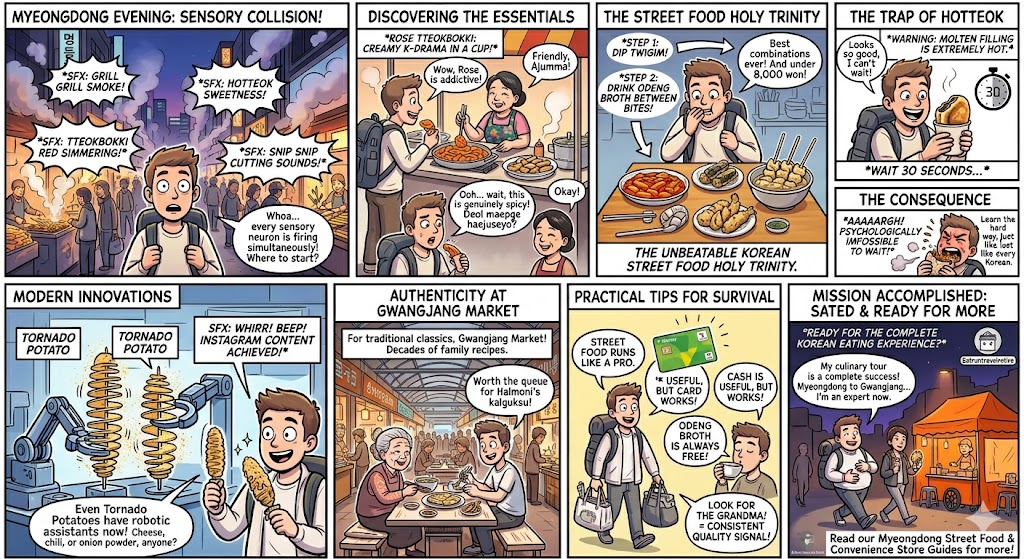
The first thing that happens when you turn into Myeongdong’s main food alley in the evening is a sensory collision — smoke from a dozen grills, the sharp sweetness of hotteok browning on a flat iron, the deep red of tteokbokki simmering in pots, the sound of scissors cutting through crispy fried things, and the particular kind of crowd energy that forms when hundreds of people from every country imaginable are all simultaneously trying to figure out what to eat first.
This is Korean street food — and it is one of the best eating experiences in Asia.
But Korean street food is much larger than Myeongdong. It lives in the covered food halls of Gwangjang Market, where the same families have been frying mung bean pancakes for decades. It lives at pojangmacha — the orange tent stalls that appear on Seoul’s streets after dark, where Korean office workers eat fish cake skewers and drink makgeolli under fluorescent lights. It lives in the seasonal rhythms of the country: sweet potato carts in winter, sikhye in summer, cherry blossom makgeolli in spring.
Culinary tourism participation in Korea jumped from 56.5% in 2019 to 76.8% by 2025 — and street food sits at the center of that shift. This guide covers every dish worth knowing, every location worth visiting, and everything you need to eat Korean street food like someone who actually lives here. Eatruntravelretire
Before reading this guide, take a look at our Korean Convenience Store Guide — Korea’s street food culture and convenience store culture overlap significantly, and understanding both gives you the complete picture of how Koreans actually eat.
What Is Korean Street Food: The Essential Dishes
Tteokbokki (떡볶이) — Spicy Rice Cakes
Tteokbokki is widely considered the most popular Korean street food and can be found in nearly every street market. Cylindrical, chewy rice cakes simmered in a deep red gochujang sauce — sweet, spicy, and impossible to stop eating — served in paper cups with fish cakes and a boiled egg. Hidden Korea Guide
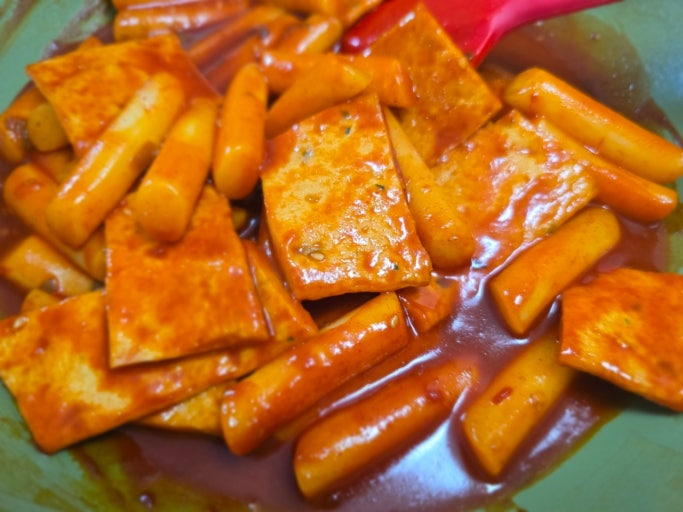
The 2026 version worth knowing: Rose tteokbokki (로제 떡볶이) — a creamy, carbonara-influenced variation that adds heavy cream to the gochujang base, making it significantly less spicy and significantly more addictive. Available at most tteokbokki stalls now alongside the classic version.
Spice level note: the classic version is genuinely spicy. Say “덜 맵게 해주세요” (deol maepge haejuseyo — less spicy, please) if needed. No vendor will judge you for asking.
Where to find the best version: Sindang-dong Tteokbokki Town near Sindang Station — considered the birthplace of the modern gochujang version of the dish, an entire cluster of restaurants dedicated to tteokbokki, many operating since the 1970s. MileAsia
Cost: ₩4,000–₩6,000 per cup.
Odeng / Eomuk (어묵) — Fish Cake Skewer
Long skewers of soft fish cake boiled in a mild, savory broth — one of the most distinctly Korean street food experiences, and one of the cheapest. The broth is served free in small paper cups at the stall. The combination of the warm skewer and a cup of broth in cold weather produces a particular kind of satisfaction that no other Korean food quite matches.
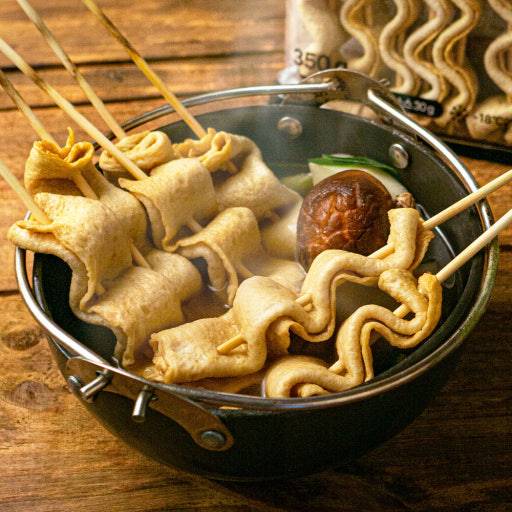
The Korean street food holy trinity: tteokbokki + twigim (fried items) + odeng, all from the same stall. Dip the twigim in the tteokbokki sauce. Drink the fish cake broth between bites. This is how Koreans do it — all three for under ₩8,000. KoreaPeek
Cost: ₩700–₩1,500 per skewer. Broth: free.
Hotteok (호떡) — Sweet Filled Pancake
A thick yeasted dough pancake pressed flat on a griddle until the outside caramelizes to a deep amber and the inside reveals a molten filling of brown sugar, cinnamon, and crushed nuts. Best eaten immediately from the paper cup, hot enough to burn — which is unavoidable because waiting is psychologically impossible.
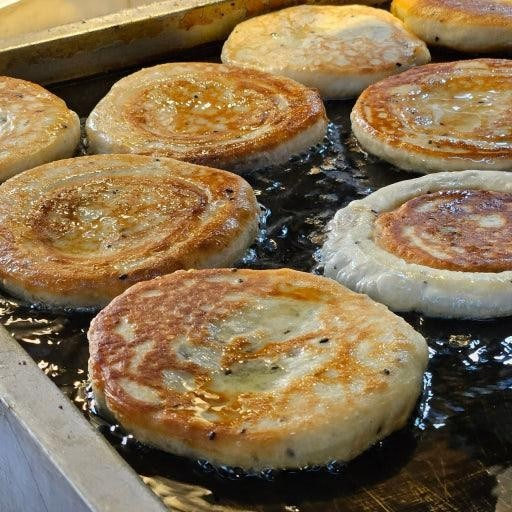
Warning: the filling is extremely hot. Wait 30 seconds before biting. Every Korean has learned this the hard way. KoreaPeek
A green tea version with red bean filling has become the standard Insadong variant. The classic brown sugar version near Myeongdong is the original and still the best.
Cost: ₩1,500–₩2,000.
Twigim (튀김) — Korean Fried Things
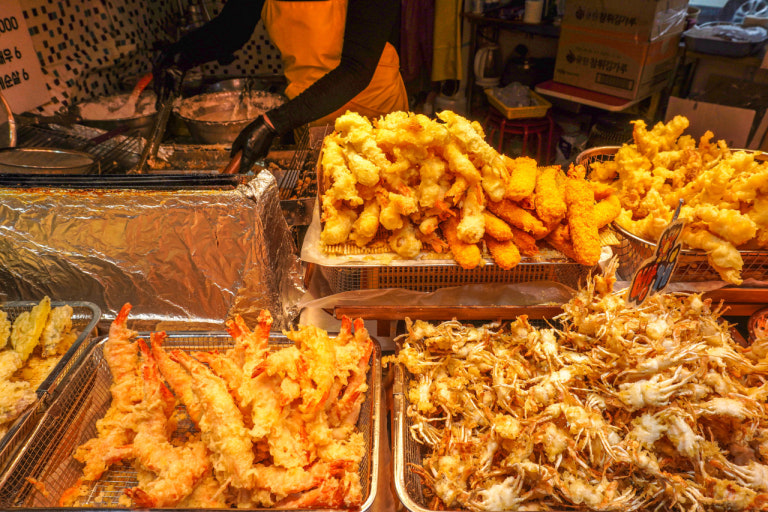
Twigim is the umbrella term for Korean street food tempura — vegetables, sweet potato, squid, glass noodles wrapped in seaweed (gimmari), and more, battered and fried fresh at the stall. 김말이 (gimmari — glass noodles wrapped in seaweed, fried) is the classic: crispy, savory, perfect. KoreaPeek
The correct way to eat twigim at a tteokbokki stall: dip directly into the tteokbokki sauce. The combination of the crispy batter softening in the spicy sauce is one of Korean street food’s most satisfying bites.
Cost: ₩500–₩1,000 per piece. Mix-and-match bags of five for ₩3,000–₩5,000.
Gyeran-ppang (계란빵) — Egg Bread
A small oval loaf of sweet yeasted bread baked around a whole egg — the savory egg cooked into the sweet bread center produces a combination that sounds confusing and tastes excellent. In the cold weather of Myeongdong, steaming egg bread is a true “soul food” that provides a hearty meal for travelers. HaniSeoul
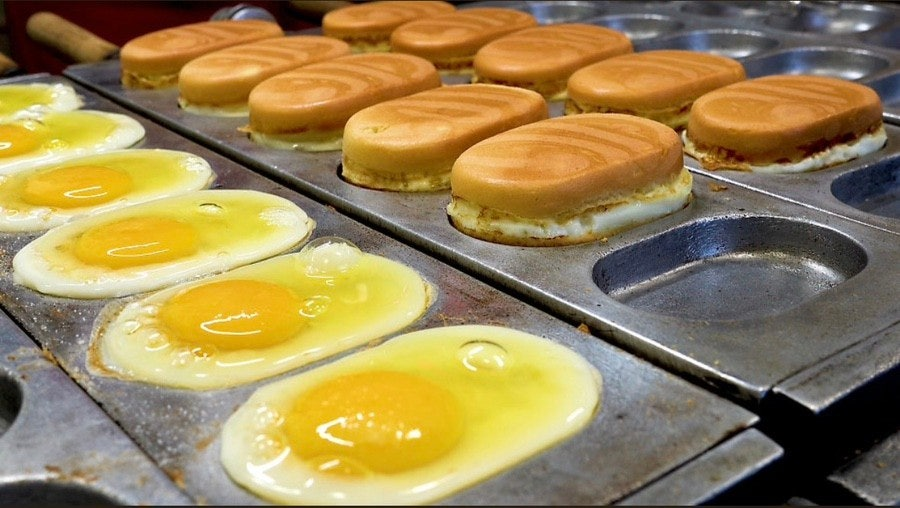
Cost: ₩2,000–₩2,500. Best eaten straight from the vendor, hot.
Korean Corn Dog (핫도그)
A frankfurter or mozzarella stick coated in a thick batter — panko, ramen crumbs, or potato cubes — fried until golden, then rolled in sugar and finished with condiments. The mozzarella version is the one that photographs best and tastes best: the cheese stretches dramatically when pulled apart, and the contrast of sweet sugar coating against savory melted cheese is aggressively good.
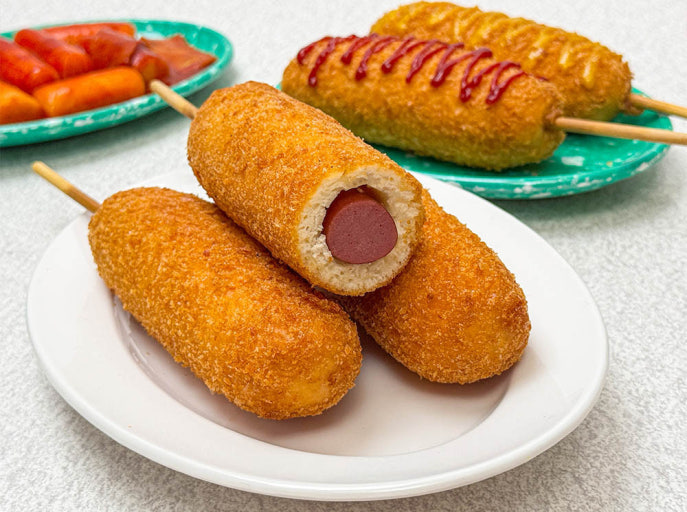
In 2026, cheese waterfall-style corn dogs are trending — thick cheese skewers grilled until molten and eaten with condensed milk or spicy sauce. HaniSeoul
Cost: ₩3,000–₩6,000 depending on fillings and size.
Tornado Potato (회오리 감자)
A whole potato cut into a continuous spiral, stretched along a skewer, and deep-fried until completely crispy — one of the most satisfying textures in Korean street food. In 2026, stalls featuring robotic arms that precisely cut the potatoes have become popular — partly functional, mostly Instagram content. Seasoned with cheese powder, chili, onion, or a combination. HaniSeoul
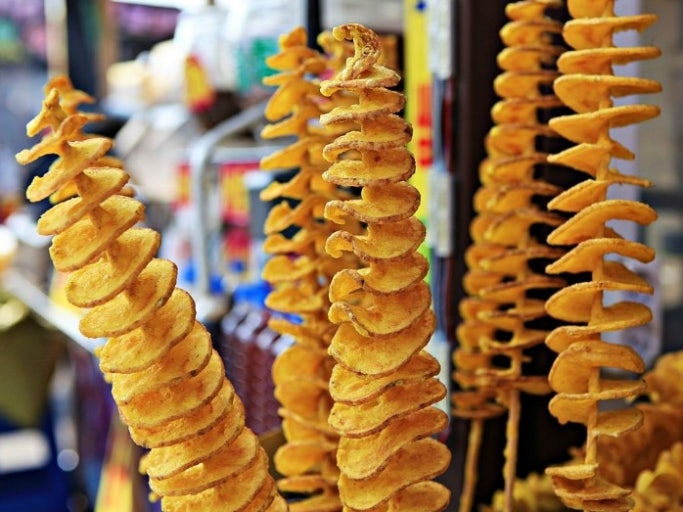
Cost: ₩3,000–₩5,000.
Gilgeori Toast (길거리 토스트) — Korean Street Toast
Korea’s version of a breakfast sandwich — buttered bread toasted on a flat iron, filled with a fried egg, shredded cabbage mixed with sugar and salt, ham, and processed cheese. The sugar in the cabbage sounds wrong and tastes completely right. It’s notably one of the few street foods substantial enough to eat as a full meal. Cozymeal
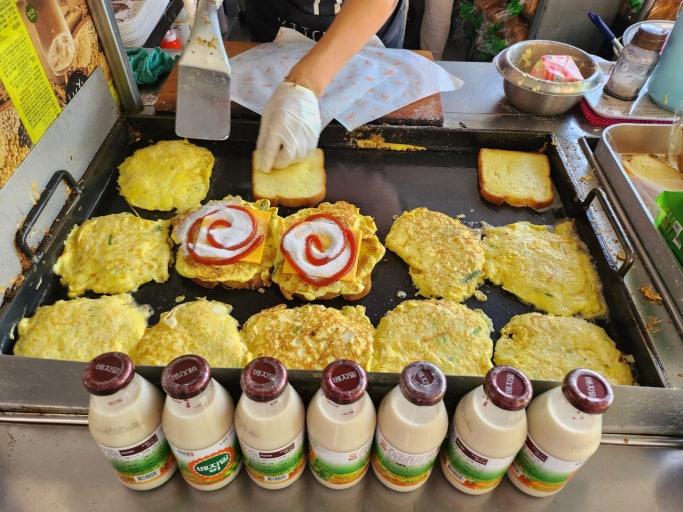
The Isaac Toast chain has formalized this into a fast-food concept, but the best versions come from the older sandwich carts near traditional markets.
Cost: ₩2,500–₩4,000.
Soondae (순대) — Korean Blood Sausage
Glass noodles, rice, and vegetables packed into a pork intestine casing — Korea’s blood sausage, served sliced with salt and chili dipping powder. The flavor is mild and savory rather than intensely gamey, and the texture is dense and chewy. Most commonly found at traditional markets rather than tourist-facing street food areas.
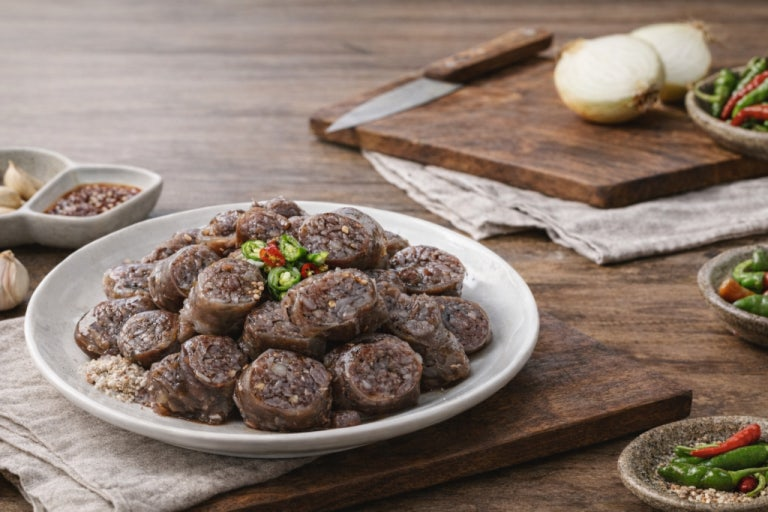
Not for everyone. Absolutely worth trying once. If there’s a line and a grandmother at the helm, just get in it. Eatruntravelretire
Cost: ₩3,000–₩5,000 for a portion.
Bungeoppang (붕어빵) — Fish-Shaped Bread
A fish-shaped waffle filled with sweet red bean paste or custard cream — one of the most beloved winter street foods in Korea, sold from small cart ovens that warm the surrounding air with the smell of caramelizing batter. The 2026 evolution: a reinterpretation using multi-layered croissant dough for a crispy, flaky exterior — the combination of texture and sweet filling represents the essence of Korean fusion street food. HaniSeoul
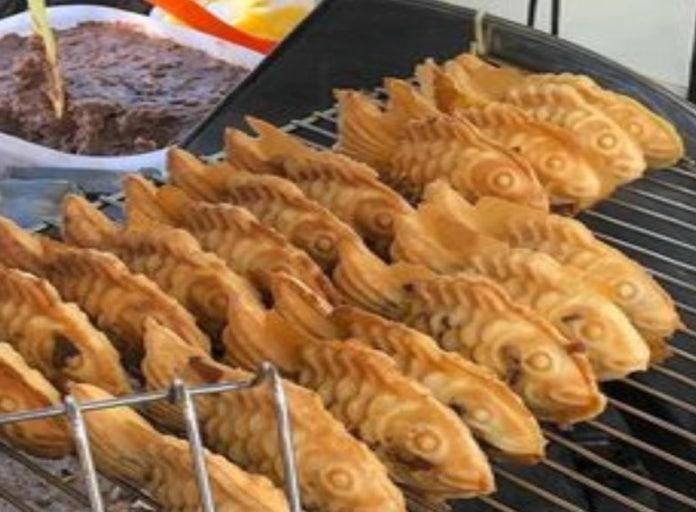
Cost: ₩1,000–₩1,500 each, or 3 for ₩3,000. Seasonal — primarily autumn through spring.
What Is Korean Street Food: 2026 Price Guide
| Dish | Korean Name | Price Range | Spice Level |
|---|---|---|---|
| Tteokbokki | 떡볶이 | ₩4,000–₩6,000 | 🌶🌶🌶 |
| Rose tteokbokki | 로제 떡볶이 | ₩5,000–₩7,000 | 🌶 |
| Odeng skewer | 어묵꼬치 | ₩700–₩1,500 | — |
| Hotteok | 호떡 | ₩1,500–₩2,000 | — |
| Twigim (fried) | 튀김 | ₩500–₩1,000/pc | — |
| Gyeran-ppang | 계란빵 | ₩2,000–₩2,500 | — |
| Korean corn dog | 핫도그 | ₩3,000–₩6,000 | — |
| Tornado potato | 회오리감자 | ₩3,000–₩5,000 | — |
| Gilgeori toast | 길거리토스트 | ₩2,500–₩4,000 | — |
| Soondae | 순대 | ₩3,000–₩5,000 | — |
| Bungeoppang | 붕어빵 | ₩1,000–₩1,500 | — |
A complete Korean street food run — four to five items — costs approximately ₩15,000–₩25,000 per person. One of the most affordable quality eating experiences anywhere in Asia.
What Is Korean Street Food: Where to Eat It
Gwangjang Market (광장시장) — Best for Traditional Classics
Seoul’s oldest and most authentic traditional market, and the best single food destination in the city. The covered food hall serves bindaetteok (mung bean pancakes fried to order), mayak gimbap (tiny sesame rice rolls — addictively good), and yukhoe (raw seasoned beef) from stalls run by the same families for decades. MileAsia
The famous Netflix Lady of Gwangjang Market, Cho Yonsoon, featured on Street Food Asia, has been serving hand-stretched kalguksu noodles for nearly 30 years. The queue at her stall is still worth it. MileAsia
Getting there: Jongno 5-ga Station, Line 1, Exit 8. Open daily from approximately 9 AM to 11 PM. Weekday mornings are the least crowded; Friday and Saturday evenings are the most atmospheric.
What to order: Bindaetteok (mung bean pancake) and mayak gimbap as the entry point. Yukhoe (raw beef) if you eat raw meat. Eomuk-tang (fish cake soup) in cold weather.
Myeongdong Food Alley (명동 먹자골목) — Best for the Classic Tourist Experience
The most concentrated street food corridor in Seoul — dozens of vendors along the pedestrian shopping street with every major Korean street food represented. Stalls usually begin setting up around 4 PM, and the most active time is between 5 PM and 9 PM. HaniSeoul
Best for: first-time visitors who want maximum variety in a single location. The atmosphere is electric on weekend evenings, though crowd density peaks uncomfortably between 6–8 PM on Saturdays.
Getting there: Myeongdong Station, Line 4, Exit 5 or 6.
Read our Myeongdong Street Food Guide for the complete breakdown of every stall worth stopping at.
Pojangmacha (포장마차) — Best for Late-Night Atmosphere
The orange tent stalls that appear on Seoul’s streets after dark — portable kitchens serving tteokbokki, odeng, twigim, gimbap, and Korean alcohol to standing and seated customers under fluorescent lights. This is the Korean street food experience most removed from tourism: practical, cheap, unpretentious, and deeply atmospheric.
Chewy rice cakes in a spicy, sweet gochujang sauce remain the soul of the city — available from pojangmacha street tent stalls, market stalls, and dedicated tteokbokki restaurants throughout Seoul for ₩4,000–₩6,000. MileAsia
Where to find them: Around Hongdae, near Dongdaemun, and along the side streets of Mapo-gu. Active from approximately 7 PM to 2 AM.
Namdaemun Market (남대문시장) — Best for Local Prices
The largest traditional market in South Korea — many small food alleys inside sell classic Korean street foods, attracting both tourists and locals who come to eat affordable meals prepared quickly by long-time vendors. Hidden Korea Guide
The kalchi jorim (braised beltfish) and hotteok near the market gates are the highlights. Less internationally famous than Gwangjang but arguably more authentic to how Seoul actually eats.
Getting there: Hoehyeon Station, Line 4, Exit 5.
What Is Korean Street Food: Practical Tips
Arrive hungry and eat small. Korean street food is designed for grazing — multiple small portions from different vendors rather than a single large meal at one stall. Budget your appetite accordingly.
Cash is useful but not essential. While many stalls now accept cards, the oldest and best vendors often prefer cash or T-Money card payment. Carry ₩20,000–₩30,000 in small bills for street food runs. Eatruntravelretire
The odeng broth is always free. If you’re at a fish cake stall, the broth is usually free — grab a paper cup, help yourself to the steaming soup, and sip while you wait for your main dish. Eatruntravelretire
Look for the grandma. The vendors who have been at the same spot for decades — usually older women (아주머니, ajumma or 할머니, halmoni) with worn equipment and practiced efficiency — consistently produce the best food. A queue of Korean locals at a stall is the single most reliable quality signal.
Explore the side alleys. Some of the best street food vendors operate in less crowded locations — side streets and smaller alleys away from the main tourist flow often have the same quality at lower prices. Hidden Korea Guide
Seasons change the menu. Korean street food follows seasonal logic: hotteok and bungeoppang in winter, nokcha (green tea) hotteok and bingsu in summer, sweet potato and chestnut in autumn. The best street food experience is always the one that matches what the season offers.
What Is Korean Street Food: A Complete Street Food Day in Seoul
| Time | Location | What to Eat |
|---|---|---|
| 9 AM | Gwangjang Market | Bindaetteok, mayak gimbap, sikhye |
| 12 PM | Namdaemun Market | Gilgeori toast, odeng, hotteok |
| 3 PM | Insadong | Green tea hotteok, bungeoppang (seasonal) |
| 6 PM | Myeongdong | Tteokbokki, corn dog, gyeran-ppang |
| 9 PM | Pojangmacha, Hongdae | Twigim, odeng broth, makgeolli |
This route covers six hours and approximately ₩40,000–₩60,000 per person — one of the best full-day itinerary options in Seoul.
For transport between these locations, read our Seoul Subway Guide. For the Korean BBQ experience that pairs naturally with a street food day, read our Korean BBQ Guide.
What Is Korean Street Food: FAQ
Is Korean street food spicy? Some of it is, but not all. Tteokbokki and anything with gochujang sauce is genuinely spicy. Hotteok, gyeran-ppang, bungeoppang, corn dogs, and tornado potatoes are not spicy at all. Most stalls with spicy items will reduce the heat if you ask — say “덜 맵게” (deol maepge).
Is Korean street food safe to eat? Yes. Korea has strict food safety standards, and vendors operating at established markets like Gwangjang and Namdaemun have been inspected and operating for years. Street food in tourist areas is uniformly safe.
Can vegetarians eat Korean street food? Some items are naturally vegetarian — hotteok, tornado potato, gyeran-ppang, and most twigim vegetables. Tteokbokki is vegetarian if made without fish cake, which you can request. Many traditional items contain fish products in the broth or sauce, so asking specifically is advisable.
What is the most iconic Korean street food? Tteokbokki — without question. It appears in every K-drama, every food documentary about Korea, and every Korean childhood memory. If you eat only one Korean street food, it should be tteokbokki at a stall that’s been there for decades.
For official tourism information and updated travel guides,
visit the Korea Tourism Organization website.
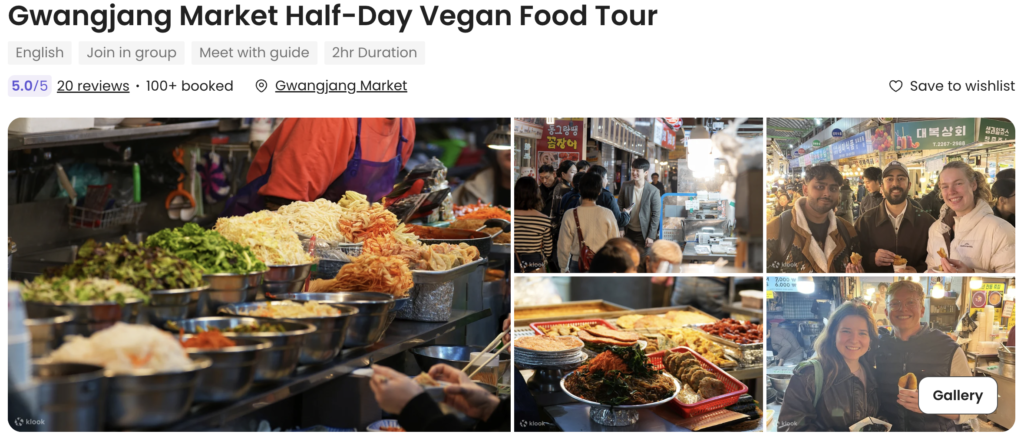
Not sure where to start with Seoul’s markets and street food alleys? A Seoul street food tour on Klook takes you through Gwangjang Market, a pojangmacha experience, and Myeongdong’s food alley with an English-speaking local guide who explains the history and ordering etiquette at each stop — and handles the navigation so you can focus entirely on eating.
Ready to eat your way through Seoul? Read our Myeongdong Street Food Guide for the complete tourist food corridor breakdown, our Korean Convenience Store Guide for late-night eating between market visits, and our Seoul 3-Day Itinerary to fit the full street food experience into a first visit.

Korea Insider has lived in South Korea for 50 years and worked at international companies for over two decades — explaining Korean culture, food, and society to colleagues from the US, Europe, and Australia.
Internationally married with a Japanese spouse, Korea Insider brings both an insider’s depth and an outsider’s perspective to every topic on My Korea Tip.