
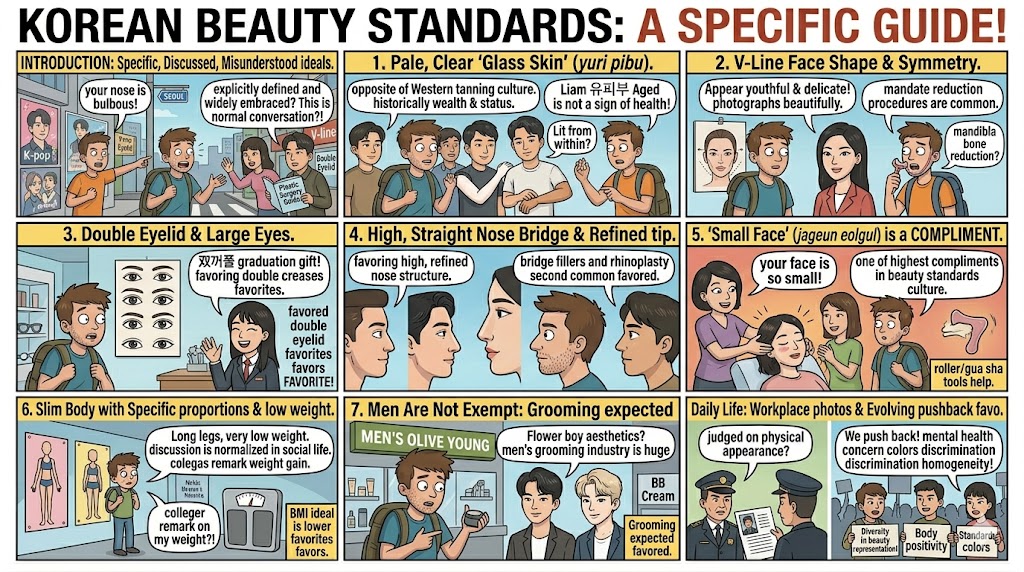
I’ve watched Korean beauty standards evolve over fifty years — and the pace of change has only accelerated. What foreigners often miss is that these aren’t vague cultural preferences. In Korea, beauty ideals are specific, widely discussed, and taken seriously in ways that genuinely surprise most Western visitors.
Foreigners encountering Korean beauty standards for the first time — through K-dramas, K-pop, or visiting Korea — are consistently surprised by how explicitly defined and widely embraced these standards are. Korean beauty standards are not vague cultural preferences. They are specific, measurable, and deeply embedded in Korean social culture.
This complete guide explains exactly what Korean beauty standards are, why they exist, how they affect daily Korean life, and what foreigners need to understand about them.
Before exploring Korean beauty standards, read our Korean Plastic Surgery Guide — the most direct expression of how seriously Koreans pursue their beauty standards.
Korean Beauty Standards: The Core Ideals
Korean beauty standards are built around a specific set of physical ideals that differ significantly from Western beauty standards.
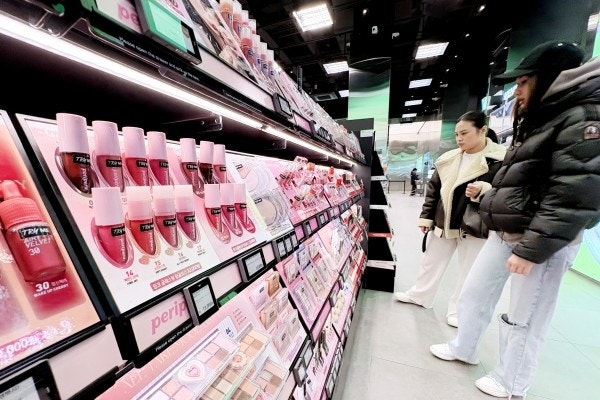
Korean Beauty Standards #1 — Pale, Flawless Skin
The most fundamental of all Korean beauty standards is pale, clear, luminous skin — often described as “glass skin” (유리 피부, yuri pibu).
Korean beauty standards prize skin that is:
- As pale as possible
- Completely free of blemishes, pores, and dark spots
- Luminous and reflective — appearing lit from within
- Even-toned with no redness or hyperpigmentation
Korean beauty standards around skin tone are the direct opposite of Western tanning culture. While Western beauty standards have historically valued tanned skin as a sign of health and leisure, Korean beauty standards consider pale skin the ultimate complexion goal.
This Korean beauty standard has ancient roots — pale skin historically signaled that a person worked indoors (a sign of wealth and status) rather than outdoors in fields. The association between pale skin and high social class became deeply embedded in Korean beauty standards over centuries.
The Korean beauty standards obsession with skin has directly produced the world’s most advanced skincare industry. The elaborate K-beauty routines foreigners worldwide now follow exist because of Korean beauty standards around skin quality. Read our K-Beauty Skincare Routine Guide and Why Koreans Look So Young Guide for the full skincare context.
Korean Beauty Standards #2 — V-Line Face Shape
The V-line face — a slim, oval face with a pointed chin creating a V-shape when viewed from the front — is one of the most defining Korean beauty standards.
Korean beauty standards consider the V-line face ideal because it:
- Appears youthful and delicate
- Creates facial symmetry
- Photographs beautifully
- Signals femininity in Korean beauty standards culture
Korean beauty standards around face shape have directly driven demand for V-line surgery — jaw reduction procedures that shave the mandible bone to narrow the lower face. This is one of the most uniquely Korean plastic surgery procedures and the most direct physical expression of Korean beauty standards around face shape.
Even without surgery, Korean beauty standards around face shape influence makeup techniques — contouring to create the appearance of a V-line is a fundamental Korean beauty standards makeup skill.

Korean Beauty Standards #3 — Double Eyelids and Large Eyes
Korean beauty standards place enormous emphasis on large, defined eyes — specifically the double eyelid crease that approximately 50% of East Asians are born without.
Korean beauty standards around eyes favor:
- Double eyelid crease (쌍꺼풀, ssangkkeopul)
- Large, rounded eye shape
- Bright, clear whites of the eyes
- Long eyelashes
Korean beauty standards around eye size have made double eyelid surgery the most performed cosmetic procedure in Korea — a direct physical expression of these beauty standards. Korean beauty standards are so specific about eye shape that the procedure is sometimes given as a graduation gift by parents.
Korean Beauty Standards #4 — High, Straight Nose Bridge
Korean beauty standards favor a high, well-defined nose bridge with a refined tip — a significant departure from typical East Asian nose structure.
Korean beauty standards prize:
- High nose bridge (코대, kodae)
- Straight profile
- Refined, not bulbous tip
- Narrow nostrils
Korean beauty standards around nose shape have made rhinoplasty the second most common cosmetic procedure in Korea. Nose bridge fillers and contouring makeup are Korean beauty standards alternatives to surgery.
Korean Beauty Standards #5 — Small Face
“Small face” (작은 얼굴, jageun eolgul) is one of the most distinctly Korean beauty standards — the ideal that the face should be as small as possible relative to the body.
Korean beauty standards around face size are so specific that Koreans routinely compliment each other with “your face is so small!” — one of the highest compliments in Korean beauty standards culture.
Korean beauty standards around small face size have produced specific products — face-slimming rollers, gua sha tools, and lymphatic massage techniques all marketed specifically for the Korean beauty standards goal of reducing face size.
Korean Beauty Standards #6 — Slim Body with Specific Proportions
Korean beauty standards around body shape are specific and demanding — slim overall with long legs relative to torso height.
Korean beauty standards body ideals include:
- Very low body weight — Korean beauty standards BMI ideals are significantly lower than Western equivalents
- Long legs (다리가 길다, dariga gilda) — considered one of the highest Korean beauty standards compliments
- Small waist
- Slim arms and ankles — areas specifically targeted in Korean beauty standards diet culture
Korean beauty standards around body weight are among the most controversial aspects of Korean beauty culture internationally. The explicit discussion of weight and body shape in Korean social culture — colleagues commenting on weight gain, friends discussing diets openly — reflects Korean beauty standards’ deep normalization in daily social life.
Korean Beauty Standards #7 — Straight, White Teeth
Korean beauty standards around dental appearance have grown significantly in recent decades. Straight, white teeth are now considered an important component of Korean beauty standards — particularly for public-facing roles in entertainment and business.
Orthodontic treatment is increasingly common among Korean teenagers as Korean beauty standards have expanded to include dental appearance.
Korean Beauty Standards: How They Affect Daily Korean Life
Korean beauty standards are not abstract ideals — they shape concrete daily behaviors and social interactions in ways that frequently shock foreigners.
Korean Beauty Standards in the Workplace
Korean beauty standards have documented effects on Korean professional life. Research has shown that physical appearance — judged against Korean beauty standards — affects hiring decisions, salary levels, and promotion rates in Korean workplaces.
Korean job applications traditionally include a photo — a practice directly linked to Korean beauty standards’ influence on professional evaluation. The existence of this practice reflects how normalized Korean beauty standards are in Korean institutional culture.
Korean Beauty Standards in Relationships
Korean beauty standards play an explicit role in Korean dating culture. Physical appearance evaluated against Korean beauty standards is openly discussed in Korean dating contexts in ways that most Westerners find uncomfortable.
Korean dating apps routinely include appearance-based filtering. Korean beauty standards are openly referenced in relationship discussions. Read our Korean Dating Culture Guide for the full context of how Korean beauty standards interact with romantic relationships.
Korean Beauty Standards and Social Media
Korean social media culture — particularly Instagram and TikTok — is saturated with Korean beauty standards content. Korean beauty standards tutorials, product reviews, before-and-after transformation content, and beauty standards commentary generate enormous engagement both domestically and internationally.
Korean beauty standards have been a primary driver of K-beauty’s global expansion — as international audiences encounter Korean beauty standards through K-pop and K-drama, interest in achieving Korean beauty standards through skincare and cosmetics has grown exponentially worldwide.
Korean Beauty Standards: Men Are Not Exempt
One of the most surprising aspects of Korean beauty standards for Western foreigners: Korean beauty standards apply nearly as explicitly to Korean men as to Korean women.
Korean male beauty standards — sometimes called “flower boy” (꽃미남, kkotminam) aesthetics — include:
- Clear, pale, well-groomed skin — Korean male beauty standards explicitly include skincare
- Slim, fit physique — Korean male beauty standards favor lean over muscular
- Well-styled hair
- Symmetrical facial features
Korean male beauty standards have produced a thriving men’s grooming industry in Korea — the world’s largest per capita market for men’s cosmetics. Korean men use BB cream, tinted moisturizer, and skincare products at rates that shock most Western men.
K-pop idols — with their carefully managed appearances that meet Korean male beauty standards — have significantly influenced global perceptions of what male attractiveness means.
Read our Korean Skincare Routine for Men Guide for the practical application of Korean male beauty standards in daily grooming.
Korean Beauty Standards: The Criticism
Korean beauty standards are not without significant criticism — both within Korea and internationally.
Korean Beauty Standards and Mental Health
The specificity and pervasiveness of Korean beauty standards create documented mental health impacts. Korean youth — particularly young women — report high rates of appearance-related anxiety directly linked to Korean beauty standards.
Korean beauty standards’ emphasis on specific, often unattainable physical ideals creates pressure that Korean mental health researchers and advocates have increasingly highlighted as a public health concern.
Korean Beauty Standards and Colorism
Korean beauty standards around skin tone — specifically the preference for very pale skin — have been criticized for perpetuating colorism. Darker-skinned Koreans and Korean residents from other Asian countries have documented experiences of discrimination based on Korean beauty standards around skin color.
Korean Beauty Standards and Diversity
Korean beauty standards are remarkably homogeneous — the physical ideal is very specific, leaving little room for the diversity of appearance that exists in Korean society. Korean beauty standards have been criticized for creating a narrow definition of attractiveness that excludes many Koreans by default.
Korean Beauty Standards Are Evolving
It’s important to note that Korean beauty standards are not static. Younger Koreans — particularly the MZ generation — are increasingly pushing back against rigid Korean beauty standards. Social movements emphasizing body positivity, diversity in beauty representation, and mental health awareness are challenging traditional Korean beauty standards from within Korean society.
Korean Beauty Standards vs Western Beauty Standards
| Aspect | Korean Beauty Standards | Western Beauty Standards |
|---|---|---|
| Skin tone | Pale, luminous | Tanned, bronzed |
| Eye shape | Large, defined crease | Varied |
| Face shape | V-line, small | Varied |
| Body type | Very slim, long legs | More varied recently |
| Men’s grooming | Skincare expected | Less emphasis |
| Openness about appearance | Very open | More taboo |
Korean Beauty Standards: What Foreigners Should Know
Korean beauty standards comments are not always rude. When a Korean comments on your appearance — noting weight gain, pale or tanned skin, or facial features — they are often applying Korean beauty standards frameworks that treat appearance as normal conversational territory. This is culturally different from Western norms but is not always intended as criticism.
Korean beauty standards are changing. The Korean beauty standards of today are not those of 20 years ago, and Korean beauty standards will continue evolving. Younger Koreans are increasingly diverse in their beauty ideals.
Korean beauty standards are not universal within Korea. Individual Koreans have diverse personal beauty ideals. Korean beauty standards describe cultural averages, not universal individual beliefs.
Want to understand more about Korean culture? Read our guides on Korean Dating Culture and Why Koreans Look So Young for deeper cultural context.

Korea Insider has lived in South Korea for 50 years and worked at international companies for over two decades — explaining Korean culture, food, and society to colleagues from the US, Europe, and Australia.
Internationally married with a Japanese spouse, Korea Insider brings both an insider’s depth and an outsider’s perspective to every topic on My Korea Tip.