
I’ve watched Korean dating culture change dramatically over the past three decades — and some things haven’t changed at all. The pressure to be in a relationship, the obsession with couple culture, the very specific anniversary rituals — these aren’t K-drama inventions. They’re real, and they shape how millions of Koreans approach romance every day.
What surprises most foreigners isn’t that Korean romance is different. It’s how specific it is. There are rules, rituals, and expectations that Koreans grow up absorbing without ever being explicitly taught. This guide breaks all of them down — from someone who has lived it for fifty years.
Before diving in, read our guide on Why Koreans Always Ask Your Age — age hierarchy shapes Korean relationships more than most foreigners expect, including romantic ones.
What Makes Korean Dating Different?
Romance here runs on a set of unspoken rules that most foreigners never fully decode — until something goes wrong.
Three things define how Koreans approach relationships above all else: the formal confession, couple culture, and anniversary obsession. Once you understand these three, everything else starts to make sense.
Korean relationships are also shaped by Confucian values that still run deep — respect for age, clearly defined roles, and a strong emphasis on commitment over casual connection. This isn’t a society where “situationships” are culturally comfortable. Koreans generally want to know exactly where they stand.
The Confession (고백, Gobaek) — How Korean Relationships Begin
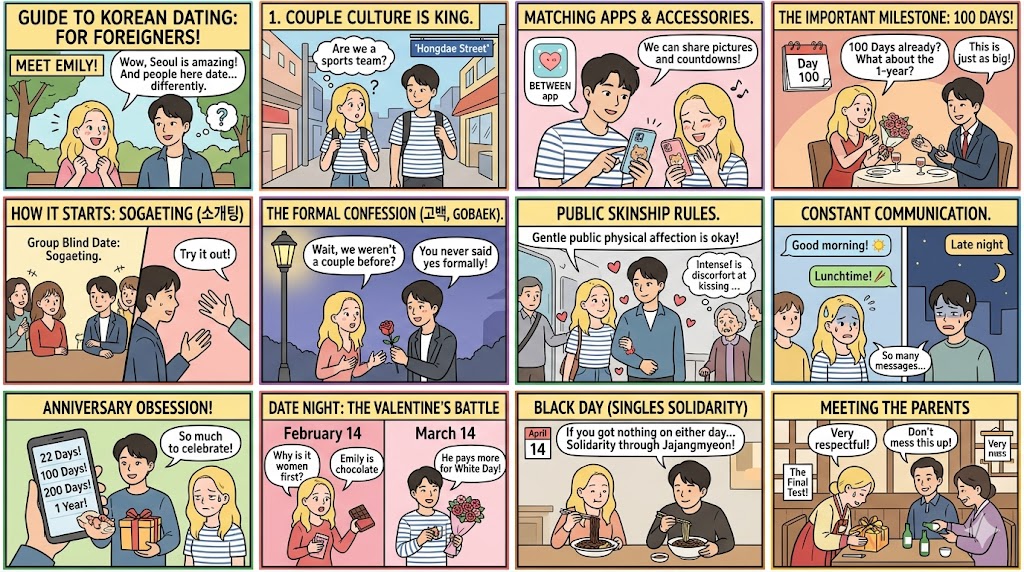
One of the biggest cultural differences I explain to foreign colleagues is this: in Korea, relationships don’t just happen. They begin with a formal confession.
One person explicitly asks the other to be their boyfriend or girlfriend — this is called 고백 (gobaek). Until this moment occurs, the two people are considered just friends, regardless of how much time they spend together, how many dates they’ve been on, or how obvious the mutual interest seems.
This creates a dating culture with very clear relationship statuses. You are either officially together or you are not. The grey zone that Western dating culture often occupies for months — or indefinitely — is far less common here. Koreans tend to find prolonged ambiguity uncomfortable, and the gobaek tradition exists precisely to resolve it.
I’ve seen foreign colleagues genuinely confused when a Korean they’d been seeing for weeks suddenly seemed to pull back — not because of lost interest, but because they were waiting for a formal commitment that never came.
Sogaeting (소개팅) — The Korean Blind Date Tradition
One of the most common ways relationships begin in Korea is through sogaeting — a blind date arranged by a mutual friend. One friend sets up two people, they meet for coffee or a meal, and from there it either develops or it doesn’t.
Sogaeting is not considered awkward or desperate in Korean culture. It’s a completely normal, widely accepted way to meet a potential partner, and most Koreans have been on at least a few. The mutual friend acts as a social guarantor of sorts — their involvement makes the meeting feel safer and more legitimate than meeting a stranger on an app.
University MT (membership training) outings serve a similar function — group social trips organized by clubs and departments where singles naturally meet in a structured, low-pressure setting.
Couple Culture (커플 문화) — Korea’s Most Visible Dating Tradition
If you spend a weekend afternoon in Hongdae or Insadong, you’ll notice something that takes most first-time visitors by surprise: couples in matching outfits everywhere.
Matching clothes, shoes, phone cases, and accessories are a genuine and enthusiastic part of romantic culture here. Korean couples wear coordinating or identical items on dates as a public expression of commitment and unity. My Japanese spouse found this charming when first visiting Korea — it’s one of those cultural details that reads as quirky from the outside but feels completely natural once you’re here.
Beyond matching outfits, couple culture manifests in several other ways:
Couple apps. KakaoTalk’s “Together” feature and dedicated apps like Between give couples a private shared space for messages, photos, and anniversary countdowns. These digital spaces are taken seriously.
Couple items. Beyond clothing, couples often buy matching rings (not engagement rings — just couple rings), phone cases, and keychains. These are sold everywhere in Korean shopping districts.
Public affection. Holding hands and linking arms are extremely common. Kissing in public is more restrained than in some Western countries but not unusual, particularly among younger couples in urban areas.
The Anniversary Obsession — 100 Days and Beyond
Western dating culture typically marks one anniversary per year. Korean couples mark anniversaries far more frequently — and the 100-day anniversary is treated with the same significance most Westerners give to a full year together.
Key anniversaries that Korean couples celebrate:
| Anniversary | Significance |
|---|---|
| 22 days | Early sweet milestone |
| 100 days | Major celebration — gifts and dinner expected |
| 200 days | Continued celebration |
| 1 year | Significant — often involves travel |
| Every year after | Ongoing annual celebration |
Apps like Between automatically count relationship days, which tells you everything about how central anniversary culture is to romance here. Forgetting a 100-day anniversary in a Korean relationship is a serious misstep.
Communication Expectations — KakaoTalk and Constant Contact
Korean couples communicate far more frequently than most Western couples consider normal — and this is an expectation, not just a preference.
KakaoTalk is the primary relationship maintenance tool. Couples message throughout the day, send good morning and good night messages as a standard daily ritual, and notice when responses are slow. KakaoTalk shows read receipts, which means reading a message without responding promptly can create genuine tension.
I’ve explained this dynamic to foreign colleagues many times: what feels like excessive contact from a Western perspective often feels like basic attentiveness in a Korean relationship context. Neither is wrong — they’re just calibrated differently.
The key adjustment for foreigners is understanding that communication frequency signals investment here. Irregular or infrequent messaging is often interpreted as disinterest, even when that’s not the intention.
Skinship (스킨십) — Physical Affection in Korean Relationships
Skinship — a Korean-English blend of “skin” and “relationship” — refers to physical affection between couples.
Public skinship is common but follows certain norms. Hand-holding and arm-linking are standard and visible everywhere. More intimate contact tends to be kept private. What varies most from Western norms is the pace — Korean relationships generally move more slowly toward physical intimacy, with emotional connection and formal commitment expected to come first.
This can occasionally create mismatches when Koreans date foreigners who operate on different timelines. Being aware of this difference prevents a lot of unnecessary misunderstanding.
Dating Apps in Korea
Korean dating culture has embraced apps enthusiastically, with a few platforms dominating the local market:
Noondate (눈데이트) — The most popular Korean dating app. Sends two curated matches per day at noon. Known for a quality-over-quantity approach that fits Korean relationship values well.
Amanda (아만다) — Applicants are voted in by existing users based on attractiveness. Controversial, but extremely popular among younger Koreans.
Glam — Focused on video profiles and video dates. Grew significantly post-pandemic.
Tinder — Used primarily by foreigners and internationally-minded Koreans in major cities.
For international visitors interested in meeting locals, Noondate and Glam are worth knowing about — though both operate primarily in Korean. According to Statista, South Korea’s online dating market has grown consistently and is one of the most active in Asia.
Valentine’s Day, White Day, and Black Day
Korea has a uniquely structured take on romantic holidays that surprises most foreigners:
February 14 — Valentine’s Day: Women give chocolate to men. Handmade chocolate carries more meaning than store-bought.
March 14 — White Day: Men return the gesture with candy or gifts, typically something more expensive than what they received.
April 14 — Black Day: Singles who received nothing on either day gather to eat jajangmyeon (black bean noodles) together. This started as a joke but has become a genuinely beloved cultural tradition. According to Korea JoongAng Daily, Black Day celebrations have grown significantly in recent years, particularly among young urban Koreans.
Age and Hierarchy in Korean Relationships
Age shapes Korean relationships more than most foreigners expect. As covered in our Korean Age System Guide, hierarchy based on age influences all social dynamics here — including romantic ones.
In many Korean couples, the older partner (오빠/언니 — oppa/unnie) takes on a more protective, providing role, while the younger partner tends to defer in certain decisions. This dynamic is less rigid among younger, more internationally-minded Koreans, but it remains a cultural baseline worth understanding.
Meeting the Parents — What to Expect
Meeting a partner’s parents in Korea signals serious commitment. This isn’t a casual step.
Standard etiquette includes: bringing gifts (fruit baskets, quality health supplements, or premium food items are safe choices), dressing conservatively, using formal speech, and demonstrating respect through small gestures like pouring drinks with two hands.
Read our Korean BBQ Guide to understand the food and drinking etiquette that will almost certainly be part of any family dinner — sharing a meal is central to how Koreans build and signal trust.
Practical Tips for Foreigners Dating in Korea
Learn basic Korean. Even minimal effort is appreciated enormously. A few phrases go further here than in most countries.
Understand the confession. Don’t assume a relationship exists without an explicit conversation. The gobaek matters — and skipping it creates confusion.
Embrace couple culture. Matching items, frequent check-ins, and anniversary celebrations are features, not bugs. Approaching them with genuine openness makes a significant difference.
Be consistent with communication. Irregular messaging signals disinterest here in a way it might not back home. Daily check-ins are normal, not clingy.
Respect age dynamics. Even if hierarchy feels unfamiliar, being aware of how it operates prevents misunderstandings that are easy to avoid.
FAQ
Is Korean dating culture open to foreigners? Yes, particularly in Seoul. Younger Koreans in major cities are generally open to international relationships, though language remains a practical barrier in many cases.
Do Koreans date casually? Less commonly than in many Western countries. The gobaek tradition and strong couple culture reflect a general preference for defined, committed relationships over casual arrangements.
What is ‘some’ (썸) in Korean dating culture? 썸 (ssum) refers to the ambiguous pre-relationship stage — the mutual interest period before a confession. It’s the Korean equivalent of “talking” or “seeing someone.”
How important is age in Korean relationships? Significant, but generationally variable. Younger Koreans are more flexible about age dynamics than older generations, particularly those with international exposure.
What should I know about dating apps in Korea? Noondate is the dominant local app. Tinder exists but skews toward foreigners. Most major Korean apps operate primarily in Korean.
Explore more: Korean Marriage Culture Guide · Korean Age System Explained · Things to Do in Seoul

Korea Insider has lived in South Korea for 50 years and worked at international companies for over two decades — explaining Korean culture, food, and society to colleagues from the US, Europe, and Australia.
Internationally married with a Japanese spouse, Korea Insider brings both an insider’s depth and an outsider’s perspective to every topic on My Korea Tip.
Pingback: Korean Jjimjilbang Guide: How to Use a Korean Spa for First-Timers - My Korea Tip