
Koreans don’t just drink — they play. Walk into any hof bar, pojangmacha, or company dinner in Korea and within twenty minutes someone will suggest a game. This is as true at a casual Friday night out with friends as it is at a formal company hweshik dinner.
I’ve played every game on this list more times than I can count — at university, at work dinners, at family gatherings, and at late-night sessions that stretched well past midnight. Korean drinking culture is fundamentally social in a way that goes beyond alcohol. The games exist to create connection, dissolve hierarchy, and give people a structured reason to laugh together.
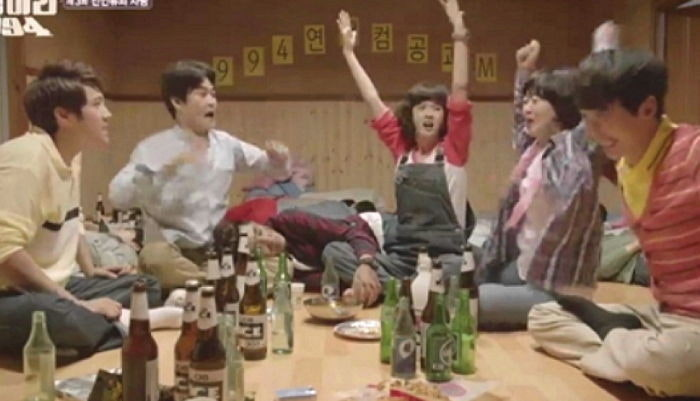
This guide covers 10 essential games — rules, strategy, cultural context, and what happens when you lose.
Before reading further, check our Korean Soju Guide — soju is the fuel that powers most of these games, and understanding it helps.
Why Koreans Play Drinking Games
The cultural context matters here.
Korean social culture places significant weight on age hierarchy and formal roles. In a group that includes a manager and their team, or seniors and juniors at university, these dynamics are always present and always felt. Drinking games create a specific kind of social space — structured, rule-based, and temporary — where those hierarchies can be suspended.
A junior employee can make their director drink in Titanic. A university freshman can become King and command a fourth-year student to perform. The game provides the permission that normal social structure wouldn’t allow.
This is also why these games are central to hweshik (회식) — company dining culture. Read our Korean Work Culture Guide for more on how drinking functions in Korean professional settings.
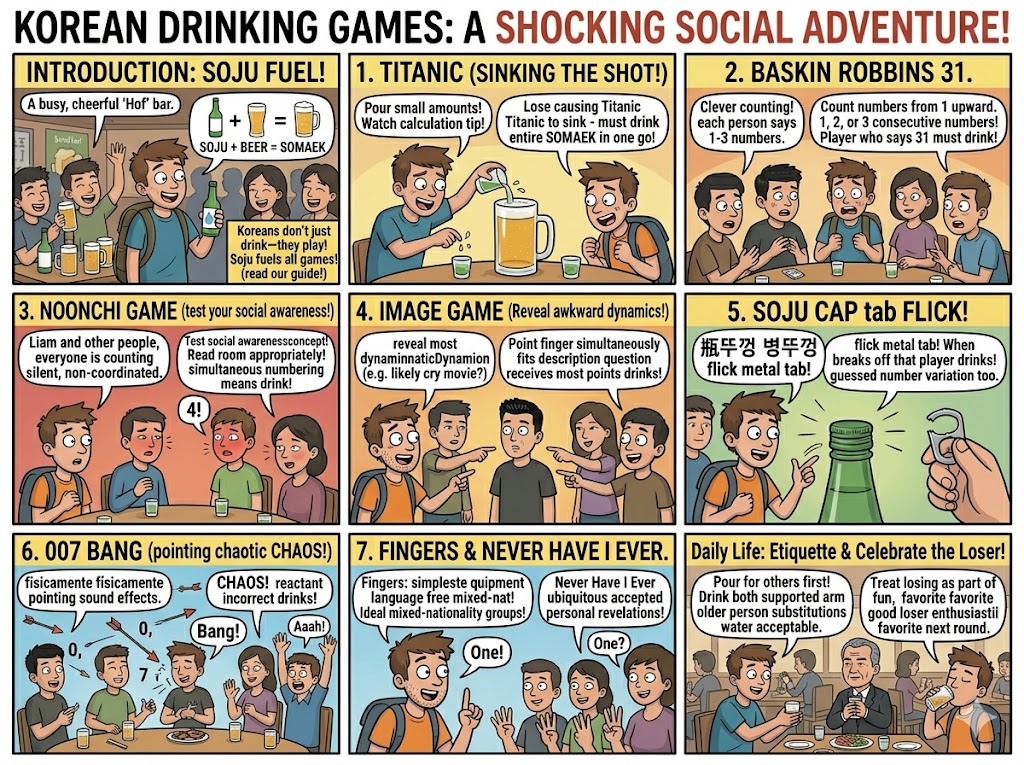
1. Titanic (타이타닉)
The most universally played game in Korea — simple to explain, tense to play, and perfectly designed to create shared drama.
How to play: Fill a large glass halfway with beer. Float a small shot glass of soju on the surface. Players take turns carefully pouring small amounts of soju into the floating shot glass. The player whose pour causes the shot glass to sink — making the Titanic go down — must drink the entire mixture in one go.
Strategy: Pour as little as possible each turn. Watch how much others add and calculate when the glass is close to tipping. The slow accumulation of tension as the shot glass gradually sinks lower is exactly what makes this game work.
Drink: Somaek (soju + beer mixture)
2. Baskin Robbins 31 (배스킨라빈스 31)
Named after the ice cream chain’s 31 flavors — a typically Korean touch of brand-aware humor.
How to play: Players take turns counting numbers from 1 upward. Each player can say 1, 2, or 3 consecutive numbers per turn. The player who says the number 31 must drink.
Example round:
- Player 1: “1, 2, 3”
- Player 2: “4, 5”
- Player 3: “6”
- Player 4: “7, 8, 9”
- Continue until someone reaches 31
Strategy: Count backward from 31 to identify the “safe” numbers. The player who lands on 28 forces the next person into a losing position regardless of how many numbers they say — 29, 30, or 31 all result in losing on the following turn.
3. Noonchi Game (눈치게임)
The most psychologically interesting game on this list — and the most distinctly Korean.
눈치 (noonchi) is the Korean concept of social awareness — the ability to read a room and act appropriately without being told what to do. This game literally tests it.
How to play: Players must collectively count from 1 to the total number of players — but no one coordinates who speaks when. Any player can say any number at any time. If two players say a number simultaneously, both drink. If the same player says two consecutive numbers, they drink. The round ends successfully only when all numbers are counted without conflict.
Why it works: The game requires players to simultaneously read everyone else’s intentions and act on their own instinct — a perfect distillation of what noonchi actually means in daily Korean life. Groups with good social chemistry tend to complete rounds more smoothly, which tells you something.
4. Image Game (이미지 게임)
The game that reveals the most about how a group actually sees each other — and occasionally creates genuinely surprising moments.
How to play: One player asks a question beginning with “Who in this group is most likely to…” All players simultaneously point at whoever they think fits the description. The person receiving the most points drinks.
Good questions to use:
- “Who is most likely to become famous?”
- “Who would survive the longest on a desert island?”
- “Who is secretly the wildest?”
- “Who cries most easily at movies?”
- “Who is the best cook?”
What makes it interesting: The results often surprise both the group and the person being pointed at. I’ve seen company dynamics shift noticeably after a round of Image Game — people discovering how colleagues perceive them in ways that normal professional interaction would never surface.
5. Soju Cap Game (병뚜껑 게임)
The only game on this list that requires the soju bottle itself as a component — making it uniquely and specifically Korean.
How to play: After opening a soju bottle, the metal cap has a small tab on the underside. Players take turns flicking the tab. The player whose flick finally breaks the tab off must drink.
Variation: The player who breaks the tab writes a number on the inside of the cap. Other players guess the number — whoever guesses correctly assigns a drink to anyone at the table.
Cultural note: This game can only be played with traditional Korean soju bottles. Bringing it up as a game option is itself a signal of cultural familiarity that Koreans tend to notice and appreciate.
6. 007 Bang (007 빵)
The most physically animated game on the list — involving pointing, sound effects, and fast reactions that deteriorate entertainingly as the evening progresses.
How to play: Players sit in a circle. One player starts by pointing at someone and saying “0.” That person points at someone and says “0.” That person points at someone and says “7.” That person points at anyone and says “Bang!” The two players sitting immediately beside the Bang recipient must raise their hands and say “Aaah!” — while the Bang recipient must duck. Whoever reacts incorrectly drinks.
Strategy: Speed is your weapon. Pointing quickly and saying your number before the previous person has fully finished creates hesitation. Deliberately slowing down then suddenly accelerating is equally effective.
7. Train Game (기차놀이)
A rapid-fire rhythm game that catches players off guard — particularly effective later in the evening.
How to play: Establish a rhythm by hitting the table twice and clapping twice, repeating continuously. Within this rhythm, players take turns saying their own name followed by another player’s name — passing the turn to that person. Any player who breaks rhythm, hesitates, or calls the wrong name drinks.
Tip: Deliberately calling someone who’s distracted or mid-drink is standard and encouraged. The game accelerates naturally as concentration lapses.
8. King Game (왕게임)
The game with the most explicit power dynamics — where hierarchy inverts entirely for the duration of each round.
How to play: Number chopsticks or small sticks — one marked “King,” others numbered. Players draw randomly. The King is revealed and can issue any command: “Number 3 must drink,” “Numbers 1 and 4 must arm wrestle — loser drinks,” “Number 2 must tell an embarrassing story.” A new King is drawn each round.
Cultural significance: The temporary hierarchy inversion here is genuinely meaningful in Korean social context. A junior employee becoming King and commanding a senior to drink represents a social release valve that Korean culture builds into group gatherings deliberately. The game provides the permission; the rules provide the cover.
9. Fingers (손가락 게임)
The simplest game on the list — no equipment, no language skills required, works in any group size.
How to play: All players hold up one finger. One player calls a number. Everyone simultaneously chooses to either keep their finger up or put it down. Count how many fingers remain — if the number matches what was called, the caller drinks. If not, the caller tries again until they match.
Why it’s useful: This is the most foreigner-friendly game on the list. No Korean language ability needed, rules communicate in thirty seconds, and it works equally well with two people or twenty. I’ve used it successfully with foreign colleagues who spoke no Korean at all.
10. Never Have I Ever (나는 절대 안 해)
Not originally Korean — but fully adopted into Korean social culture and now ubiquitous at gatherings of all ages.
How to play: All players hold up five fingers. Players take turns saying “Never have I ever…” followed by something they’ve genuinely never done. Any player who has done that thing puts down a finger. The first player to put down all five fingers drinks — and typically must answer questions about whichever confession cost them their last finger.
Korean context: This game is particularly interesting here because Korean social culture typically maintains more personal privacy than Western counterparts. Never Have I Ever creates a socially sanctioned space for personal revelations that normal Korean social dynamics rarely permit. The combination of the game format and the alcohol provides the cover that makes honesty feel safe.
Essential Etiquette for All Games
A few rules apply regardless of which game you’re playing:
Pour for others first. Before any game begins, pour soju for the people around you — never pour your own glass first. This applies throughout the evening, not just at the start.
Receive drinks with two hands. When accepting a drink after losing, hold your glass with both hands or support your right arm with your left — especially when receiving from someone older. This is basic Korean drinking etiquette, not specific to games.
Don’t pressure non-drinkers. Modern Korean social culture is genuinely more aware of this than it used to be. Substituting water or juice in any game is acceptable and shouldn’t require explanation.
Lose graciously. Korean drinking game culture treats losing as part of the entertainment — not as humiliation. The best players lose enthusiastically, drink without complaint, and immediately call for the next round.
What to Drink
Soju — Korea’s national spirit, the primary choice for most games. Standard abv is around 16–17%. Read our Korean Soju Guide for everything you need to know.
Maekju (beer) — Light Korean lagers are ideal for games that involve frequent drinking. Cass and Hite are the standard choices.
Somaek — Soju mixed with beer, roughly 3:7 ratio. Korea’s most popular social drinking combination and the standard for Titanic.
Non-alcoholic alternatives — Sparkling water, juice, or non-alcoholic beer work in any game. Modern Korean social culture accommodates non-drinkers without the pressure that existed in previous generations.
Where to Play in Seoul
Hof bars (호프집) — The classic venue. Beer, fried chicken, and games until late. Found everywhere, price-accessible, and built for exactly this purpose.
Pojangmacha (포장마차) — Street tent bars where games happen spontaneously among strangers. The informal setting often produces the best sessions.
Norebang (노래방) — Private karaoke rooms where games frequently precede or follow singing. The combination is a complete Korean night out. Read our Norebang Guide for how these work.
Korean BBQ restaurants — Games emerge naturally during long grill sessions. The combination of food, soju, and a shared table makes BBQ restaurants ideal game venues.
For a guided introduction to Seoul’s nightlife culture, consider a Seoul Night Food Tour on Klook — most include stops at venues where these games are happening in real time.
FAQ
Do I need to speak Korean to play these games? For most of them, no. Titanic, Fingers, Image Game, and Never Have I Ever all work across language barriers. A local who speaks some English can explain the others in a few minutes.
Is it rude to refuse to drink when you lose? Not in modern Korean social culture. Substituting water is acceptable. What matters is participating in the game — the drink is secondary.
What’s the most popular game at company dinners? Titanic and Baskin Robbins 31 are the most common at hweshik because they’re simple enough to explain quickly and work well in mixed-age professional groups.
Are these games only for young people? No. Koreans of all ages play these games. The specific games vary somewhat by generation, but the culture of playing games while drinking spans all age groups.
What’s the best game for a group of foreigners new to Korea? Start with Titanic — it’s visual, requires no language, and the tension builds naturally. Follow with Fingers. By the time you move to the third game, someone in the group will have learned enough Korean to attempt Baskin Robbins 31.
Read our Things to Do in Seoul Guide for the best Korean drinking game venues in Seoul.
Ready to experience Korean nightlife? Read our Korean Soju Guide and Korean Work Culture Guide for the complete Korean drinking culture picture.

Korea Insider has lived in South Korea for 50 years and worked at international companies for over two decades — explaining Korean culture, food, and society to colleagues from the US, Europe, and Australia.
Internationally married with a Japanese spouse, Korea Insider brings both an insider’s depth and an outsider’s perspective to every topic on My Korea Tip.