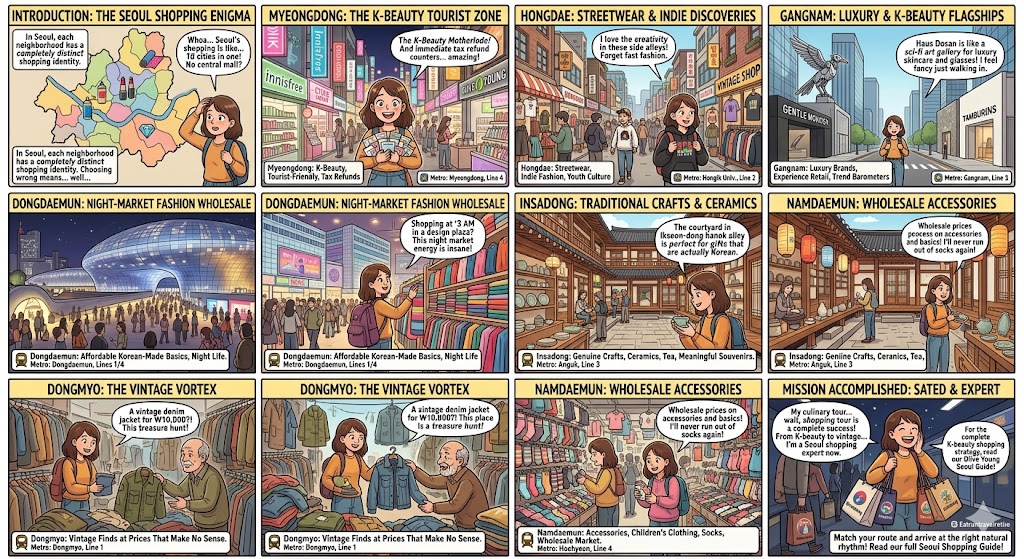
The shopping areas in Seoul do not work the way shopping areas in most cities work. In most cities, the shopping district is a single zone — a downtown strip or a mall cluster — where everything competes for the same customer. In Seoul, each neighborhood has evolved a completely distinct shopping identity: Myeongdong for K-beauty and tourist convenience, Hongdae for streetwear and independent designers, Gangnam for luxury and skincare flagships, Dongdaemun for fashion wholesale that runs through the night, Insadong for traditional crafts and ceramics, Dongmyo for vintage finds at prices that make no sense.
The result is a city where your shopping itinerary is essentially a neighborhood itinerary — and where choosing the wrong district for what you want means paying double the price or coming home without the thing you came for.
This guide organizes every major Seoul shopping area by what it’s best for, what it costs, and who it’s actually for — so you spend your time in the right place.
Before you start planning your shopping route, read our Seoul 3-Day Itinerary to see how these districts connect geographically, and our Olive Young Seoul Guide for the complete K-beauty shopping strategy.
Shopping Areas in Seoul: Quick Reference Guide
| District | Best For | Budget Level | Metro Station |
|---|---|---|---|
| Myeongdong | K-beauty, tourist-friendly shopping | ₩–₩₩₩ | Myeongdong, Line 4 |
| Hongdae | Streetwear, indie fashion, youth culture | ₩₩ | Hongik Univ., Line 2 |
| Gangnam / Apgujeong | Luxury brands, K-beauty flagships | ₩₩₩–₩₩₩₩ | Gangnam / Apgujeong, Line 3 |
| Dongdaemun | Wholesale fashion, late-night | ₩–₩₩ | Dongdaemun, Line 1/4 |
| Insadong | Crafts, souvenirs, ceramics, tea | ₩₩ | Anguk, Line 3 |
| Seongsu-dong | Concept stores, pop-ups, K-beauty | ₩₩–₩₩₩ | Seongsu, Line 2 |
| Namdaemun | Wholesale market, accessories | ₩ | Hoehyeon, Line 4 |
| Dongmyo | Vintage, flea market, antiques | ₩ | Dongmyo, Line 1 |
Shopping Areas in Seoul: Myeongdong (명동)
Best for: K-beauty, international brand flagships, street food between shops, tax refunds
Myeongdong remains Seoul’s most visitor-friendly neighborhood for shopping and street culture. International travelers come for Korean beauty brands, fashion flagships, and ever-changing street food stalls. The area has solidified itself as a global retail zone, with multilingual services and late-night energy that appeals to short-stay tourists. Haps Korea
The highest concentration of K-beauty flagship stores in Seoul is in Myeongdong — Innisfree, Etude House, Laneige, Sulwhasoo, Missha, The Face Shop, Tony Moly, and COSRX all have large stores within a few blocks of each other. Prices are the same as or lower than Korean online retailers and significantly lower than international stockists. MileAsia
What to buy: Korean skincare and cosmetics (the best prices and widest selection), international fashion brands (better prices than duty-free in some categories), Korean souvenirs, street food between stops.
What to skip: Korean BBQ and sit-down restaurants — prices are tourist-inflated. Eat at street stalls only, or save meals for other neighborhoods.
Tax refund: Myeongdong has the highest density of tax-free participating stores in Seoul. Foreign visitors can claim VAT refunds on purchases over ₩30,000 at participating stores — keep your passport and all receipts. Lotte Department Store and most major beauty stores have dedicated tax refund counters on site. MileAsia
Best timing: Weekday evenings. Weekend afternoons in peak season (April–May, September–October) produce crowds dense enough to make browsing uncomfortable.
Getting there: Myeongdong Station, Line 4, Exit 5 or 8.
Shopping Areas in Seoul: Hongdae (홍대)
Best for: Korean streetwear, independent fashion designers, vintage, youth culture
The area around Hongik University is Seoul’s most creatively active fashion neighbourhood. Independent Korean designers, streetwear labels, vintage resellers, and small boutiques mix with mainstream fast fashion chains. The main Hongdae Shopping Street and the surrounding alleys are best explored on foot over a few hours. MileAsia
Hongdae’s character comes from its proximity to one of Korea’s leading art universities — decades of student designers, musicians, and artists moving into the neighborhood have produced a retail environment where independent creativity is genuinely the main product. The chains are here too (H&M, Zara, Uniqlo), but the reason to come is the independent boutiques in the alleys behind the main street.
What to buy: Korean streetwear brands (Ader Error, Critic, and newer independent labels), vintage clothing, handmade accessories, K-pop merchandise (the density here rivals dedicated merchandise stores), limited-edition sneakers.
The alleys matter more than the main street. Hongdae’s main shopping street has the chains. The side alleys running perpendicular to it — particularly the cluster between Eoulmadang-ro and the park — have the independent stores worth finding.
Best timing: Late afternoon into evening. Hongdae comes alive after 5 PM with buskers, pop-up stalls, and the full energy of the neighborhood.
Getting there: Hongik University Station, Line 2, Airport Railroad, or Gyeongui-Jungang Line, Exit 9.
Shopping Areas in Seoul: Gangnam, Apgujeong & Garosu-gil (강남·압구정·가로수길)
Best for: Luxury brands, K-beauty experience retail, high-end Korean fashion, Gentle Monster, Tamburins
South of the Han River, the Gangnam area contains Seoul’s most upscale commercial zones — clustered but distinct, each with its own specific identity.
Garosu-gil (가로수길): The nation’s first official Apple store opened in this area, widely regarded as a barometer of trends. A great number of cute select shops and luxury brand stores where you can enjoy shopping for unique items. Tree-lined, pleasant to walk, and significantly less crowded than Myeongdong. Good for quality over quantity. VISITKOREAVISITKOREA
Apgujeong Rodeo Street (압구정 로데오): Where the Korean socialites shop — luxury brands like Louis Vuitton alongside Korea’s most exclusive domestic designers. The Dosan Park area nearby has become the home of Seoul’s most architecturally ambitious brand flagships. The Soul of Seoul
Gentle Monster & Tamburins: These brands have completely rewritten the rules of what a store should look like. From kinetic robots to hyper-realistic art installations, their flagship stores feel like entering a sci-fi film rather than a shop. The Apgujeong Haus Dosan complex, which houses both brands alongside a café and gallery, is one of the most extraordinary retail experiences available anywhere in Asia. Entry is free — even if you don’t buy anything, it’s worth visiting. TRIP.COM
COEX Mall (코엑스몰): One of Asia’s largest underground malls, famous for the Starfield Library — a towering installation of bookshelves that has become one of Seoul’s most photographed interiors. The mall itself covers luxury retail, Korean brands, a large bookstore, cinemas, and the SM Entertainment flagship store.
Getting there (Garosu-gil): Sinsa Station, Line 3, Exit 8. Getting there (Apgujeong): Apgujeong Station, Line 3, Exit 2. Getting there (COEX): Samseong Station, Line 2, Exit 5 or 6.
Shopping Areas in Seoul: Dongdaemun (동대문)
Best for: Affordable Korean-made fashion, wholesale pricing, late-night shopping
Dongdaemun is the centre of Korea’s fashion manufacturing and wholesale industry, with a cluster of enormous multi-storey shopping malls selling both wholesale and retail, some operating through the night. The area is particularly busy from late evening through the early hours when wholesale buyers from across Asia do their sourcing. Good for affordable Korean-made basics and trendy pieces. MileAsia
The key buildings: Doota! (retail-friendly, English signage, international card acceptance), Migliore (more wholesale-oriented), and the surrounding wholesale towers for serious fashion buyers.
The Dongdaemun Design Plaza (DDP): Designed by Zaha Hadid, this flowing silver structure adjacent to the shopping district hosts rotating design exhibitions and fashion events. Even if you don’t shop here, the venue is worth a visit for the architecture, the nightscape, and its history as a filming spot for multiple Korean dramas including My Love from the Star and Vincenzo. VISITKOREA
Best timing: 10 PM onwards is when Dongdaemun’s wholesale culture is most alive. The retail floors are open from 10 AM, but the neighborhood’s real character only appears at night.
Getting there: Dongdaemun History & Culture Park Station, Lines 2, 4, and 5, Exit 1.
Shopping Areas in Seoul: Insadong (인사동)
Best for: Traditional crafts, Korean ceramics, tea, hanji (traditional paper), genuine souvenirs
Seoul’s main traditional arts and crafts district — galleries, antique shops, ceramics, hanji (traditional Korean paper), calligraphy supplies, and souvenir goods. More tasteful than Myeongdong for gifts. The Ssamziegil courtyard complex features independent designers and craft sellers in a pleasant, multi-level outdoor space. MileAsia
Insadong is where to buy gifts that are actually Korean rather than manufactured-in-China tourist merchandise. The Korean ceramics (handmade celadon bowls, tea sets), hanji products (notebooks, lampshades), and traditional teas available here represent genuine Korean craft culture rather than mass-market souvenir production.
Ikseon-dong (익선동): A short walk from Insadong, a renovated hanok alleyway with design stores, ceramics studios, and concept cafés in traditional wooden buildings. One of Seoul’s most pleasant shopping areas — quality over quantity. The blend of traditional architecture and contemporary retail is the most visually satisfying shopping environment in Seoul. MileAsia
What to buy: Korean ceramics (tea bowls, small plates), hanji notebooks and products, traditional tea (green tea, barley tea, chrysanthemum), Korean ink paintings, handmade accessories from independent designers in Ssamziegil.
Getting there: Anguk Station, Line 3, Exit 6.
Shopping Areas in Seoul: Dongmyo Flea Market (동묘 벼룩시장)
Best for: Vintage clothing, military surplus, retro electronics, antiques at genuinely low prices
The best vintage market in Seoul and one of the best in Asia. A sprawling flea market near Dongmyo Station with stalls selling second-hand clothing, military surplus, vintage accessories, retro electronics, ceramics, and antiques at genuinely low prices. The atmosphere is chaotic and authentically local, with very few international tourists. MileAsia
For second-hand goods, antiques, and general market browsing, the Dongmyo area hosts a large weekend flea market on Saturdays and Sundays from 12 PM to 6 PM. The Soul of Seoul
This is the shopping area that most international visitors never find — and the one that rewards those who do with prices that make the tourist-facing areas feel embarrassing by comparison. Military jackets for ₩5,000. Vintage denim for ₩10,000. Ceramic bowls that would cost ten times as much in Insadong.
Who it’s for: Vintage enthusiasts, designers sourcing references, anyone who prefers finding something unexpected over buying something predictable.
Getting there: Dongmyo Station, Line 1 or 6, Exit 1.
Shopping Areas in Seoul: Namdaemun Market (남대문시장)
Best for: Wholesale prices, accessories, children’s clothing, K-pop merchandise at lower prices
The largest traditional market in South Korea — small food alleys inside sell classic Korean street foods alongside wholesale goods including stationery, children’s clothing, shoes, accessories, and lifestyle goods, often at wholesale prices. K-pop merchandise is available here more cheaply than in tourist areas, though you’ll need to hunt for it. The Soul of Seoul
Namdaemun rewards browsers — the market is dense and partially chaotic, but the prices on accessories, socks, basic clothing, and housewares are among the lowest in Seoul. The food alley running through the market is worth navigating for hotteok and gimbap alone.
Getting there: Hoehyeon Station, Line 4, Exit 5.
Shopping Areas in Seoul: Practical Tips That Apply Everywhere
Sizing runs small. Clothing and shoe sizing in Korea runs smaller than in the US or Europe, with limited availability for extended sizes. Try before buying whenever possible. Most Korean clothing stores have fitting rooms — ask “피팅룸 있어요?” (fitting room isseoyo?). Fora Travel
Card payment is universal in malls and chain stores. Traditional markets and individual stalls may prefer cash. Carry ₩50,000–₩100,000 for market shopping days.
Always carry your passport for tax refunds. The immediate VAT deduction at point of sale — available at most Myeongdong and Gangnam stores — requires your physical passport, not a copy.
The Seoul subway connects every district. All of the shopping areas in this guide are within comfortable subway distance of each other. Line 2 (green) covers Hongdae, Seongsu, and Gangnam. Line 4 (blue) covers Myeongdong, Dongdaemun, and Namdaemun. Read our Seoul Subway Guide for full navigation guidance.
Morning is best for markets, evening is best for Hongdae and Dongdaemun. Match your timing to the district’s natural rhythm — Gwangjang and Namdaemun are at their freshest before noon; Hongdae and Dongdaemun peak after dark.
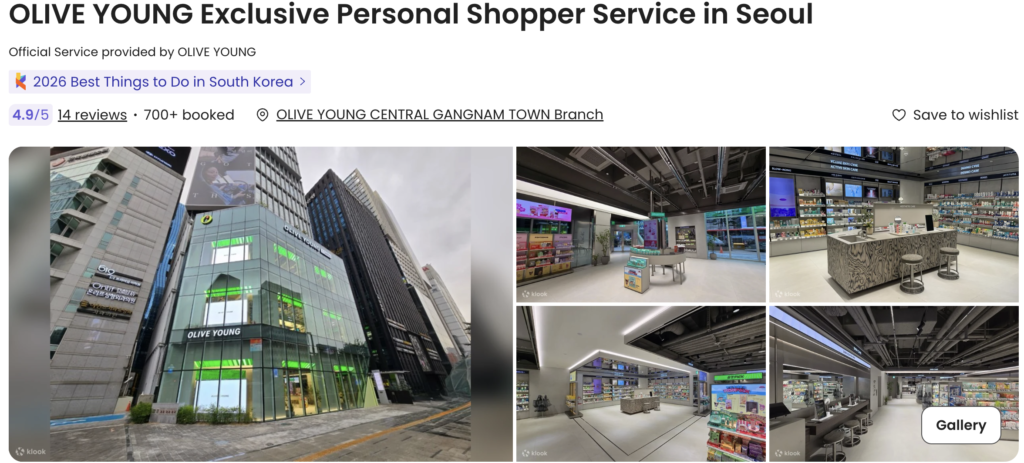
Not sure where to start with Seoul’s shopping districts? A Seoul shopping tour on Klook covers K-beauty flagships, the Hongdae streetwear alleys, and a local market stop — with an English-speaking guide who knows which stores have the best prices and where the hidden discount racks are.
Shopping Areas in Seoul: What to Buy Where — Summary
| What You Want | Best District | Why |
|---|---|---|
| Korean skincare / K-beauty | Myeongdong | Widest selection, tax refund easy, competitive pricing |
| Streetwear / indie fashion | Hongdae | Independent designers, youth labels, best variety |
| Luxury brands | Apgujeong / Gangnam | Full range, genuine stock, concept retail |
| Affordable fashion | Dongdaemun | Wholesale pricing, Korean-made, night market energy |
| Meaningful souvenirs | Insadong / Ikseon-dong | Genuine crafts, ceramics, traditional products |
| Vintage / second-hand | Dongmyo | Best prices, most authentic, least touristy |
| Market browsing | Namdaemun | Chaotic but cheap, good for accessories and basics |
| Concept store experience | Seongsu-dong | Pop-up culture, brand flagships, Olive Young N-flagship |
For the complete K-beauty shopping strategy within these districts, read our Olive Young Seoul Guide. For the Seongsu-dong shopping experience specifically, read our Seongsu-dong Seoul Guide. And for budgeting your shopping trip alongside everything else, our Korea Travel Budget Guide covers what a full Seoul shopping day realistically costs.
Korea Insider has lived in South Korea for 50 years and worked at international companies for over two decades — explaining Korean culture, food, and society to colleagues from the US, Europe, and Australia.
Internationally married with a Japanese spouse, Korea Insider brings both an insider’s depth and an outsider’s perspective to every topic on My Korea Tip.