
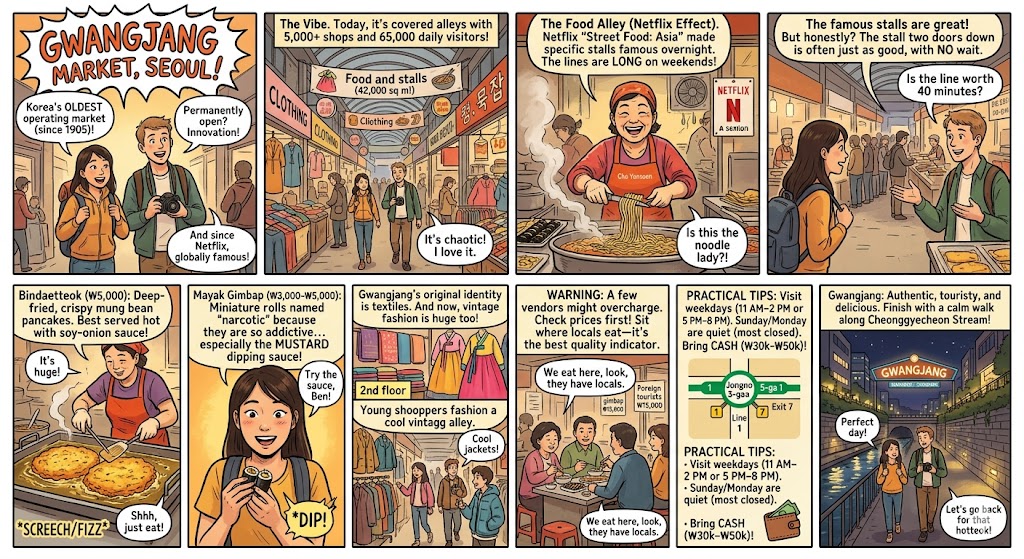
Gwangjang Market Seoul is the oldest continuously operating market in Korea — and since a 2019 Netflix documentary made it globally famous, one of the most visited food destinations in the country.
The market association that manages Gwangjang was founded in 1905, making it among the oldest active companies in South Korea. At the time, most markets were temporary and open only occasionally — Gwangjang became the first to be permanently established and open every day of the week. That permanence was the original innovation. Today the market covers 42,000 square meters of covered alleys in the Jongno district, with more than 5,000 shops and an estimated 65,000 visitors per day. EnkoEnko
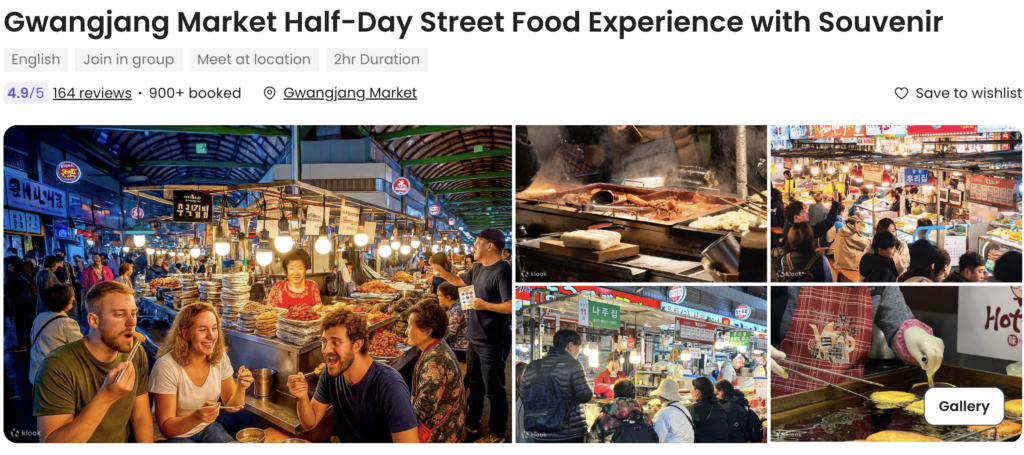
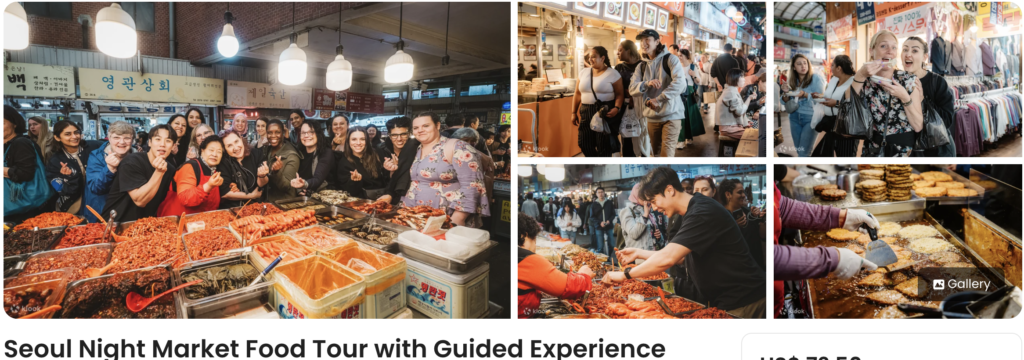
What Netflix captured — and what brings the majority of international visitors today — is the food alley: a covered corridor of tightly packed stalls where vendors cook directly in front of you, the smell of frying mung bean pancakes fills the air from 50 meters out, and the energy of a busy weeknight market makes eating here feel genuinely exciting rather than performed.
What’s distinctive about Gwangjang is that it doesn’t feel staged. Vendors are cooking in front of you, the food is what it is, and the whole place has a speed and energy that makes eating here feel exciting rather than tourist-packaged. Don’t get me wrong though — it is tourist-packed these days. Seoulorthopedics
That last sentence matters. This guide is honest about both sides: the food that makes Gwangjang worth visiting, and the practical knowledge that prevents you from overpaying or missing what’s actually good.
For the broader Seoul food context, read our Korean Street Food Guide. For planning which Seoul neighborhoods to pair with a Gwangjang visit, read our Seoul Neighborhoods Guide.
Gwangjang Market Seoul: Essential Information
| Detail | Info |
|---|---|
| Address | 88 Changgyeonggung-ro, Jongno-gu, Seoul |
| Nearest subway | Jongno 5-ga Station (Line 1, Exit 7) |
| Alternative subway | Euljiro 4-ga Station (Lines 2 & 5, Exit 4) |
| Hours | Daily 9 AM – 11 PM (most food stalls open from 11 AM–noon) |
| Quietest day | Sunday / Monday — most stalls closed |
| Best time to visit | Weekday, 11 AM–2 PM or 5–8 PM |
| Entry fee | Free |
| Average food spend (one person) | ₩15,000–₩35,000 |
Gwangjang Market Seoul: The Netflix Effect — What Changed
Several stalls were featured on Netflix’s Street Food: Asia series in 2019, which pushed what was already a popular destination into a different category of visibility entirely. On a busy weekend it shows. Seoulorthopedics
Two stalls became globally famous overnight:
Cho Yonsoon’s Gohyang Kalguksu — hand-cut noodles, featured in the documentary’s Seoul episode. Queue times on weekends regularly exceed 40 minutes.
Soonheene’s Bindaetteok — the mung bean pancake stall shown frying enormous golden rounds of batter. You can still expect lengthy queues for the food stalls featured on the Netflix show. Creatrip
The honest assessment: both are genuinely good. Neither is dramatically better than the equivalent stall two doors down that doesn’t have a Netflix poster. The queue for the famous versions is real; the difference in quality is marginal. This guide includes both the famous stalls and the unlisted alternatives that produce the same food with a shorter wait.
Gwangjang Market Seoul: What to Eat — The Complete Breakdown
빈대떡 (Bindaetteok) — Mung Bean Pancakes
The signature Gwangjang food and the item that most visitors come specifically to eat. A dollop of freshly ground mung bean batter is mixed with fresh bean sprouts (and sometimes vegetables or meat), deep-fried into thick, crispy pancakes, and served with a side of soy sauce and raw onion. Creatrip
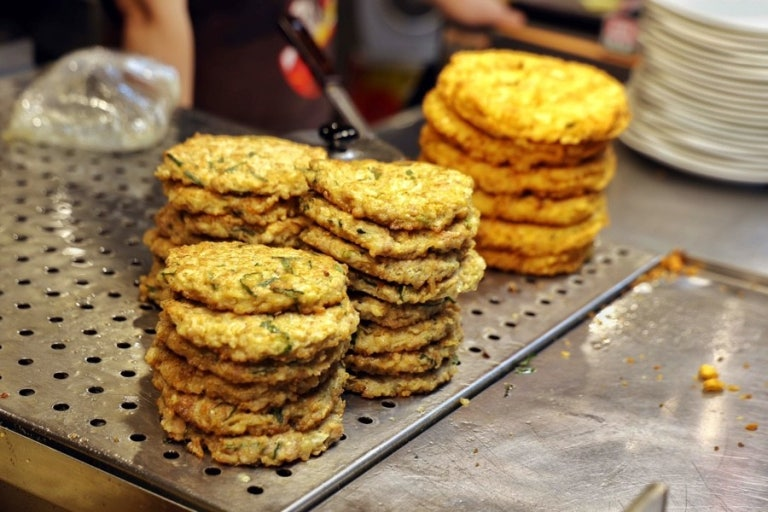
The correct way to eat bindaetteok: hot from the pan, torn into pieces with chopsticks, dipped in the provided soy-onion sauce. The exterior should shatter; the interior should be dense and slightly nutty. A fresh bindaetteok from a good stall costs ₩4,000–₩6,000 and is one of the best ₩5,000 purchases in Seoul.
Famous stall: Soonheene’s Bindaetteok (순희네 빈대떡) — the Netflix-featured stall. Queue expected on weekends. Alternative: Any stall where you can see the vendor actively grinding fresh mung beans — the grinding station visible at the front indicates fresh batter rather than pre-mixed.
마약 김밥 (Mayak Gimbap) — “Narcotic” Gimbap
“Mayak” means drugs in Korean — the name was given because the gimbap is so addictive. Gwangjang’s mayak gimbap is miniature-sized, tightly rolled, and served with a mustard-soy dipping sauce that is itself the reason people return. YAAN Dermatology
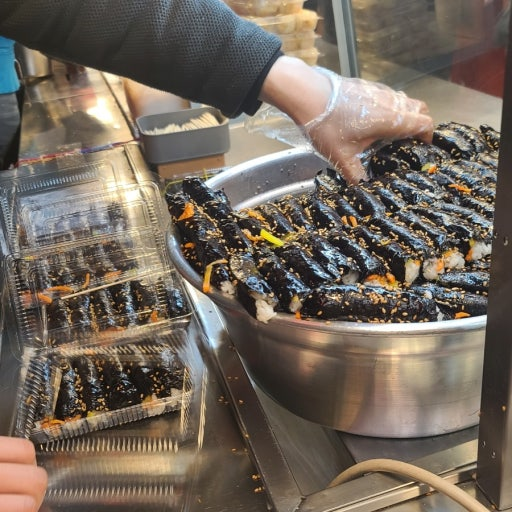
Unlike the large gimbap rolls at convenience stores, Gwangjang’s mayak gimbap is finger-sized — 6 to 8 rolls per order, each about the diameter of a large coin. The filling is minimal (pickled radish, carrot, spinach) but the dipping sauce, applied between every bite, does more work than the roll itself.
Cost: ₩3,000–₩5,000 per portion. The most affordable and most portable food in the market — buy a portion at the entrance and eat while walking.
칼국수 (Kalguksu) — Hand-Cut Noodles
Kalguksu — knife-cut noodles — is another must-try food at Gwangjang. For the most well-known knife-cut noodle stall, visit Cho Yonsoon’s Gohyang Kalguksu, also featured in the Netflix Street Food: Asia show. Creatrip
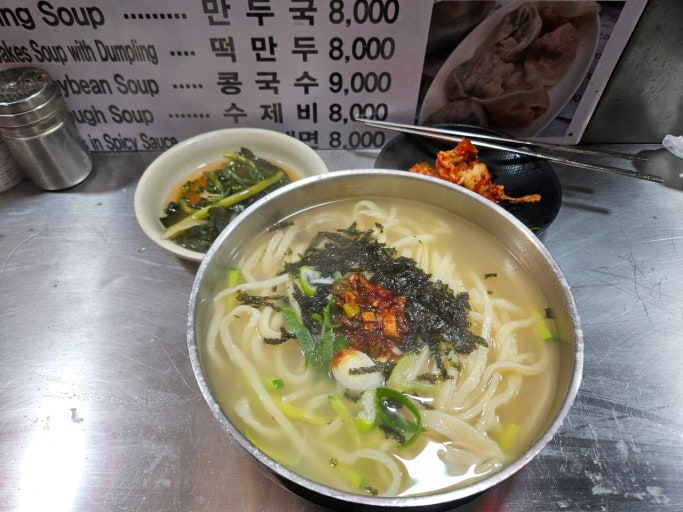
The broth is the point — a long-simmered anchovy and vegetable stock, clean and deeply savory, served with wide flat noodles cut to order. The portion is substantial; this is a meal rather than a snack. Eat at the stall with the largest group of locals — the Cho Yonsoon stall is good, but the line of Korean grandmothers eating at any given table is a more reliable quality indicator than a Netflix poster.
Cost: ₩8,000–₩12,000 per bowl.
육회 (Yukhoe) — Korean Beef Tartare
Go to “yukhoe alley” and you’ll find a narrow lane dedicated entirely to yukhoe — similar to steak tartare, it is a raw beef dish topped with a raw egg. The Bib Gourmand-awarded Buchon Yukhoe restaurant has been serving locals in this alleyway since 1965. Creatrip
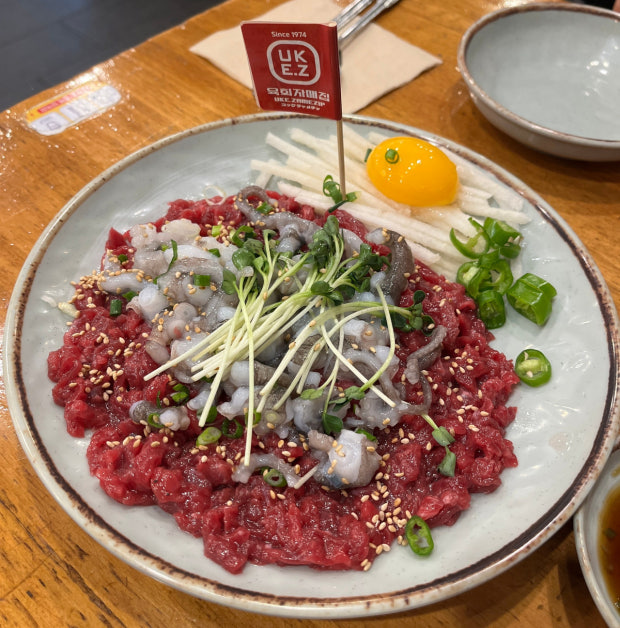
Yukhoe is the most surprising Gwangjang food for most Western visitors — raw beef, julienned finely, seasoned with sesame oil, garlic, and Asian pear for sweetness, topped with a raw egg yolk. It is served cold. The texture is silky rather than chewy; the flavor is clean and mineral. It is one of the genuinely distinctive Korean dishes that does not exist in this form elsewhere.
Finding yukhoe alley: From the main food alley entrance near Jongno 5-ga, walk toward the center of the market and look for the cluster of restaurants with raw beef displayed at the entrance. The alley is separate from the main street food section — sit-down restaurants, not standing stalls.
Cost: ₩15,000–₩25,000 per portion at alley restaurants.
간장게장 (Ganjang Gejang) — Soy Marinated Crab
This must-try Korean delicacy is raw crab marinated in soy sauce. Honglim Banchan food stall shot to fame after being featured in Street Food: Asia — this is the place for ganjang gejang, as well as a huge selection of pickled vegetables. Creatrip
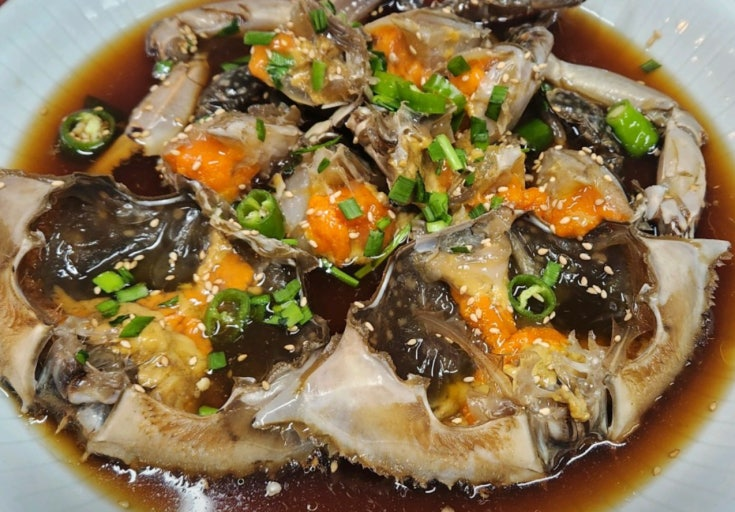
Ganjang gejang is called “rice thief” in Korean — the intensely savory, slightly sweet marinated crab liquid is so compelling that it causes involuntary rice consumption. Eaten by cracking the shell, sucking the marinated meat directly from the claw, and spooning the liquid over rice. One of Korea’s most polarizing foods for Western palates (raw marinated shellfish) and one of the most beloved for those who connect with it. Worth trying at Honglim Banchan.
만두 (Mandu) — Korean Dumplings
At Gwangjang Market, mandu are most often stuffed with gogi (minced pork) or kimchi and served with a soy and raw onion dipping sauce. Creatrip
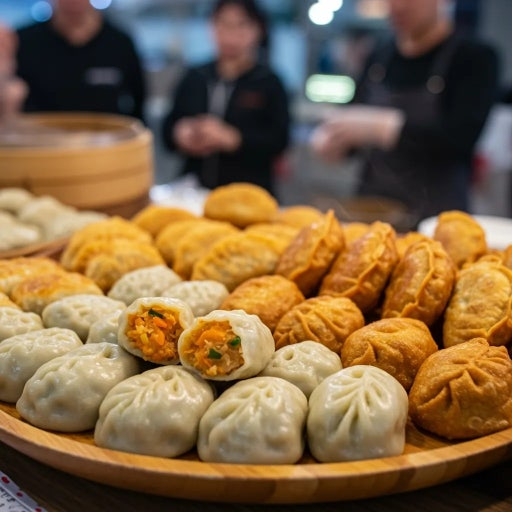
Gwangjang mandu are hand-made and pan-fried or steamed to order — thicker-skinned and more substantial than the thin-wrapped versions at Chinese restaurants. The kimchi mandu is the correct order — the fermented cabbage filling caramelizes slightly during cooking and produces a sour-savory combination that the plain pork version cannot match.
Cost: ₩5,000–₩8,000 per portion (8–10 pieces).
꽈배기 (Kkwabaegi) — Twisted Doughnuts
The twisted doughnuts have drawn such long lines that navigating the alley has become a challenge. Freshly fried and lightly dusted with cinnamon powder, these doughnuts are nearly impossible to resist. Theme Dermatology
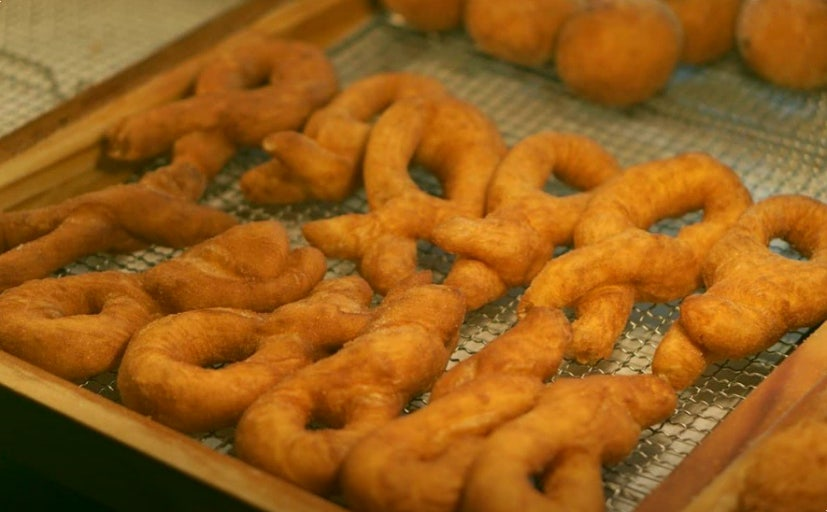
The most 2026 item in the market — a traditional Korean twisted doughnut that went viral among younger Korean and international visitors. The most popular stall is called Twisted Donut, which offers flavors including sweet rice, red bean, black rice, and sweet potato. Eat immediately — they cool and harden within 15 minutes. Theme Dermatology
호떡 (Hotteok) — Stuffed Pancakes
Hotteok Jjang serves versions stuffed with ingredients like injeolmi (Korean rice cake), cheese, and Nutella, as well as the classic honey hotteok — a must-try. Creatrip
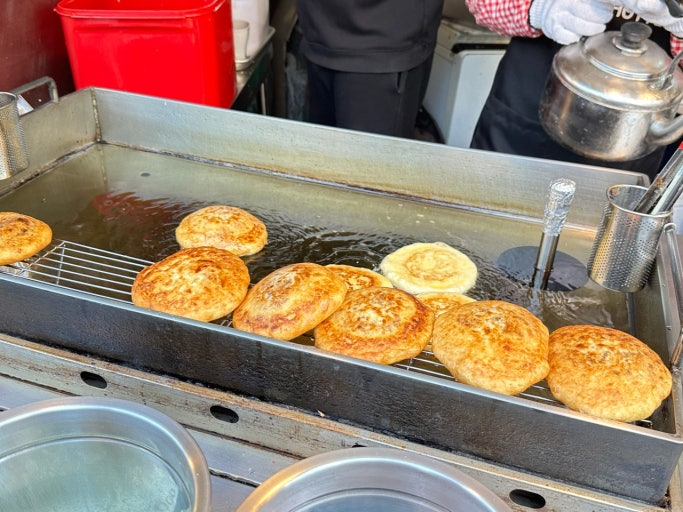
Classic hotteok: a yeast-risen dough pancake pressed flat on a griddle, filled with brown sugar, cinnamon, and crushed nuts. The filling melts during cooking — bite carefully, the interior is extremely hot. The honey version at Hotteok Jjang is the correct starting point before exploring the more experimental fillings.
Cost: ₩2,000–₩4,000 per piece.
Gwangjang Market Seoul: The Honest Tourist Pricing Warning
Some vendors at Gwangjang Market have been flagged for overcharging tourists — setting prices significantly above what Korean visitors pay at the same stalls. Gangnamobgyn
The practical defense:
Check the price before sitting. Most stalls display prices. If a price is not visible, ask before ordering — 얼마예요? (eol-ma-ye-yo / “how much?”). If the vendor quotes a price significantly above what neighboring stalls display for the same item, move on.
The price range to know: Bindaetteok ₩4,000–₩6,000. Mayak gimbap ₩3,000–₩5,000. Kalguksu ₩8,000–₩12,000. Mandu ₩5,000–₩8,000. Any quote dramatically above these ranges is a tourist premium — not worth accepting.
Sit at stalls where locals are already eating. This is the most reliable quality and fair-price indicator in any Korean market. Stalls where every seated customer is a foreign tourist are not necessarily bad — but stalls with a mix of Korean regulars alongside tourists are consistently more fairly priced.
Don’t feel obligated after eye contact. Vendors at Gwangjang are famously enthusiastic about inviting visitors to sit — the “Sit! SIT!” experience is part of the market character. You are not obligated to order because a vendor made eye contact or pointed at you. Browse, compare, and choose deliberately.
Gwangjang Market Seoul: Beyond the Food
Gwangjang’s food alley is what most international visitors see — but the market’s original identity is textile and fabric.
2층 (2F) — Fabric and Hanbok The second floor sells silk, satin, and linen bedsheets and is the largest and most famous fabric market in Seoul. It is also the market visited by Korean couples planning weddings — hanbok made to order, wedding gifts, and home furnishings are all available. For visitors interested in having a hanbok made to order rather than renting, Gwangjang’s second floor offers custom hanbok at prices significantly below dedicated hanbok shops in tourist areas. Gangnamskincenter
빈티지 의류 (Vintage Clothing) A growing vintage clothing section — concentrated in the alleys between the main food corridor and the fabric floors — has made Gwangjang a destination for younger Korean shoppers seeking pre-owned fashion. The selection is broad and the prices are negotiable. PLEATSMAMA, a brand that creates accordion-style bags from recycled yarn, has opened its flagship store amid the bustling alleys of Gwangjang Market — a signal that the market is evolving beyond its traditional categories. Theme Dermatology
팝업 스토어 (Pop-Up Stores) Since the launch of a Jeju Beer Company pop-up store in 2023, a series of pop-up stores have continued to debut in Gwangjang Market — showcasing products including unrefined rice wine, wine, oysters, and specialty foods from across Korea. Check current pop-up listings before visiting — they rotate regularly and occasionally feature limited-edition items not available elsewhere. Theme Dermatology
Gwangjang Market Seoul: Practical Tips
Arrive at 11 AM on a weekday. Most food stalls do not open until 11 AM or noon, particularly the more popular stalls that don’t need the early trade. The best time to visit to avoid crowds is first thing in the morning on a weekday, or late afternoon on a weekday. Weekend afternoons are the most crowded period by a significant margin. Gangnamskinclinic
Sunday warning. Most stalls close on Sunday or Monday. If you visit on either of these days, the choice will be more limited. Sunday has some food stalls open but the market operates at approximately 30% of its weekday capacity. Gangnamskinclinic
Eat standing or at the stall counters. The correct Gwangjang experience is not a sit-down meal but a moving circuit — one item at one stall, walk, another item at the next. Order one portion each of bindaetteok, mayak gimbap, and mandu, eat as you move, then sit for kalguksu or yukhoe as a more substantial course.
Bring cash. Many stalls do not accept cards — particularly the smaller standing vendors. ₩30,000–₩50,000 cash per person covers a thorough eating circuit with room for snacks and drinks.
The Cheonggyecheon walk. Cheonggyecheon Stream runs directly beside the market and the walk along the riverside is pleasant — an ideal wind-down after the sensory intensity of the market’s interior. The stream is illuminated at night and significantly more beautiful after dark. Read our Korean Drama Filming Locations Guide for the stream’s drama appearances. Seoulorthopedics
Combine with Jongno. Gwangjang is 10 minutes on foot from Gyeongbokgung Palace’s eastern entrance and 15 minutes from Insadong — making a morning at the palace and an afternoon at the market the most logical Jongno-gu day itinerary. Read our Gyeongbokgung Palace Guide for the palace logistics.
Gwangjang Market Seoul: FAQ
Is Gwangjang Market worth visiting? Yes — with calibrated expectations. The food is genuinely good, the atmosphere is unlike any other market in Seoul, and the combination of bindaetteok, mayak gimbap, and kalguksu in one visit produces a meal that costs under ₩20,000 and is more interesting than most restaurant lunches in the city.
When is the best time to visit Gwangjang Market? The best time to visit to avoid crowds is first thing in the morning on a weekday, or late afternoon/evening on a weekday. Avoid Saturday and Sunday afternoons. Arrive after 11 AM when stalls are open and before the lunch peak at 12:30–2 PM. Gangnamskinclinic
Are the prices fair at Gwangjang Market? For Korean visitors, yes — the prices are reasonable for Seoul street food. For tourists, variable. Some vendors have been flagged for overcharging tourists. Check prices before sitting, know the standard price range for each item, and move on if a quote seems inflated. This is manageable with basic preparation. Gangnamobgyn
What is the one thing I must eat at Gwangjang? Bindaetteok — the mung bean pancake — is the answer that most visitors and most Korean food writers converge on. It is the dish most specific to Gwangjang, most difficult to find at this quality elsewhere, and most representative of what makes the market worth visiting.
Is Gwangjang Market just for food? No — the textile and fabric floors are the original identity of the market and still the most significant wholesale fabric market in Seoul. Vintage clothing has become a secondary destination for younger visitors. The food alley is the primary draw for international visitors, but the full market is significantly more than a food court.
Can I visit Gwangjang Market and Gyeongbokgung on the same day? Yes — and this is the most efficient Jongno-gu day itinerary. Gyeongbokgung in the morning (9 AM – 12 PM), Insadong or Bukchon briefly (12–1 PM), Gwangjang for lunch and early afternoon (1–3 PM). All three are within 15 minutes of each other. Read our Gyeongbokgung Palace Guide for the palace morning logistics.

Korea Insider has lived in South Korea for 50 years and worked at international companies for over two decades — explaining Korean culture, food, and society to colleagues from the US, Europe, and Australia.
Internationally married with a Japanese spouse, Korea Insider brings both an insider’s depth and an outsider’s perspective to every topic on My Korea Tip.