
Every first-time visitor to Korea eventually faces this question. I’ve lived in Korea my entire life and watched both cities transform over five decades — and my honest answer is always the same: if you have the time, visit both. The KTX connects them in 2.5 hours, and they complement each other in ways that make the combined trip far more rewarding than either city alone.
But if you genuinely have to choose — or you’re trying to decide where to spend more time — this guide breaks down every meaningful difference between the two cities so you can make the right call for your trip.
The Fundamental Difference
Start here, because everything else flows from this.
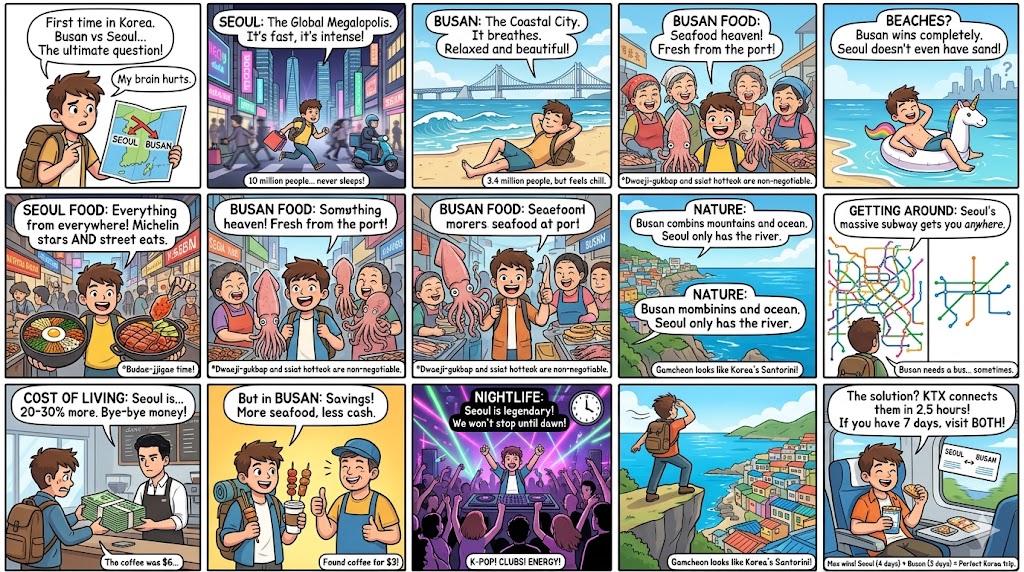
Seoul is Korea’s capital and largest city — a global megalopolis of 10 million people with world-class shopping, dining, nightlife, and culture. It’s intense, fast-paced, and endlessly stimulating. Seoul operates at a speed that surprises most visitors, even those who come from other major Asian cities.
Busan is Korea’s second city and largest port — a coastal city of 3.4 million with beaches, mountains, fresh seafood, and a pace that is noticeably, genuinely more relaxed than Seoul. Where Seoul impresses you, Busan tends to charm you. They’re different experiences, not just different scales of the same one.
Before your trip, read our Incheon Airport to Seoul Guide for arrival logistics and our Korea Travel Budget Guide for cost planning across both cities.
Food
Both cities have exceptional food cultures, but in very different directions.
Seoul is defined by variety. Every regional Korean cuisine is represented, alongside world-class international dining, Michelin-starred restaurants, and one of the best street food scenes in Asia. Budae jjigae (army stew), galbi tang (beef rib soup), and the full range of Korean BBQ are Seoul staples worth seeking out. Read our Korean BBQ Guide for where to start.
Busan wins decisively on seafood. As Korea’s largest port city, Busan has access to the freshest catch in the country, and the food culture reflects this at every price point. Jagalchi Fish Market — Korea’s largest seafood market — is a Busan institution where you select live seafood and have it prepared on the spot. I’ve taken Japanese family members there multiple times, and the reaction is always the same: genuine disbelief at the freshness and the price.
Busan-specific dishes worth knowing: milmyeon (cold wheat noodles with a tangy broth), dwaeji gukbap (pork and rice soup, eaten for breakfast by locals), and ssiat hotteok (seed-filled sweet pancakes that are unique to Busan and genuinely excellent as street food).
Verdict: Seoul wins on variety; Busan wins on seafood. If fresh seafood is a priority, Busan isn’t just better — it’s in a different category.
Beaches
This one isn’t close.
Busan has beaches. Seoul does not.
Haeundae Beach is Korea’s most famous — a wide, beautiful stretch of sand backed by a modern skyline. Gwangalli Beach offers some of the best views of Gwangan Bridge, particularly at night when the bridge is lit up. Songjeong Beach, further from the city center, is quieter and more local in character.
If beaches matter to your trip at all, Busan is the answer. There’s nothing equivalent in Seoul.
Cost
Busan is consistently cheaper than Seoul across almost every category.
| Category | Seoul | Busan |
|---|---|---|
| Studio rent (monthly) | ₩700,000–1,200,000 | ₩450,000–800,000 |
| Meal at local restaurant | ₩8,000–15,000 | ₩6,000–12,000 |
| Coffee | ₩4,500–7,000 | ₩3,500–6,000 |
| Taxi (short trip) | ₩4,800–8,000 | ₩3,800–6,000 |
The gap runs roughly 20–30% across most categories. For budget-conscious travelers, this is a meaningful difference — particularly on longer trips where accommodation costs accumulate.
Nightlife
Here Seoul wins just as decisively as Busan wins on beaches.
Seoul’s nightlife is among the best in Asia. Hongdae, Itaewon, and Gangnam each offer distinct scenes — Hongdae skews younger and more indie, Itaewon is more international and diverse, Gangnam more upscale. Clubs, live music venues, rooftop bars, and pojangmacha (street tent bars) operate until dawn throughout the week.
Busan’s nightlife is centered around Haeundae and Seomyeon. It’s lively and genuinely enjoyable, but the scale and variety don’t compare to Seoul. If nightlife is a significant part of what you’re looking for, Seoul is the clear choice.
Nature and Scenery
Busan is one of the most visually dramatic cities in Korea, and this surprises many visitors who arrive expecting a smaller version of Seoul.
The city sits at the intersection of mountains and ocean — a combination Seoul simply cannot match. Gamcheon Culture Village offers stunning hillside views across colorful stacked houses that have earned it comparisons to Santorini. Taejongdae cliffs at the southern tip of the city are genuinely dramatic. The Oryukdo Skywalk extends over the ocean on a glass-floored platform that gets a strong reaction from most visitors.
Seoul has excellent parks and the Han River, but in terms of raw natural scenery, Busan is in a different league.
Getting Around
Both cities have reliable public transport, but Seoul’s network is substantially larger and more comprehensive.
Seoul’s subway runs 23 lines covering the entire metropolitan area — almost anywhere you want to go is within walking distance of a station. I’ve used it my entire adult life and it remains one of the best urban transit systems in the world. Read our Seoul Subway Guide for everything you need to know.
Busan’s subway runs 4 lines, which covers the main tourist areas adequately but requires buses for some destinations. Navigation is straightforward but less seamless than Seoul.
Atmosphere and Vibe
This is the most subjective category, but often the most decisive one.
Seoul feels like Tokyo or New York — dense, fast, relentlessly stimulating. The energy is genuine and exciting, but it can also be exhausting. First-time visitors are often overwhelmed in a way they didn’t anticipate.
Busan breathes differently. The ocean air, the hills, the seafood markets, the slightly slower pace — there’s a warmth and character to the city that many travelers find more immediately lovable than Seoul’s intensity. I’ve watched many visitors who were skeptical about Busan before arriving become its strongest advocates after two days there.
A pattern I’ve noticed over the years: visitors who come to Korea primarily for the culture and K-pop tend to prefer Seoul. Visitors who come to experience Korea as a place — its food, its landscape, its everyday life — often end up preferring Busan.
Which City Should You Visit?
| Choose Seoul if… | Choose Busan if… |
|---|---|
| It’s your first time in Korea | You’ve already seen Seoul |
| Shopping is a priority | Beaches matter to your trip |
| Nightlife is important | Seafood and nature are priorities |
| You want maximum variety | You want a more relaxed pace |
| K-beauty and fashion are the goal | You want authentic local atmosphere |
The honest recommendation: If you have 7 or more days in Korea, spend 4–5 days in Seoul and 2–3 days in Busan. The KTX train connects the two cities in approximately 2.5 hours for around ₩60,000 — which makes the choice largely unnecessary if your schedule allows.
If you’re short on time and can only do one, first-time visitors almost always get more out of Seoul. Return visitors, or those specifically seeking beaches and seafood, often find Busan more rewarding.
Getting Between Seoul and Busan
The KTX high-speed rail is the standard choice — fast, comfortable, and reliable. Tickets cost approximately ₩60,000 one way and should be booked in advance during peak travel periods. Book your KTX Seoul to Busan tickets on Klook to secure your seat in advance.
Budget airlines (Air Busan, Jin Air) offer flights for similar prices when booked early, though the time saved over KTX is minimal once airport procedures are factored in.
FAQ
Is Busan worth visiting if I’ve already been to Seoul? Absolutely. The two cities are different enough that visiting both provides a much more complete picture of Korea than either one alone.
How many days do I need in Busan? Two to three days is enough to cover the main highlights — Haeundae, Jagalchi Market, Gamcheon Village, and Gwangan Beach. Four days allows for a more relaxed pace and day trips.
Is English spoken in Busan? Less commonly than in Seoul, particularly outside tourist areas. Basic navigation is manageable, but learning a few Korean phrases helps considerably. Read our Korean Phrases for Travelers Guide before you go.
Which city is better for solo travelers? Both are safe and manageable solo. Seoul offers more options for meeting other travelers. Busan’s more relaxed pace can actually suit solo travel well — the city is easy to explore independently.
What’s the best time to visit Busan? Late spring (May–June) and autumn (September–October) offer the best weather. Summer is peak beach season — crowded but energetic. Winter is quiet and cold but has its own appeal, particularly for seafood.
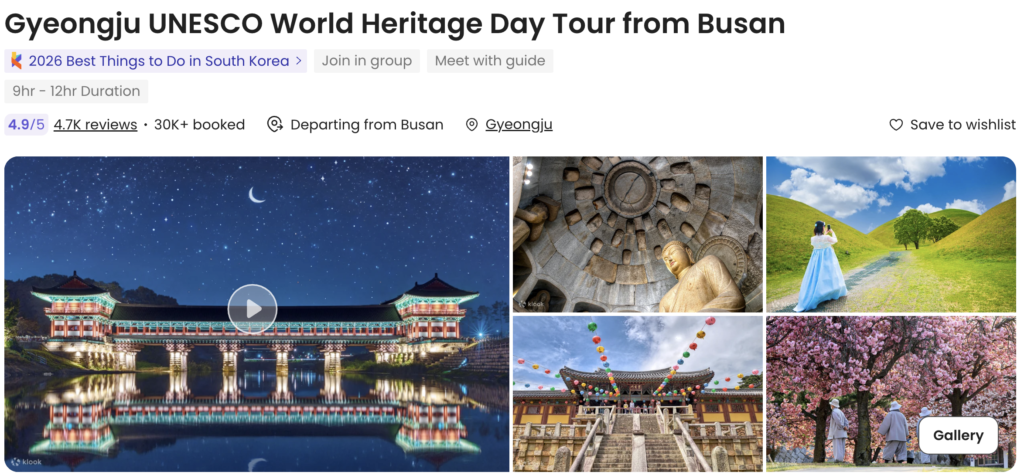
Can’t decide between Seoul and Busan? How about Gyeongju? — book a Gyeongju day tour on Klook from Seoul and experience both cities in one trip. The KTX gets you there in 2.5 hours and guided tours handle everything else.
Ready to explore Seoul? Start with our Korean Street Food Guide for the best eating experiences in the city.

Korea Insider has lived in South Korea for 50 years and worked at international companies for over two decades — explaining Korean culture, food, and society to colleagues from the US, Europe, and Australia.
Internationally married with a Japanese spouse, Korea Insider brings both an insider’s depth and an outsider’s perspective to every topic on My Korea Tip.