
The T-Money card is the single most useful item you can have in Seoul. I hand one to every foreign visitor who asks me where to start — before they ask about accommodation, before they ask about food, before anything else. Get this card first, and navigating the city becomes immediately simple.
This guide covers everything: where to buy it, how to charge it, how to use it across every form of transport, and the details that most visitors only figure out after their first confused day on the subway.
What Is the T-Money Card?
The T-Money card is a rechargeable prepaid transportation card that works across Seoul’s entire public transport network — subways, buses, taxis, and even certain convenience store purchases.
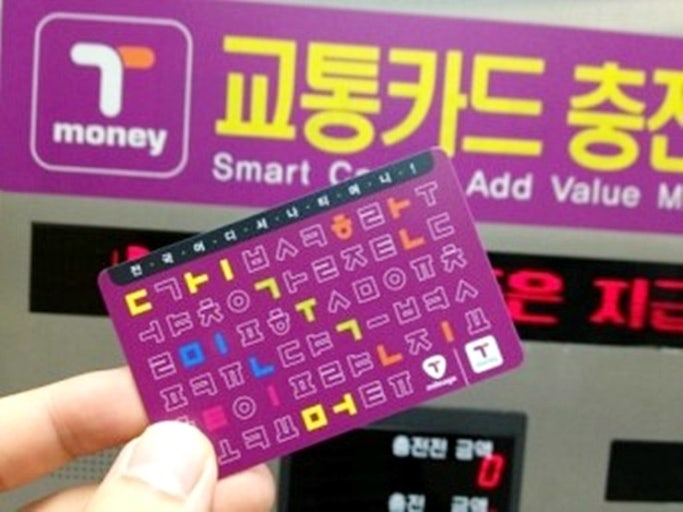
Think of it as London’s Oyster card or Tokyo’s Suica — a single card that handles all your transport needs without purchasing individual tickets for every journey. If you’ve used either of those systems, you already understand the basic concept. T-Money works the same way and is equally indispensable.
It also saves money. Every ride paid with T-Money costs ₩100–₩150 less than a single-use ticket. Over a week of regular travel, that adds up to ₩1,000–₩2,000 in savings — enough for a decent lunch.
Before your first subway journey, read our Seoul Subway Guide to understand the network layout and how to navigate between lines.
Where to Buy a T-Money Card
Buying one is genuinely easy — they’re everywhere.
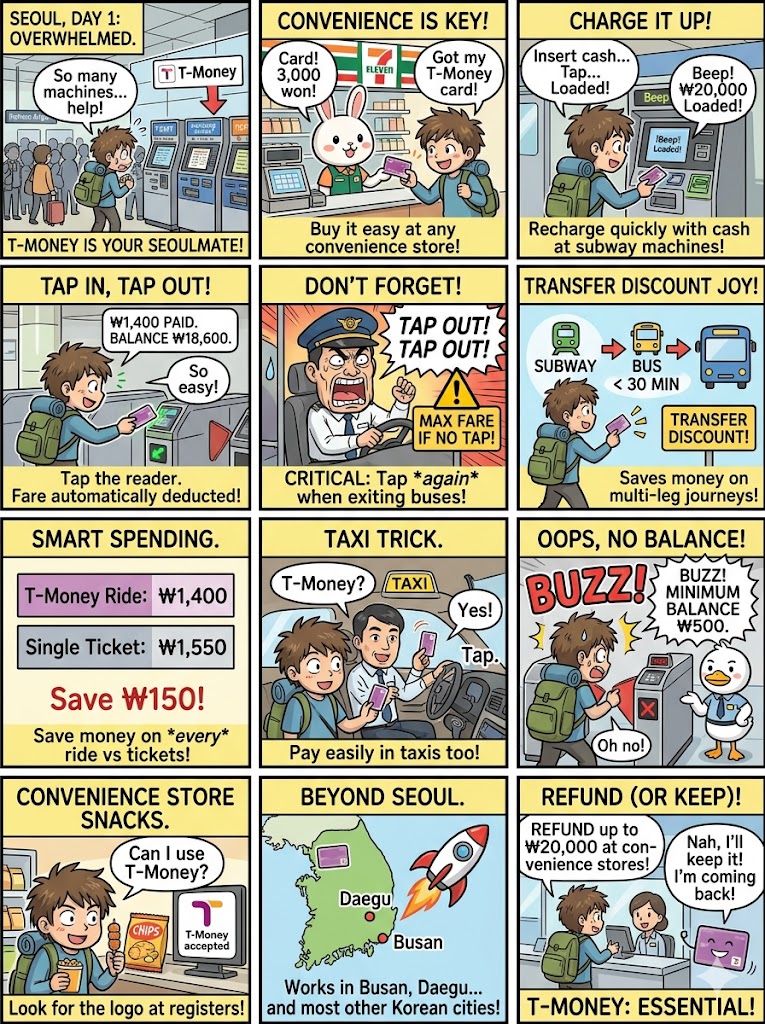
T-Money cards are sold at every convenience store in Korea: CU, GS25, 7-Eleven, and Ministop all carry them at the counter. The card itself costs ₩2,500–₩4,000 and comes blank — no credit loaded. You add money separately.
At Incheon Airport: The convenience store in the arrivals hall sells T-Money cards. I always tell visitors to buy one immediately after clearing customs, before anything else. You’ll need it for the Airport Railroad into the city. Read our Incheon Airport to Seoul Guide for full arrival logistics.
Character and themed cards: Kakao Friends, BTS-themed, and various character T-Money cards are available at convenience stores and tourist shops throughout the city. These function identically to standard cards and make genuinely good souvenirs — practical ones that recipients can actually use if they visit Korea.
How to Charge Your T-Money Card
Charging takes about 30 seconds by either of two methods.
At a convenience store: Hand the card to the cashier and say “T-Money charge” followed by the amount, or simply show the card and indicate the amount with fingers. Staff understand immediately — this is a transaction they handle dozens of times daily. Minimum charge is usually ₩1,000.
At subway station machines: Every Seoul subway station has T-Money charging machines near the entrance gates. Insert cash, tap your card on the reader, select the amount, and you’re done.
How much to load: For a week of regular use, ₩20,000–₩30,000 is a comfortable starting amount. Each subway ride costs ₩1,400–₩1,800 depending on distance. Daily bus use adds another ₩2,000–₩4,000. Better to load more than you need — unused balance is refundable when you leave.
How to Use Your T-Money Card
The system is tap-in, tap-out. That’s essentially all there is to it.
On the subway:
- Tap your card on the yellow reader at the entrance turnstile — it beeps and the gate opens
- Ride to your destination
- Tap again at the exit turnstile — the fare is automatically calculated based on distance
On buses:
- Tap when boarding at the front door reader
- Tap again when exiting — this step matters more than most visitors realize (see the tip below)
In taxis: Tell the driver you want to pay by card before the ride ends. Tap your card on the reader near the driver’s seat when you arrive. Most Seoul taxis accept T-Money without issue.
At convenience stores: Some CU and GS25 locations accept T-Money for purchases — look for the logo at the register. Useful for small purchases when you don’t want to break a bill.
The Transfer Discount — One of T-Money’s Best Features
This is the feature most visitors don’t know about until someone explains it.
When transferring between subway lines, or from subway to bus (or bus to subway) within 30 minutes, T-Money automatically applies a transfer discount. Instead of paying a full new fare, you pay only the distance difference from your previous journey.
On longer cross-city trips involving multiple transport types, this discount can save ₩500–₩1,000 per journey. It applies automatically — there’s nothing to activate or request. It only works with T-Money; single-use tickets don’t qualify.
I’ve used this system my entire adult life and still appreciate how seamlessly it handles multi-leg journeys that would require multiple transactions in most other cities.
Checking Your Balance
Three easy ways to check:
At subway turnstiles: Your balance appears on the reader screen every time you tap in or tap out. Make a habit of glancing at it.
At convenience stores: Ask the cashier to check — they can see it instantly on the register without any separate process.
At subway charging machines: Insert your card into any charging machine to see your current balance before deciding whether to top up.
Important: If your balance drops below ₩500, you may not be able to complete a trip. The system will reject the card at the exit turnstile, which creates an awkward situation during rush hour. Keep it charged above ₩5,000 as a buffer.
T-Money Card vs Single-Use Tickets
There is genuinely no reason to use single-use tickets if you have a T-Money card. The comparison makes this clear:
| Feature | T-Money Card | Single-Use Ticket |
|---|---|---|
| Price per ride | ₩1,400 | ₩1,550 |
| Transfer discount | ✅ Yes | ❌ No |
| Works on buses | ✅ Yes | ❌ No |
| Works in taxis | ✅ Yes | ❌ No |
| Rechargeable | ✅ Yes | ❌ No |
| Refundable balance | ✅ Yes | ❌ No |
The only scenario where a single-use ticket makes sense is if you arrive, take one subway journey to your hotel, and never use public transport again for the rest of your stay. For everyone else, T-Money is the correct choice in every respect.
Getting a Refund When You Leave
If you have remaining balance when leaving Korea, you can get it refunded.
At convenience stores: Refunds of up to ₩20,000 are available at any CU, GS25, or 7-Eleven. A ₩500 processing fee is deducted.
At subway station service centers: Larger refunds are handled at staffed service centers in major stations — Seoul Station, Hongik University Station, and airport stations all have them.
My recommendation: Keep the card. T-Money cards never expire, and if there’s any chance you’ll return to Korea, carrying the card home costs nothing and saves you ₩2,500–₩4,000 on your next visit. I’ve given T-Money cards to foreign friends as departure gifts for exactly this reason.
T-Money Works Outside Seoul Too
Your card works in Busan, Daegu, Incheon, Gwangju, and most other Korean cities. If you’re following our Busan vs Seoul Guide and visiting both cities, you won’t need a separate card for Busan — the same card handles transport there as well.
This nationwide compatibility is something visitors often don’t realize until they arrive in Busan and discover they don’t need to do anything differently.
Practical Tips Summary
Buy it at the airport. Don’t attempt your first Seoul subway journey without a T-Money card. The Incheon Airport convenience store is the easiest place to get one.
Always tap out on buses. Forgetting to tap when exiting results in the maximum distance fare being charged — which is significantly more than your actual journey cost. Always tap out.
Keep ₩10,000+ loaded. Running out mid-journey is easily avoidable. Check your balance regularly and top up at any convenience store when it gets low.
Consider the themed cards. If you’re buying souvenirs, a character T-Money card is functional and meaningful — something people can actually use rather than collect dust.
FAQ
Can I use my credit card instead of T-Money on Seoul’s subway? Some newer turnstiles accept contactless credit cards, but coverage is inconsistent and you lose the transfer discount and lower per-ride fare. T-Money remains the more reliable and economical choice.
What happens if I tap in but run out of balance mid-journey? You can exit at your destination even with a negative balance, but you’ll need to top up before your next tap-in. Negative balances of up to ₩500 are permitted to prevent being stranded.
Can children use the same T-Money card? Standard T-Money cards are charged at adult fares. Youth-specific cards with discounted rates are available — ask at the convenience store counter for a youth T-Money card if traveling with children.
Is T-Money accepted at all taxis in Seoul? The vast majority of licensed Seoul taxis accept T-Money. Unofficial or unlicensed taxis may not — another reason to use only registered cabs. Read our Korea Scams Guide for tips on avoiding taxi issues.
What’s the difference between T-Money and Cashbee? Cashbee is a competing transport card system used primarily in Busan and other southern cities. Both work across Korea’s major cities, but T-Money has broader acceptance nationwide. Either works fine for most visitors.
The T-Money card works outside Seoul. Your T-Money card works in Busan, Daegu, Incheon, and most other Korean cities — useful if you’re following our Busan vs Seoul Guide and visiting both cities.
Planning your Seoul trip? Read our Korean Street Food Guide for the best eating experiences near every subway station.

Korea Insider has lived in South Korea for 50 years and worked at international companies for over two decades — explaining Korean culture, food, and society to colleagues from the US, Europe, and Australia.
Internationally married with a Japanese spouse, Korea Insider brings both an insider’s depth and an outsider’s perspective to every topic on My Korea Tip.