
Good news: Korea is one of the safest, most honest countries you will ever visit.
Bad news: That reputation makes tourists drop their guard — and that’s exactly when the few scams that do exist catch people off guard.
This guide covers every Korea scam worth knowing about, how each one works, and exactly what to do to avoid becoming a statistic. The good news is that most Korea scams are more annoying than dangerous — and almost all of them are completely avoidable once you know what to look for.
Before you arrive, read our Korea Travel Tips Guide and Is Korea Safe for Tourists Guide for the complete picture of what to expect.
Korea Scams #1 — The Taxi Meter “Forget”
This is the most common Korea scam by a wide margin — and it’s been running for decades.
Here’s how it works: you get in a taxi, the driver seems friendly, chats you up, and by the time you arrive at your destination you realize the meter was never turned on. The driver then quotes you a price that’s two, three, or four times what the actual fare would have been. Tourists who don’t know better pay up. Tourists who push back get a shrug and a story about “extra charges.”
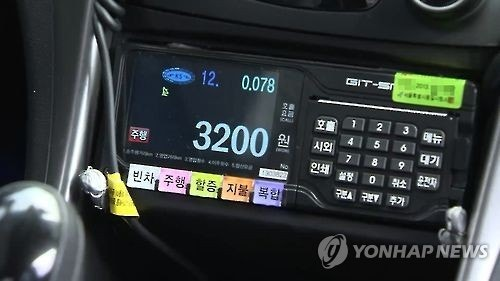
The fix is embarrassingly simple: the moment you sit down, check that the meter is running. If it isn’t, say “meter please” or point at it. A legitimate driver will start it immediately without hesitation. If they resist or start explaining why they don’t need the meter, get out of the taxi.
Better yet, use Kakao Taxi exclusively. The fare is shown in the app before the ride, the driver is logged by name and plate number, and the entire journey is tracked. The taxi meter scam literally cannot happen on Kakao Taxi. This is by far the most effective Korea scam prevention measure available to any tourist.
Read our Incheon Airport to Seoul Guide for safe transport options from the moment you land.
Korea Scams #2 — The Nightlife Overcharge
Picture this: you’re walking through Itaewon or Gangnam late at night when a charming, English-speaking person outside a bar waves you in enthusiastically. “Come in, come in — first drink is free!” The bar looks nice. You go in. You have a few drinks. You meet some people. Then the bill arrives and it’s ₩200,000 for two people when you expected ₩40,000.
This Korea scam works because the initial friendliness lowers your guard and the menu prices — if there even is a menu — are either hidden, in Korean only, or quietly inflated for foreign customers. By the time the bill arrives you’re several drinks deep and the social pressure to just pay and leave is intense.
The rule is simple: any venue that recruits customers aggressively from the street is a venue worth avoiding. Genuine good bars in Seoul don’t need to chase customers off the sidewalk. Always ask to see a menu with prices before ordering anything, and if no English menu exists, that’s your cue to move on.
For the best legitimate nightlife options in Seoul, read our Seoul Nightlife Guide — every district and venue type covered honestly.
Korea Scams #3 — The Fake Monk
You’re exploring a busy tourist area — Insadong, Myeongdong, near Gyeongbokgung — when a person in Buddhist robes approaches you with a warm smile. They place a small bracelet or trinket in your hand and explain it’s a gift, a blessing, a token of goodwill. Then comes the ask: a donation, please, for the temple, for charity, for good luck.
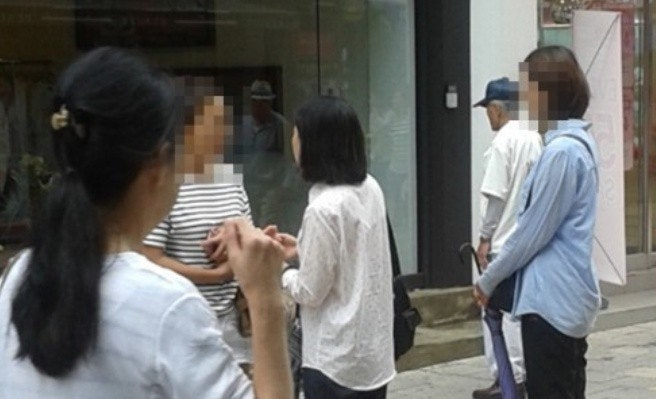
This is not genuine Korean Buddhist practice. Actual Korean Buddhist monks do not approach strangers on the street, place items in their hands, and request money. If this happens, it’s a scam — and a globally recognized one at that, appearing in cities from Seoul to Paris to New York.
The move is equally simple in every city: hand the item back, say no thank you, and keep walking. Don’t let the item stay in your hands — that’s the social trap. Once you’re “holding the gift,” the psychological pressure to pay intensifies significantly.
Korea Scams #4 — The Restaurant Tourist Tax
This one is less a scam and more an unfortunate reality of tourism economics — but it deserves a mention because it genuinely catches people out.
In heavy tourist areas like Myeongdong, Insadong, and near the major palaces, some restaurants charge prices that are significantly higher than what Korean locals pay just three streets away. A bowl of bibimbap that costs ₩8,000 in a normal neighborhood might cost ₩18,000 on the main tourist strip. The food is often the same. The location is the only difference.
The fix: before sitting down anywhere, check the menu prices outside. If you don’t see prices displayed, ask. Always check Naver Maps reviews — locals rate restaurants honestly and you can quickly see whether a place is considered overpriced. And whenever possible, follow Korean people rather than other tourists when choosing where to eat.
For the best authentic food experiences without the tourist markup, read our Korean Food Guide and Korean Street Food Guide.
Korea Scams #5 — The Friendly Stranger Invitation
This one is less common in Korea than in some other Asian countries, but it does happen occasionally — particularly around Itaewon and Hongdae late at night.
Someone approaches you, speaks excellent English, is incredibly friendly, and seems genuinely interested in showing you around or taking you to “the best bar in the city that only locals know about.” The destination turns out to be a place where the drinks are extremely expensive, the stranger is either getting a commission or is in on the arrangement, and you’re expected to pay a bill that makes your eyes water.
Korea’s social culture is genuinely warm and welcoming — but it doesn’t typically involve complete strangers approaching tourists solo at night with enthusiastic invitations to unknown destinations. If something feels off, trust that instinct. Genuine Korean hospitality usually comes through official channels — tour guides, hotel staff, restaurant recommendations — rather than midnight sidewalk encounters.
Korea Scams #6 — The Currency Exchange Trap
Not every bad exchange rate is a scam, but some are. Street-level currency exchange booths in heavy tourist areas occasionally offer rates that are significantly worse than the official rate with no clear disclosure of fees or commissions.
The solution is to always check the official exchange rate on Google before exchanging money, and to use bank ATMs or official bank branches rather than street booths whenever possible. ATMs at convenience stores — CU, GS25, 7-Eleven — that display the “Global ATM” sign reliably dispense won at competitive rates with transparent fees.
For a full breakdown of how money works in Korea, read our Cost of Living in Seoul Guide.
Korea Scams #7 — Drink Spiking
Korea is genuinely safer than most countries for drink spiking — but it is documented, particularly around Gangnam and Itaewon club scenes late at night. Both the Australian Government and UK Government travel advisories specifically mention it.
The usual precautions apply universally: don’t leave your drink unattended, don’t accept drinks from people you’ve just met, and if your drink tastes unexpectedly strong or strange, stop drinking it. Solo female travelers especially — read our Seoul Safe for Solo Female Travelers Guide for the complete nightlife safety picture.
Korea Scams: The Scams That Don’t Really Exist Here
This is actually the more important section — because fear of scams that don’t exist in Korea causes people to miss out on genuine experiences.
Pickpocketing: Almost nonexistent by global standards. Koreans regularly leave laptops on café tables, bags on subway seats, and phones on restaurant tables without concern. You do not need to clutch your belongings in Korea the way you would in Rome, Barcelona, or Paris.
Tuk-tuk ripoffs: Don’t exist. Korea doesn’t have tuk-tuks.
Gem scams: The elaborate gem purchase scams common in Southeast Asia are essentially nonexistent in Korea.
Aggressive vendors: Korean market vendors are direct but not aggressive. You will not be grabbed, followed, or harassed into buying anything.
Fake police: Extremely rare. If someone claiming to be a police officer asks to see your cash or cards, ask to see their ID and contact the real police at 112.
Korea Scams: What to Do If You’re Scammed
If you encounter a Korea scam during your visit, here’s what to do.
For taxi overcharges: note the vehicle number and call the Seoul Taxi Complaint line at 120 or file through the Seoul Metropolitan Government website.
For any tourist-related scam: call the Korea Travel Hotline at 1330 — available 24 hours in English, Chinese, and Japanese. They handle tourist complaints, provide translation support, and connect you with the right authorities.
For emergencies: police at 112, ambulance at 119.
The best Korea scam defense is knowledge — and you’ve just acquired most of what you need. Korea is overwhelmingly honest, welcoming, and safe. The few scams that exist are avoidable with basic awareness, and the country’s reputation for safety is thoroughly deserved.
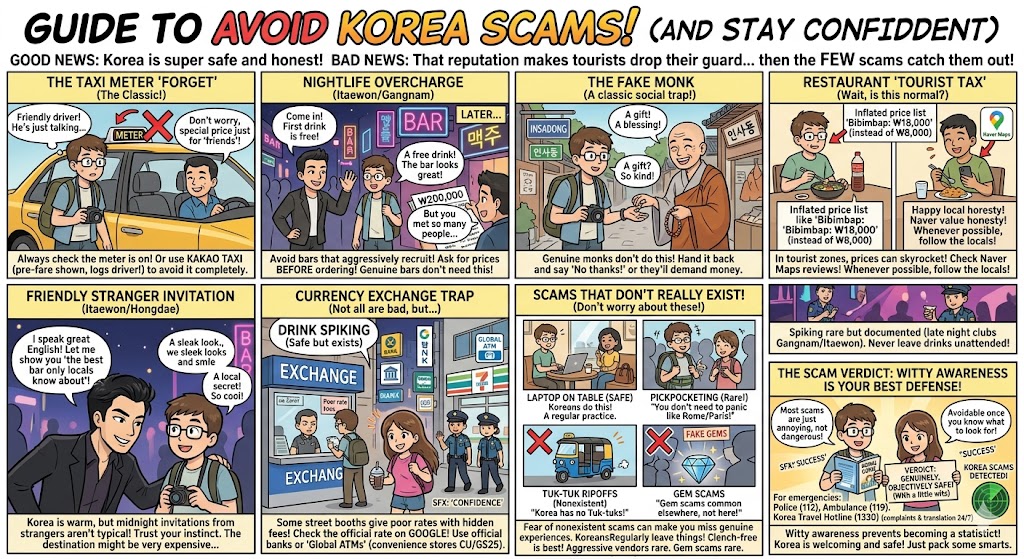
Ready to enjoy Korea worry-free? Read our Things to Do in Seoul Guide and Seoul 3 Day Itinerary to make the most of your visit.

Korea Insider has lived in South Korea for 50 years and worked at international companies for over two decades — explaining Korean culture, food, and society to colleagues from the US, Europe, and Australia.
Internationally married with a Japanese spouse, Korea Insider brings both an insider’s depth and an outsider’s perspective to every topic on My Korea Tip.