
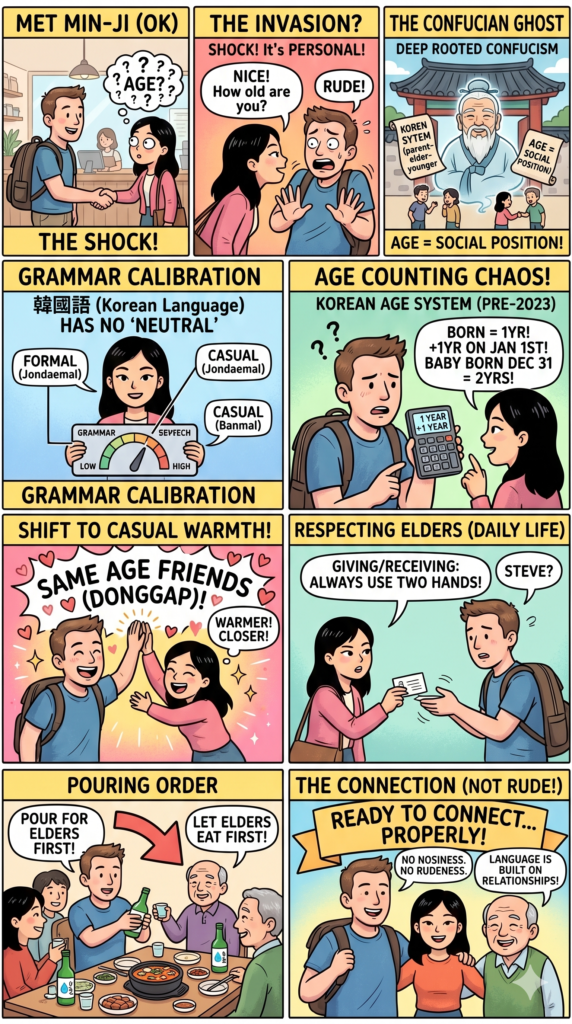
Why Koreans always ask your age? If you’ve spent time with Koreans, you’ve probably noticed this happens almost immediately upon meeting someone new.
You’ve just met someone Korean for the first time. You’ve barely exchanged names when they ask: “How old are you?”
If you’re from the West, this might feel shockingly personal. In many cultures, asking someone’s age — especially an adult’s — is considered rude. So what’s going on?
The short answer: in Korea, your age determines everything about how two people speak to each other. And without knowing it, a Korean simply doesn’t know how to talk to you.
Many foreigners wonder why Koreans ask your age so early — and the answer lies deep in the language itself.
Let me explain.
Why Do Koreans Ask Your Age? It’s All About Language
English is relatively flat when it comes to formality. You say “you” to your boss, your best friend, and a stranger on the street. The word doesn’t change.
Korean is completely different.
Korean has multiple speech levels — formal, polite, casual, and intimate — and which one you use depends almost entirely on the relationship between the two speakers. And the single biggest factor in that relationship? Age.
If you’re older, the other person must speak up to you using respectful language (존댓말, jondaemal). If you’re younger, they may speak more casually (반말, banmal) once you’re close enough. Using the wrong speech level is genuinely awkward — even offensive.
So when a Korean asks your age, they’re not being nosy. They’re trying to figure out the grammar they need to use.
Why Do Koreans Ask Your Age? The Confucian Roots
This isn’t just a language quirk. It runs much deeper.
Korean culture is heavily influenced by Confucianism, a philosophy that places enormous value on hierarchical relationships — between parent and child, teacher and student, elder and younger. Respecting your elders isn’t just polite in Korea; it’s a moral obligation that’s been woven into the culture for centuries.
This shows up everywhere in daily life:
- Pouring drinks: You pour for older people first, and you hold your glass with two hands when receiving.
- Eating: Elders sit down and begin eating before younger people start.
- Bowing: The deeper the bow, the more respect being shown.
Age isn’t just a number in Korea. It’s a social position.
The Korean Age System (Yes, It’s Different)
Here’s where it gets interesting for foreigners: Korea has traditionally used a different age-counting system than the rest of the world.
Under the traditional Korean age system:
- You are 1 year old at birth (the time spent in the womb counts)
- Everyone gains a year on January 1st, not on their birthday
This means a baby born on December 31st would technically be 2 years old the very next day.
Good news: South Korea officially switched to the international age system in June 2023 for most legal and official purposes. But in everyday conversation, many Koreans — especially older generations — still default to the traditional system out of habit.
So if a Korean asks your age and the number seems off by one or two years, that’s why.
How to Respond (And What Happens Next)
So what do you actually do when someone asks?
Just answer honestly. There’s no social trap here. Koreans aren’t judging you — they’re simply calibrating the conversation.
Once they know your age relative to theirs, one of three things usually happens:
- You’re older → They’ll treat you with visible respect, use polite language, and may even insist you go first, sit first, or eat first.
- You’re the same age → This is actually exciting for Koreans. “Same-age friends” (동갑, donggap) share a special bond, and being the same age often fast-tracks a friendship. Expect an immediate shift to more casual, warmer conversation.
- You’re younger → They may relax their speech a bit, take on a slightly older-sibling energy, and might start calling you by your first name more freely.
Is It Rude to Ask Someone’s Age in Korea?
No — but context matters.
Among Koreans meeting for the first time, asking age is completely normal and expected. It’s not considered personal or invasive. It’s practical.
That said, Koreans who have spent time abroad or who are familiar with Western culture may not ask, knowing it can feel uncomfortable to foreigners. Younger, more internationally-minded Koreans are also increasingly aware that the question can come across as odd.
If you’d rather not answer, a polite smile and “I’m in my 30s” is perfectly acceptable. Most Koreans will understand.
Learn more about Confucianism and its influence on Korean culture.
A Few Tips for Navigating Age Culture in Korea
If you’re visiting or living in Korea, here are a few practical things to keep in mind:
Use both hands. When giving or receiving something from an older person — a business card, a drink, a gift — use both hands or support your right arm with your left. It signals respect.
Let elders go first. Whether it’s sitting down at a restaurant or walking through a door, the older person leads.
Don’t be surprised by “oppa,” “unnie,” “hyung,” or “noona.” These are kinship terms (older brother, older sister) used even between friends who aren’t related. They’re tied directly to age hierarchy and are a sign of closeness, not confusion.
Age doesn’t have to mean distance. While the hierarchy is real, Koreans are also famously warm and hospitable. Once the age dynamic is established, relationships often deepen quickly.
The Bottom Line
When a Korean asks your age, take it as a sign that they’re ready to connect — and they want to do it properly.
It’s not nosiness. It’s not rudeness. It’s a culture where language itself is built on relationships, and relationships are built on knowing where you stand with each other.
Once you understand this, a lot of other things about Korean social life start to make sense too.
Also read: How to Use the Seoul Subway

Korea Insider has lived in South Korea for 50 years and worked at international companies for over two decades — explaining Korean culture, food, and society to colleagues from the US, Europe, and Australia.
Internationally married with a Japanese spouse, Korea Insider brings both an insider’s depth and an outsider’s perspective to every topic on My Korea Tip.