
How much does a trip to Korea actually cost? It’s the question every potential visitor asks — and the answer is almost always better than expected.
Korea sits in a sweet spot that very few countries occupy: it’s a genuinely world-class destination with excellent infrastructure, incredible food, and iconic experiences, yet it costs a fraction of what you’d spend in Japan, Australia, or Western Europe. A well-planned Korea travel budget can stretch surprisingly far — or you can spend lavishly and still feel like you got value for money.
This complete Korea travel budget guide breaks down every major expense category for 2026, with real numbers for three different budget levels so you can plan your trip accurately before you book a single thing.
Before diving into the numbers, read our Korea Travel Tips Guide for the practical groundwork every visitor needs.
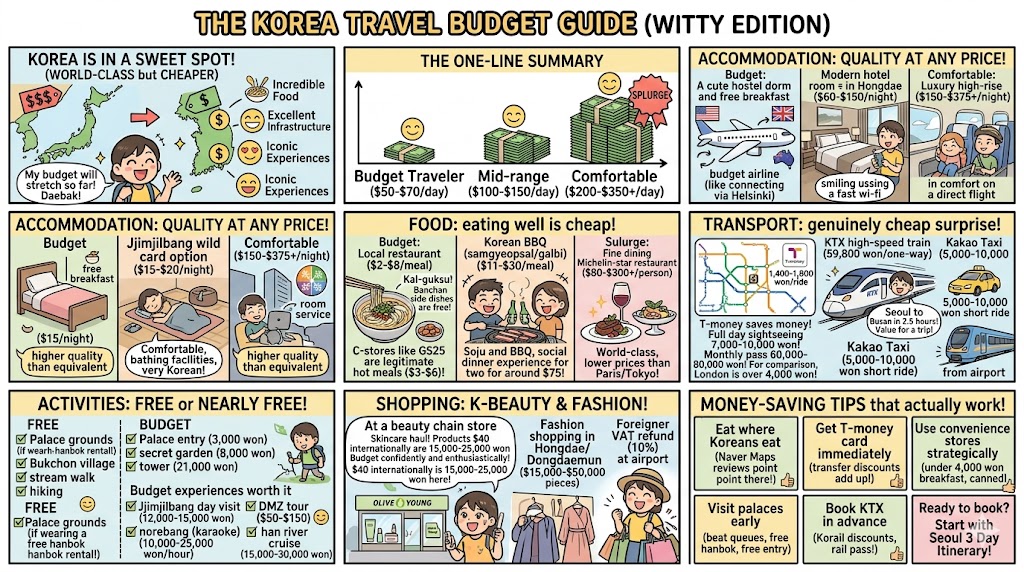
Korea Travel Budget: The One-Line Summary
Budget traveler: $50–70 per day Mid-range traveler: $100–150 per day Comfortable traveler: $200–350 per day
Everything below explains exactly how to hit each of those numbers — and where you can save or splurge without regret.
Korea Travel Budget: Flights
Flights are the biggest variable in any Korea travel budget and the one expense over which this guide has the least control. That said, some honest benchmarks:
From the United States: Round-trip flights to Seoul’s Incheon Airport (ICN) typically range from $600–$1,200 depending on departure city and season. Los Angeles and San Francisco offer the most competitive fares. Korean Air and Asiana are the legacy options; budget-conscious travelers should check Google Flights for deals on connecting services.
From the United Kingdom and Europe: Round-trip from London runs approximately £500–£900. German and French travelers will find similar ranges. Direct flights from London on Korean Air and Asiana are available; connecting through Helsinki (Finnair) or Amsterdam often produces better prices.
From Australia: Sydney to Seoul round-trip runs approximately AUD $900–$1,600. Qantas, Korean Air, and Asiana all operate this route with connections.
Korea travel budget flight tip: Seoul’s two airports — Incheon (ICN) for international and Gimpo (GMP) for some regional — both have excellent transport links to the city. Read our Incheon Airport to Seoul Guide for the cheapest and fastest ways to get into the city once you land.
Korea Travel Budget: Accommodation
Accommodation in Korea covers an extraordinary range — from ₩15,000 hostel dorms to ₩800,000 five-star hotel rooms — and the quality at every price point tends to be higher than equivalent international options.
Budget accommodation (₩20,000–₩60,000 / $15–$45 per night)
Guesthouses and hostels in Hongdae, Myeongdong, and Insadong offer clean, well-located accommodation with surprisingly good facilities at the budget end of the Korea travel budget. Many include free breakfast, fast Wi-Fi, and helpful staff who speak English.
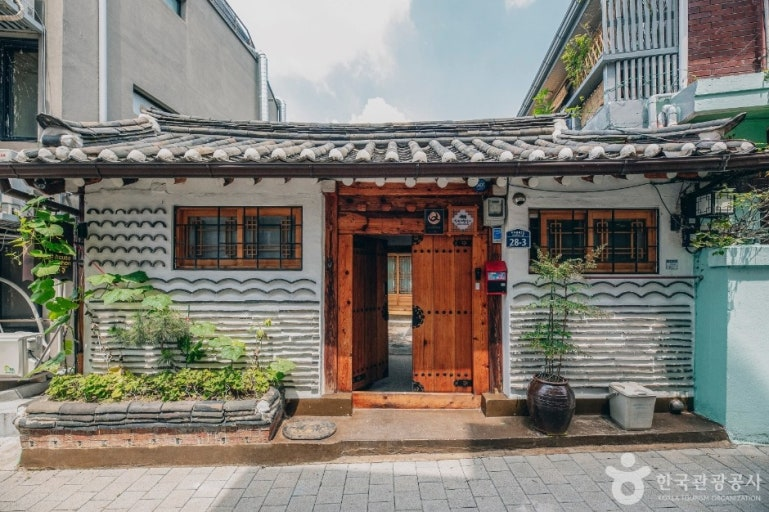
The wildcard budget option: jjimjilbang. Korea’s 24-hour public bathhouses double as overnight accommodation for ₩15,000–₩20,000. It’s not for everyone, but it’s genuinely comfortable, includes full bathing facilities, and is one of the most authentically Korean experiences available at any price point. Read our Korean Jjimjilbang Guide for exactly what to expect.
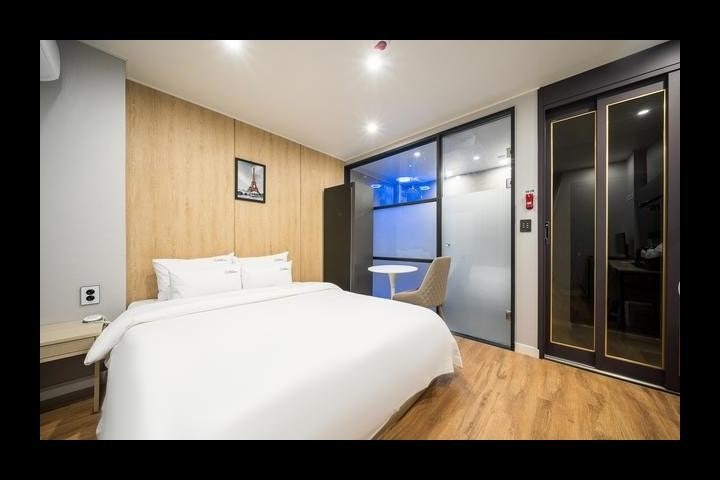
Mid-range accommodation (₩80,000–₩200,000 / $60–$150 per night)
Seoul’s mid-range hotel scene is excellent and competitive. Business hotels, boutique guesthouses in hanok-style buildings, and well-located chains all occupy this Korea travel budget tier. Areas like Myeongdong, Hongdae, and Insadong offer the best mid-range value — central locations without the premium of Gangnam.
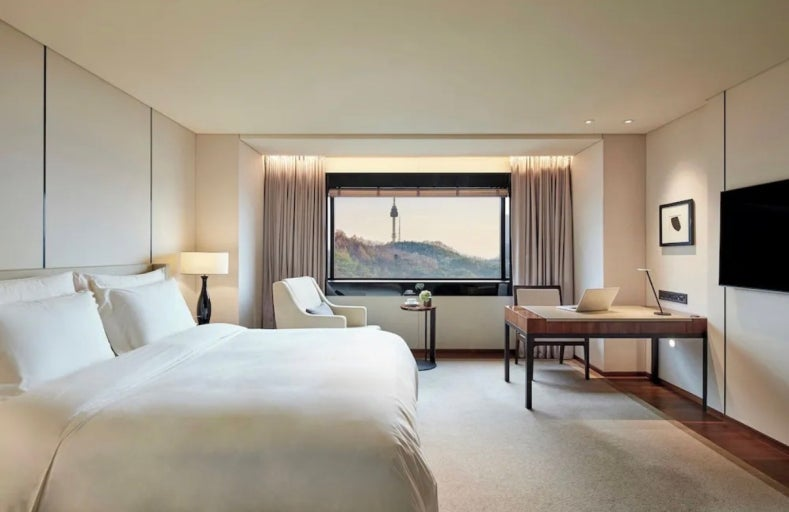
Comfortable accommodation (₩200,000–₩500,000+ / $150–$375+ per night)
Premium hotels in Gangnam, Yongsan, and around Namsan Tower represent Korea’s comfortable tier. International brands like Marriott, Hilton, and Four Seasons operate here alongside excellent Korean luxury chains. Service quality at this Korea travel budget level is outstanding.
Korea Travel Budget: Food
Food is where the Korea travel budget becomes genuinely extraordinary — because eating incredibly well in Korea is cheap by any global standard.
Budget food: ₩3,000–₩10,000 per meal ($2–$8)
This tier is not about sacrifice. A bowl of hot, freshly made kalguksu (hand-cut noodle soup) at a local restaurant costs ₩8,000–₩10,000 and is better than most $20 lunches in a Western city. Street food — tteokbokki, gimbap, Korean corn dogs — runs ₩2,000–₩5,000 per item. Korean convenience stores (CU, GS25) serve legitimate hot meals for ₩3,000–₩6,000 around the clock.
If you eat like a Korean local — which means rice-based meals, soup, and banchan side dishes at neighborhood restaurants — you will eat extraordinarily well on ₩20,000–₩30,000 per day. Read our Korean Food Guide for the 25 dishes that make this budget tier genuinely exciting.
Mid-range food: ₩15,000–₩40,000 per meal ($11–$30)
Korean BBQ — the experience every visitor should have — falls squarely in this tier. A full samgyeopsal or galbi dinner for two with soju and banchan typically costs ₩60,000–₩100,000 total. That’s a complete, memorable, multi-hour social dining experience for around $40–$75 per couple. Read our Korean BBQ Guide for the complete ordering and cooking guide.
Western food, international restaurants, and upscale Korean dining also occupy this Korea travel budget tier.
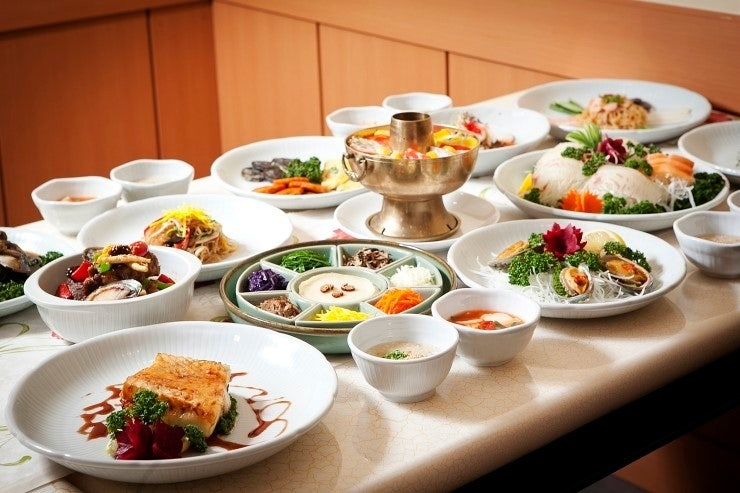
Splurge food: ₩80,000–₩300,000+ per person
Seoul’s fine dining scene is world-class. Restaurants like Gaon (three Michelin stars) and Jungsik (two Michelin stars) deliver experiences that compete with the best in Paris or Tokyo — often at significantly lower prices. If your Korea travel budget includes one special meal, Seoul’s high-end Korean cuisine is worth every won.
Korea Travel Budget: Transport
Transport is the most pleasant Korea travel budget surprise for most visitors — it’s genuinely, remarkably cheap.
Seoul subway: ₩1,400–₩1,800 per ride with a T-money card. A full day of aggressive sightseeing across multiple neighborhoods might cost ₩7,000–₩10,000 in subway fares. Monthly heavy users spend around ₩60,000–₩80,000. For comparison, a single London Underground journey costs over ₩4,000. Read our T-Money Card Guide for everything you need to know before your first ride.
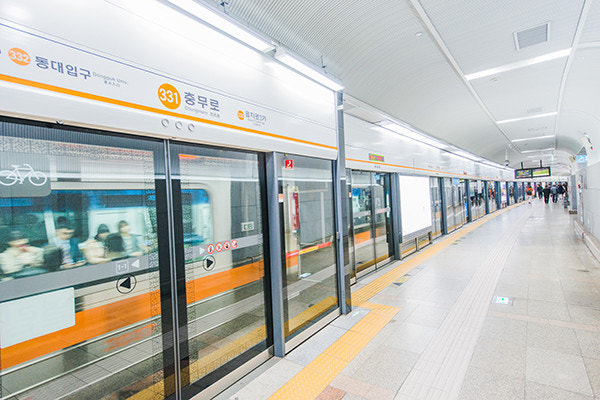
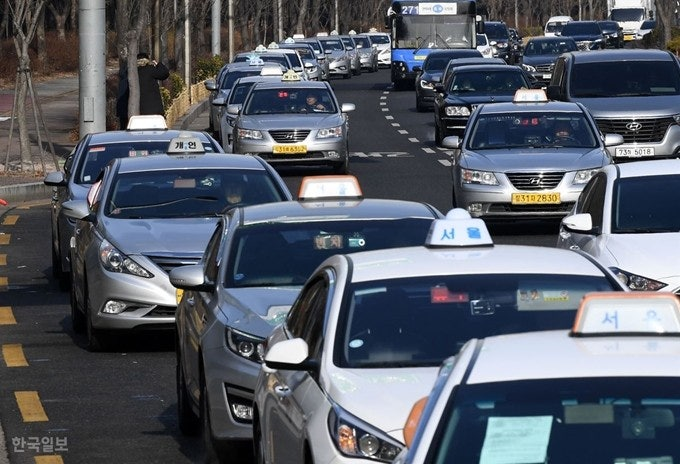
Taxis: Affordable by global standards. A short Kakao Taxi ride across central Seoul costs ₩5,000–₩10,000. Even late-night airport transfers by taxi rarely exceed ₩60,000–₩80,000 from central Seoul to Incheon.
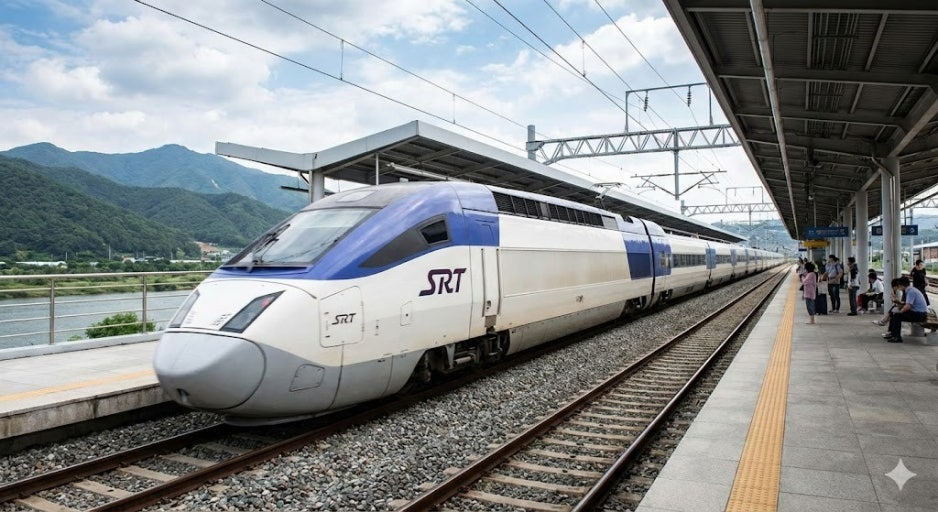
KTX (high-speed train): Seoul to Busan in 2.5 hours costs ₩59,800 one-way — exceptional value for a journey that covers the entire country. If your Korea travel budget includes a Busan day trip, this is how you do it. Read our Busan vs Seoul Guide to decide if the trip is worth it for your itinerary.
Airport transport: The AREX all-stop train from Incheon Airport to Seoul Station costs ₩4,150 — one of the best airport-to-city transport values anywhere in the world.
Korea Travel Budget: Activities and Attractions
One of the most pleasant Korea travel budget surprises is how many of Seoul’s best experiences are free or nearly free.
Free:
- Gyeongbokgung Palace grounds (free with hanbok rental, which is also free)
- Bukchon Hanok Village
- Cheonggyecheon Stream walk
- Namsan Park hiking
- Han River parks
- Most of Seoul’s best shopping neighborhoods
Budget (₩3,000–₩15,000):
- Gyeongbokgung Palace entry: ₩3,000
- Changdeokgung Secret Garden: ₩8,000
- N Seoul Tower observatory: ₩21,000
- War Memorial of Korea: free
- National Museum of Korea: free
Experiences worth budgeting for:
- Korean jjimjilbang day visit: ₩12,000–₩15,000
- Norebang (private karaoke) per hour: ₩10,000–₩25,000
- DMZ tour from Seoul: ₩50,000–₩150,000
- Han River ferry cruise: ₩15,000–₩30,000
- Cooking class: ₩50,000–₩100,000
Korea Travel Budget: Shopping
Shopping is where Korea travel budgets can expand rapidly — or stay disciplined depending on your priorities.
K-beauty is the most common shopping category for Korea visitors. A full skincare haul at Olive Young — Korea’s largest beauty chain — can be assembled for ₩50,000–₩200,000 depending on ambition. Products that cost $40+ internationally are often ₩15,000–₩25,000 in Seoul. Budget accordingly and enthusiastically.
Fashion shopping at Hongdae and Dongdaemun can be surprisingly affordable — ₩15,000–₩50,000 for quality Korean streetwear pieces. Read our Seoul Shopping Guide for the best districts by budget and style.
Don’t forget: foreigners can claim VAT refunds (10%) on purchases over ₩30,000 at participating stores. Look for the “Tax Free” logo and collect your refund at Incheon Airport before departure.
Korea Travel Budget: Complete Day Budget Examples
| Category | Budget Day | Mid-Range Day | Comfortable Day |
|---|---|---|---|
| Accommodation | ₩25,000 | ₩120,000 | ₩280,000 |
| Food (3 meals) | ₩25,000 | ₩60,000 | ₩120,000 |
| Transport | ₩6,000 | ₩12,000 | ₩25,000 |
| Activities | ₩5,000 | ₩20,000 | ₩50,000 |
| Coffee / snacks | ₩5,000 | ₩15,000 | ₩30,000 |
| Total | ₩66,000 (~$50) | ₩227,000 (~$170) | ₩505,000 (~$375) |
Korea Travel Budget: Money-Saving Tips That Actually Work
Eat where Koreans eat. The best value food in Seoul is always in the neighborhood spots three streets away from tourist areas — same quality, significantly lower prices. Naver Maps reviews will point you there.
Get a T-money card immediately. The ₩100–₩150 discount per subway ride and automatic transfer discounts add up meaningfully over a week-long trip.
Use convenience stores strategically. A CU or GS25 breakfast — triangle gimbap, a boiled egg, canned coffee — costs under ₩4,000 and keeps you fueled until a proper lunch. Read our Korean Convenience Store Guide for the full menu.
Visit palaces early. Beat the crowds and the heat (if visiting in summer) — and the free hanbok rental that gets you free palace entry is only available in the morning before queues form.
Book KTX tickets in advance. Korail offers discounts for advance booking and foreign rail passes that can meaningfully reduce intercity travel costs in your Korea travel budget.
Ready to book? Start with our Seoul 3 Day Itinerary to build your day-by-day plan around this Korea travel budget framework.

Korea Insider has lived in South Korea for 50 years and worked at international companies for over two decades — explaining Korean culture, food, and society to colleagues from the US, Europe, and Australia.
Internationally married with a Japanese spouse, Korea Insider brings both an insider’s depth and an outsider’s perspective to every topic on My Korea Tip.