
Korean work-life balance is ranked 36th out of 38 OECD countries — and understanding why reveals more about Korean society than almost any other single statistic.
I have worked at an international company in Korea for over 23 years. This means I have spent most of my professional life sitting in the space between two completely different expectations of what work means. My Korean colleagues and I grew up understanding that presence equals dedication — that leaving before your manager signals something negative about your commitment, that working late is a form of social communication as much as it is actual productivity. My international colleagues arrived with the opposite assumption: that work ends when the work is done, and that staying beyond that is either poor time management or an unhealthy culture. Both are right. Both are incomplete. What I’ve watched over 23 years is a slow, uneven, generational negotiation between these two frameworks — and the younger Korean workers I see today are navigating it very differently from the generation that came before them.
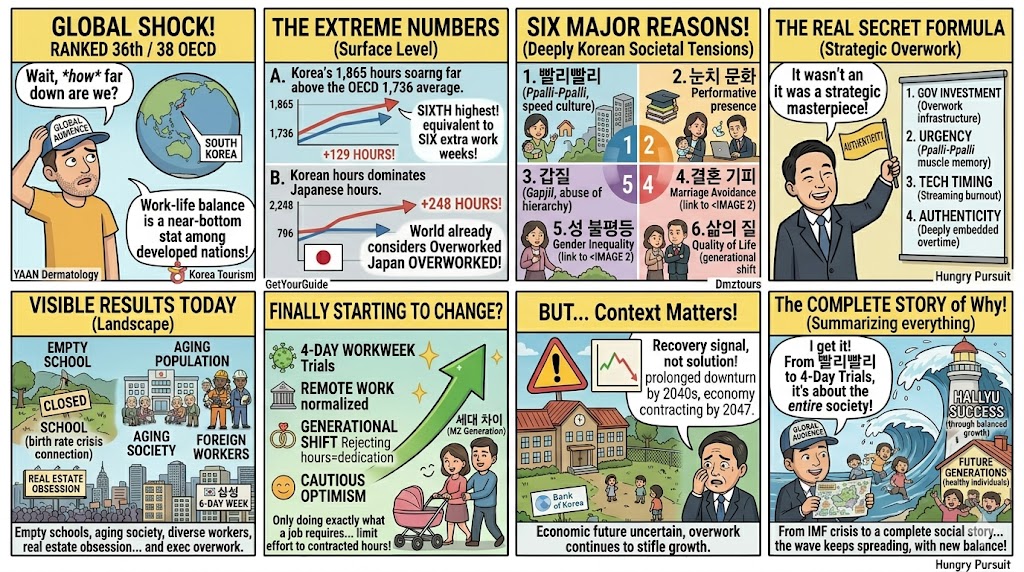
The number that defines it: Korean workers logged 1,865 hours in a recent year — the sixth highest among developed countries, and 248 hours more than workers in neighboring Japan, a country the world already considers overworked. The OECD average is 1,736 hours. Korea exceeds it by the equivalent of more than six additional full-time work weeks every year.
But the hours are only the surface. The deeper story is about a workplace culture where leaving before your manager is considered disrespectful, where unpaid overtime is described as voluntary without anyone believing that framing, where a 2023 government proposal to allow 69-hour work weeks triggered nationwide protests — and where Samsung simultaneously asked its executives to work six days a week to “inject a sense of crisis.”
This is the complete picture of Korean work-life balance: how it got this extreme, what it costs individuals, and what is actually starting to change.
For the social consequences of overwork culture, read our Korea Birth Rate Guide. For the workplace hierarchy that makes long hours structurally inevitable, read our Korean Work Culture Guide.
Korean Work-Life Balance: The Numbers
Korea’s position in global work-hour rankings has been a persistent feature of the country’s economic identity for decades.
| 지표 | 한국 | OECD 평균 | 차이 |
|---|---|---|---|
| 연간 근무시간 | 1,865시간 | 1,736시간 | +129시간 |
| 일본 대비 초과 | — | — | +248시간 |
| OECD 워라밸 순위 | 36위 / 38개국 | — | 하위 5% |
| 번아웃 경험 비율 | 40% | — | 전일제 근로자 기준 |
The 40% burnout figure comes from a government survey of full-time employees — not a fringe academic study but an official count. Four in ten Korean full-time workers report symptoms consistent with workplace burnout. The health costs are measurable: chronic sleep deprivation, anxiety, depression, and cardiovascular issues are all documented at higher rates in overworked populations.
Korea has a term for death by overwork — 과로사 (gwarosa) — borrowed from the Japanese karoshi and adapted into Korean reality. It is not a metaphor. It is a recognized cause of death with legal implications for employer liability.
Korean Work-Life Balance: Why It Got This Way
빨리빨리 (Ppalli-Ppalli) — The Speed Culture
Korean society operates on a principle of extreme urgency. 빨리빨리 — literally “hurry hurry” — is the cultural reflex that shapes everything from restaurant service to construction timelines to workplace expectations. Korea rebuilt itself from one of the poorest countries in the world to a developed economy in roughly 50 years. That pace required — and normalized — a degree of urgency and sacrifice that became self-perpetuating long after the economic emergency that justified it had passed.
The slogans of Korea’s rapid growth era — “Work harder, live better” — functioned as a genuine social contract: individuals gave their time and health, and in return the country delivered collective prosperity. The contract worked. The problem is that the cultural muscle memory of extreme effort outlasted the emergency that created it.
눈치 문화 (Nunchi Culture) — Reading the Room
눈치 is the Korean concept of reading social situations and adjusting behavior accordingly. In a workplace context, it produces a specific dynamic: no one leaves the office while senior colleagues are still present, regardless of whether there is actual work to do. Sitting at a desk — visibly present — signals commitment. Leaving at the official end of the workday — regardless of productivity — signals insufficient dedication.
The result is widespread performative presence: workers who have completed their tasks remaining at their desks for hours, doing progressively less productive work, because the social cost of leaving before the manager is higher than the personal cost of staying. This is unpaid overtime in its most structurally embedded form.
갑질 (Gapjil) — Power Hierarchy and Overwork
갑질 describes the abuse of power by those in higher positions — a pervasive dynamic in Korean workplaces where hierarchy is steep and pushback from junior employees carries significant social risk. The practical result: when a senior person assigns work at 6 PM that requires staying until midnight, the cultural framework makes refusal structurally dangerous regardless of the official employment terms.
Nearly 40% of full-time Korean employees have reported burnout symptoms — and much of it traces back not to formal policy but to this informal hierarchy of expectation.
Korean Work-Life Balance: The 52-Hour Cap
In 2018, the Korean government introduced a 52-hour weekly work cap — a maximum of 40 regular hours plus 12 hours of overtime — as a legal limit on working hours.
The reform was genuinely significant. Korea’s average annual hours dropped from 2,163 in 2010 to 1,865 in recent years — a meaningful reduction. The 52-hour cap deserves partial credit for that shift.
The problems:
Implementation gaps: The cap applies differently across company sizes and industries. Small companies, construction, healthcare, and specific white-collar sectors operate under exemptions or looser enforcement.
Unpaid “voluntary” overtime: The cap covers paid overtime. Work performed outside official hours — the emails answered at midnight, the reports finished at home, the weekend calls — exists in a legal grey zone that the cap does not effectively address.
The 69-hour proposal: In a remarkable reversal of the reform trajectory, the government proposed in 2023 to allow up to 69 hours per week, framed as a “flexibility” measure. The backlash was immediate and intense — unions, civil society, and younger workers organized opposition that forced a government retreat. The episode confirmed that while official Korea still defends long-hours culture, the population — especially younger workers — has moved significantly beyond it.
Korean Work-Life Balance: What’s Actually Changing
The gap between official culture and actual sentiment is widening in Korea’s favor.
4일 근무제 (Four-Day Workweek Trials) Gyeonggi Province — which includes Seoul — launched pilot programs offering workers choices between a four-day week every fortnight, a 35-hour week, or a half-day every Friday. Local governments in Jeju and Chungnam have run similar programs. The appetite for reduced-hour models is genuine and growing.
재택근무 (Remote Work) Remote and hybrid work, rare in Korean corporate culture before the pandemic, gained traction during that period and has partially persisted. Some companies now allow one or two days of remote work per week — a structural shift that would have been nearly unthinkable a decade ago.
세대 차이 (Generational Shift) Younger Korean workers — the MZ generation — are broadly rejecting the hours-equals-dedication equation that their parents accepted. They are more likely to leave jobs that demand performative overtime, more vocal about work-life expectations in hiring processes, and more willing to accept lower salaries in exchange for better conditions. This generational pressure is the most powerful long-term force operating on Korean workplace culture.
조용한 퇴사 (Quiet Quitting) The phenomenon of doing exactly what a job requires and no more — globally called quiet quitting — arrived in Korea and became a subject of intense cultural debate. Its existence as a discussed phenomenon marks a shift: the concept of limiting effort to contracted hours was once so socially unthinkable that it had no Korean name. Now it does.
Korean Work-Life Balance: How Koreans Actually Decompress
When Korean workers do get free time, they use it with the same intensity they apply to work.
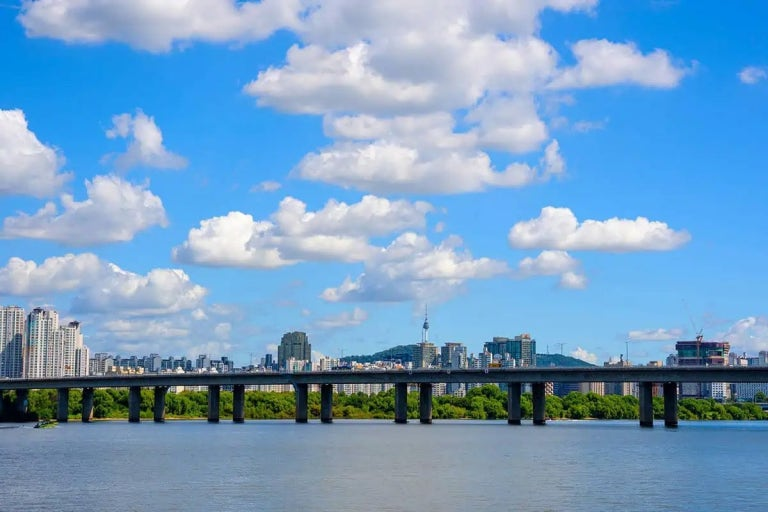
한강 (Han River Parks): On weekends, Seoul’s Han River parks fill with Korean workers and families — cycling, picnicking, drinking convenience store beer and delivery fried chicken, flying kites, exercising. The Han River is the decompression valve of Seoul’s working population. Its accessibility — free entry, open all night — makes it the great democratic leisure space of the city.
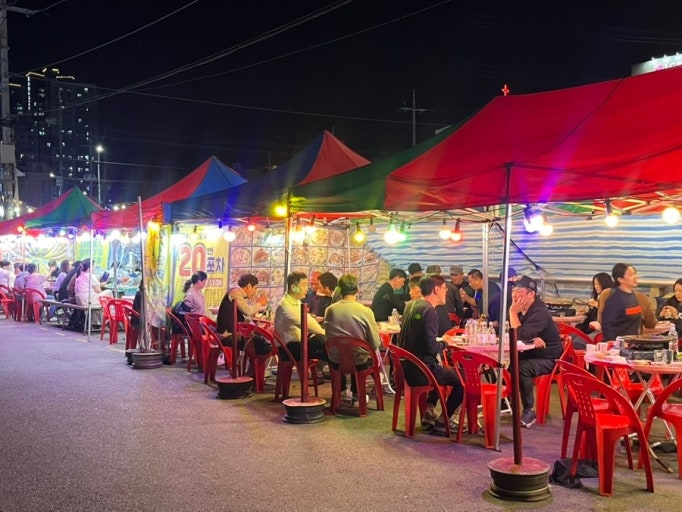
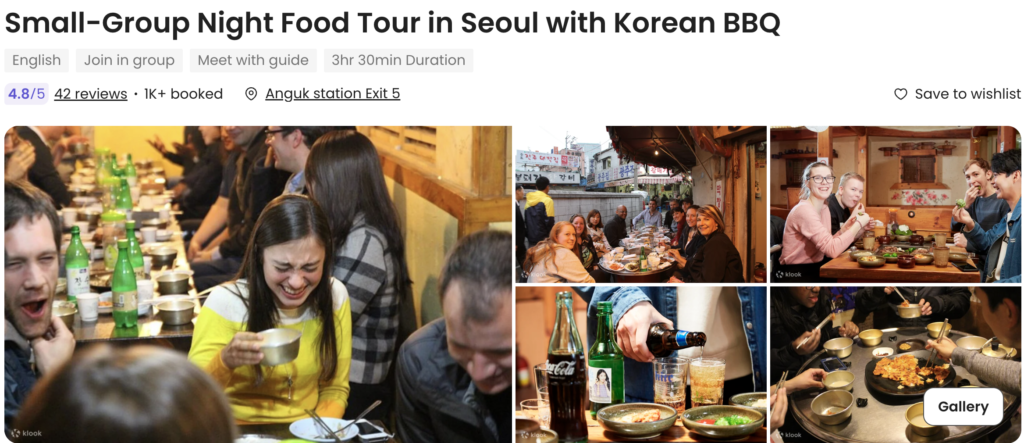
포장마차 (Pojangmacha): The tent food stalls that line Seoul’s streets after dark are where Korean workers go after long days — cheap food, cheap drinks, the particular freedom of eating and talking outside. The pojangmacha is the institutionalized after-work ritual, as distinctly Korean as the work culture it temporarily relieves.
찜질방 (Jjimjilbang): The 24-hour Korean sauna-spa is where workers who have genuinely hit their limit go — to sweat, sleep, and recover at minimal cost. Jjimjilbang see high weeknight usage precisely because the alternative — going home to a small apartment after a 12-hour day — is less appealing than collective recovery in a warm communal space.
등산 (Hiking): Korea has an extraordinary mountain culture for a heavily urbanized country. Weekend hiking is the most popular outdoor activity among Korean adults — Bukhansan in northern Seoul sees millions of visitors annually. The mountain is where Korean workers go to be somewhere where hierarchy temporarily does not apply.
Korean Work-Life Balance: FAQ
How many hours do Koreans work per year? Korean workers averaged 1,865 annual hours in recent data — the sixth highest among developed countries and 248 hours more than Japanese workers per year. The OECD average is 1,736 hours.
Where does Korea rank in OECD work-life balance? 36th out of 38 OECD countries — in the bottom 10% globally, alongside only Mexico and Colombia below it.
What is the legal maximum working hours in Korea? Since 2018, the legal maximum is 52 hours per week — 40 regular hours plus 12 overtime hours. Implementation and enforcement vary across industries and company sizes.
What is gapjil? The abuse of hierarchical power in Korean workplaces — the dynamic by which senior employees assign excessive work, demand after-hours availability, or create environments where junior staff cannot enforce their legal rights without significant social or professional cost.
Is Korean work culture changing? Yes, meaningfully. Four-day workweek pilots are running in multiple regions. Remote work has partially normalized. Younger Korean workers are explicitly rejecting the hours-equals-dedication equation. The 2023 backlash against the 69-hour workweek proposal demonstrated that most Koreans no longer view extreme hours as a badge of honor.
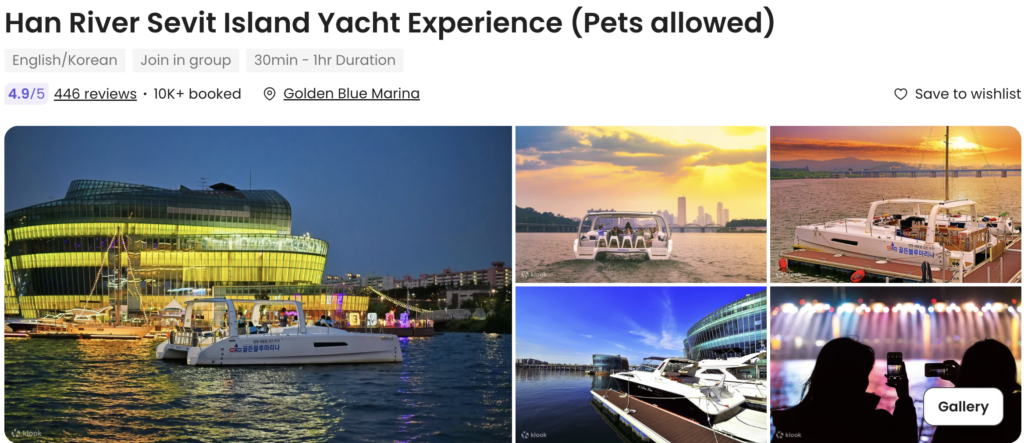
What do Koreans do to decompress? Han River parks, pojangmacha food stalls, jjimjilbang, weekend hiking, and convenience store culture are the primary decompression mechanisms — all relatively accessible, affordable, and deeply embedded in Korean urban life.
Korea Insider has lived in South Korea for 50 years and worked at international companies for over two decades — explaining Korean culture, food, and society to colleagues from the US, Europe, and Australia.
Internationally married with a Japanese spouse, Korea Insider brings both an insider’s depth and an outsider’s perspective to every topic on My Korea Tip.