
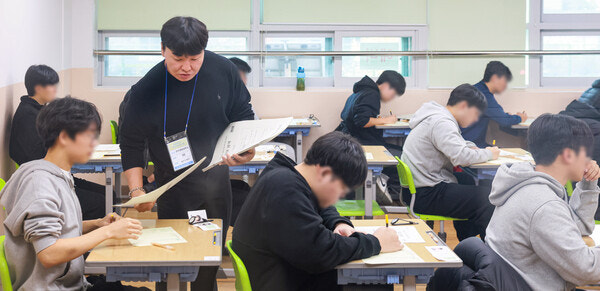
Suneung is a single exam taken every November by over 550,000 Korean students — and on the day it happens, the entire country reorganizes itself around it.
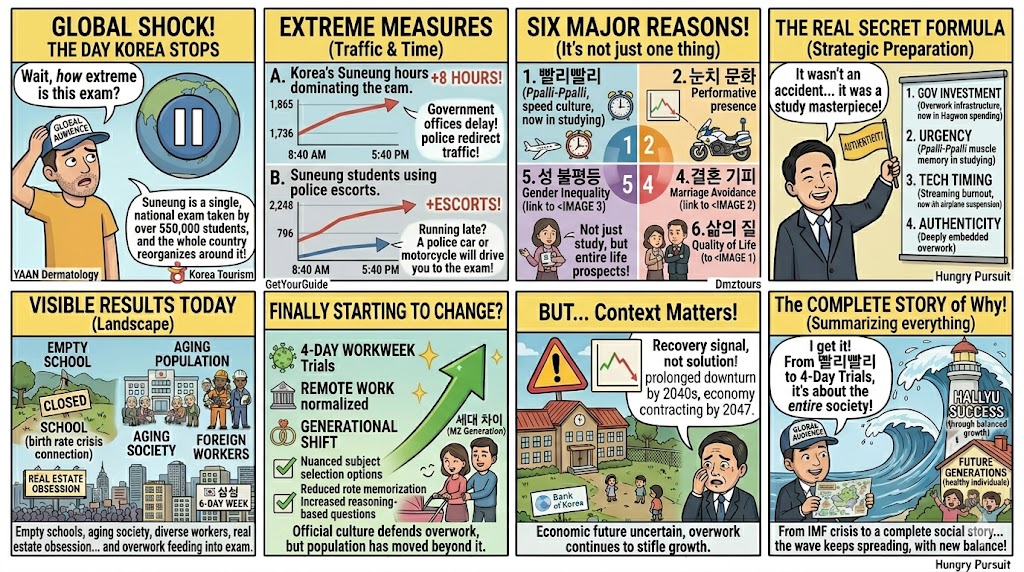
Government offices delay their opening hours. Police officers across the country redirect traffic to clear paths for test-takers. If a student is running late, a police car or motorcycle will drive them to the exam center. Airlines are prohibited from taking off or landing during the English listening section — a nationwide flight suspension enforced by the government so that aircraft noise does not interfere with the audio.
The exam runs from 8:40 AM to 5:40 PM. Eight hours. Approximately 200 questions. Six subject sections. One attempt per year. One score that determines — to a degree that Western students would find difficult to comprehend — which university a student attends, which career becomes accessible, what social tier they occupy, and who they are likely to marry.
This is Suneung (수능) — the College Scholastic Ability Test — and understanding it is essential for understanding almost everything else about Korean society: why children study 12-hour days from elementary school, why hagwon academies are a billion-dollar industry, why Korean parents sacrifice so much for their children’s education, and why the birth rate is what it is.
For the education system that prepares students for this moment, read our Korean Education System Guide. For the work culture that Suneung scores ultimately feed into, read our Korean Work Culture Guide.
Suneung: The Day Korea Stops
The third Thursday of November is the most consequential single day in the Korean calendar — not a holiday, not a national celebration, but a day organized entirely around 550,000 teenagers sitting at desks.
The scale of societal adjustment is unlike anything in the Western world:
교통 통제 (Traffic Control): Police officers manage traffic flow nationwide specifically to ensure test-takers arrive on time. Students who are running late can flag down a police officer and request — and receive — an emergency escort to their exam center.
공무원 출근 시간 조정 (Government Office Delays): Government offices, many private companies, and financial institutions delay their opening hours to reduce traffic congestion during the morning commute to exam centers.
비행기 이착륙 금지 (Flight Suspension): During the English listening section, Korean airspace enforces a suspension of takeoffs and landings in the vicinity of exam centers. This is not a recommendation. It is a regulated requirement.
군사 훈련 중단 (Military Training Pause): Military exercises are suspended on exam day to eliminate noise that might disturb test centers.
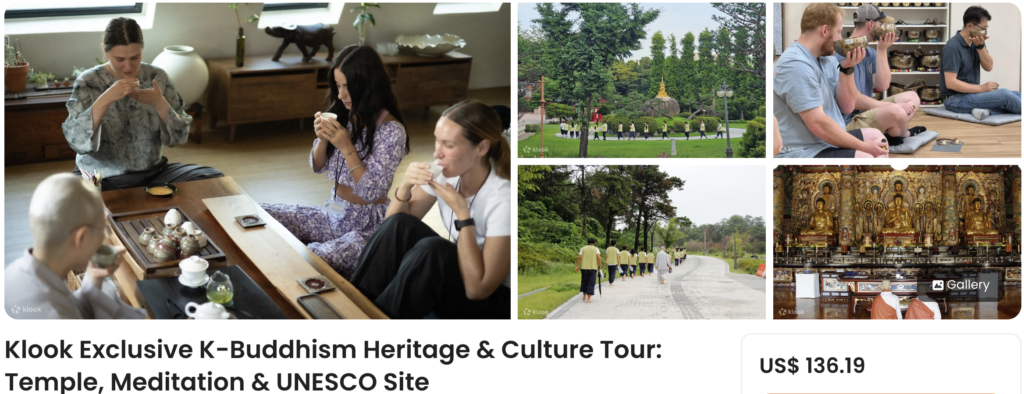
사찰 기도 (Temple Prayer Sessions): Parents of exam-takers gather at Buddhist temples from the night before to pray through the morning — a practice so widespread that Korean temples are crowded well before dawn on Suneung day. The intersection of secular exam pressure and religious petition is one of the most distinctly Korean images of the entire year.
Suneung: What the Exam Actually Is
The full official name is 대학수학능력시험 — the College Scholastic Ability Test. It is administered by the Korea Institute for Curriculum and Evaluation on the same day, at the same time, at thousands of exam centers across the country.
시험 구조 (Exam Structure):
| 교시 | 과목 | 시간 |
|---|---|---|
| 1교시 | 국어 (Korean Language) | 80분 |
| 2교시 | 수학 (Mathematics) | 100분 |
| 3교시 | 영어 (English) | 70분 |
| 4교시 | 한국사 + 탐구 (History + Electives) | 각 30분 |
| 5교시 | 제2외국어/한문 (Optional) | 40분 |
The English section includes a listening component — the reason for the flight suspension. The exam runs continuously from morning through late afternoon with minimal breaks. For visually impaired students, the extended version runs until nearly 10 PM.
Approximately 20% of test-takers in any given year are 재수생 — students who took the exam previously, were unsatisfied with their scores, and spent an entire additional year preparing to retake it. A significant proportion of Korean young adults spend one or more years of their lives in this liminal state — out of high school, not yet in university, studying full-time for a single day’s performance.
Suneung: What’s at Stake
The exam score determines admission to Korean universities through a highly stratified ranking system. At the top sit the SKY universities: Seoul National University (서울대학교), Korea University (고려대학교), and Yonsei University (연세대학교). Below them, a precisely calibrated hierarchy of institutions.
The consequences of where a student lands in this hierarchy extend far beyond the campus:
취업 (Employment): Korean corporations — particularly the large chaebols like Samsung, LG, Hyundai, and SK — use university credentials as a primary filter in hiring. A degree from SKY signals something specific and measurable. The correlation between university tier and first employer tier is stronger in Korea than in almost any comparable economy.
수입 (Income): The income gap between SKY graduates and graduates of lower-tier universities is documented and persistent. A single exam score, achieved at age 18, creates a financial trajectory that compounds over decades.
결혼 (Marriage): University credentials factor explicitly into Korean marriage considerations — both through informal social signals and through the formal information exchange that precedes seon (arranged blind dates). A person’s educational background is standard information shared between families before a meeting takes place.
사회적 지위 (Social Status): Korea’s college attendance rate stands at approximately 79% — nearly four in five Korean students go to university. In a society where near-universal university attendance is the norm, the question is not whether you attended but where. The answer to that question, established on one November Thursday at age 18, echoes through a Korean person’s professional and social life for decades.
Suneung: The Years of Preparation
The exam is one day. The preparation is a childhood.
Korean students typically begin attending hagwon — private after-school academies — from elementary school age. By high school, a typical studying student’s day runs from 7 or 8 AM at school, through after-school self-study, to hagwon sessions that can extend past 10 PM. Sleep becomes a competitive variable — a famous Korean student saying holds that sleeping four hours a night means university success, sleeping five hours means failure.
The hagwon industry exists entirely around this pressure. Korea has more private tutoring centers per capita than almost any country in the world. The annual household spending on private education — across all ages but concentrated in the years leading to Suneung — represents a significant portion of Korean family budgets and is directly cited as a reason for the country’s low birth rate. Families that cannot afford to fund multiple children through the hagwon system have fewer children. The math is explicit.
The subjects covered in Suneung reflect Korea’s educational priorities: deep verbal reasoning in Korean, rigorous mathematics, English proficiency, and Korean history as a mandatory component. The English listening section — the one that stops airplanes — tests skills that Korean students practice for years in academies that simulate the exact exam format.
Suneung: The Mental Health Cost
The pressure surrounding Suneung is inseparable from Korea’s youth mental health statistics. Suicide is the leading cause of death among Korean teenagers — a fact that cannot be discussed in the context of Korean education without acknowledging the Suneung system as a structural contributor.
The concentration of life prospects onto a single exam performance, at a single moment, with one attempt per year, creates a psychological pressure that has no parallel in most Western educational systems. A student who performs poorly faces not just disappointment but the perception — shared by the student, the family, and often the broader social environment — that a fundamental failure has occurred.
The response — the additional year of 재수 study, the retake, the attempt to correct a score that feels identity-defining — is itself another year of the same pressure, now freighted with the additional weight of having already failed once.
Korean educational reformers have argued for decades that the Suneung system produces exactly the wrong skills for a creative, innovative economy: extreme tolerance for rote memorization and high-pressure performance, combined with diminished capacity for risk-taking, lateral thinking, and self-directed learning. The exam tests what can be tested — not what actually produces economic value in the 21st century.
Suneung: What’s Changing
The Suneung is not static. The exam format has evolved significantly over its history, and debates about its reform are ongoing and active.
Recent changes have introduced more nuanced subject selection options, reduced emphasis on certain forms of rote memorization, and incorporated more reasoning-based questions. Universities are also increasingly incorporating other admissions criteria — extracurricular activities, teacher evaluations, interviews — though Suneung scores remain the dominant factor for most programs at most institutions.
The deeper structural question — whether a single high-stakes exam at age 18 is an appropriate gateway to life prospects in a modern economy — is debated openly in Korea but has not produced fundamental reform. The exam’s persistence reflects the difficulty of constructing any alternative that the Korean public would trust to be equally fair and transparent.
Suneung: FAQ
What is Suneung? Suneung (수능) is Korea’s College Scholastic Ability Test — a single national standardized exam taken by over 550,000 students every November that determines university admissions across South Korea. It is one of the most consequential standardized exams in the world in terms of its social and economic impact.
How long is Suneung? The standard exam runs approximately eight hours, from 8:40 AM to 5:40 PM, covering six subject areas. For visually impaired students, the extended version can last until nearly 10 PM.
Why do planes stop flying during Suneung? During the English listening section, takeoffs and landings are suspended near exam centers nationwide to prevent aircraft noise from interfering with the audio. This is a regulated government requirement, not a voluntary courtesy.
What are SKY universities? SKY refers to Seoul National University (서울대), Korea University (고려대), and Yonsei University (연세대) — Korea’s three most prestigious universities. Admission to SKY is strongly correlated with Suneung scores and carries significant professional and social weight throughout a graduate’s career.
What is a 재수생? A 재수생 is a student who has already taken Suneung, was unsatisfied with the score, and is spending an additional year studying full-time to retake the exam. Approximately 20% of any given year’s test-takers are repeaters. Some students spend two or more years in this state before entering university.
Can foreigners take Suneung? Eligible foreign residents in Korea can take Suneung under specific conditions, though most international students applying to Korean universities use alternative admissions pathways designed for foreign applicants.
When is Suneung? The exam is administered on the third Thursday of November every year. It has been delayed only under extraordinary circumstances — including a major earthquake and the COVID-19 pandemic.

Korea Insider has lived in South Korea for 50 years and worked at international companies for over two decades — explaining Korean culture, food, and society to colleagues from the US, Europe, and Australia.
Internationally married with a Japanese spouse, Korea Insider brings both an insider’s depth and an outsider’s perspective to every topic on My Korea Tip.