
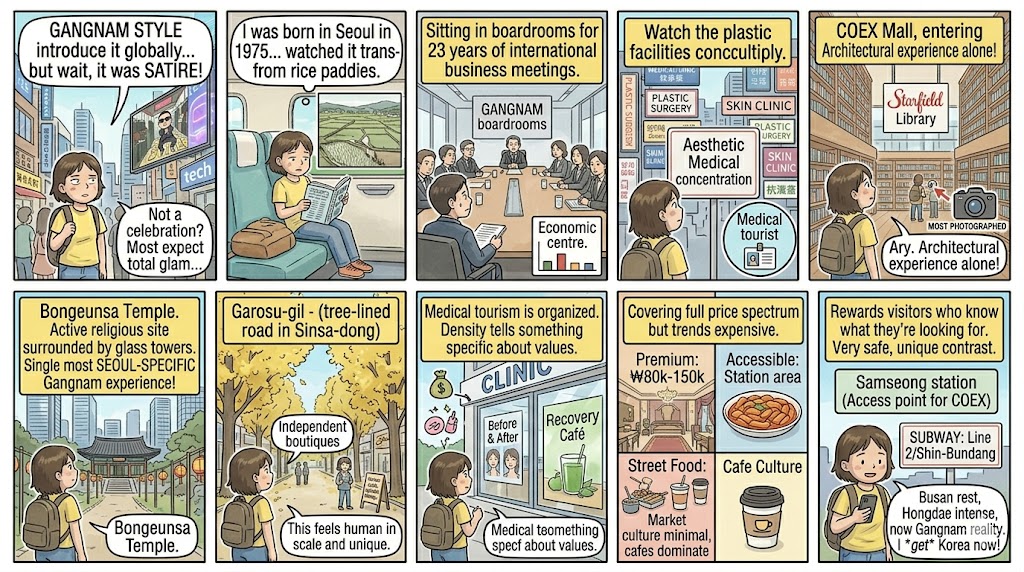
Gangnam Seoul is not what most international visitors expect, for reasons that start with a song. PSY’s Gangnam Style — which introduced the neighbourhood’s name to a global audience in 2012 — was satire, not celebration. It was making fun of the affected wealth signalling and status performance of Gangnam’s aspirational class, not advertising the neighbourhood as a destination. Most visitors who arrive expecting glamour encounter a district that is impressive, expensive, and considerably more interesting once you understand what it actually is.
I was born in Seoul in 1975 and have spent decades watching Gangnam transform from a development project south of the Han River into the financial, medical, and cultural centre of South Korea’s wealthiest class. I’ve sat in Gangnam boardrooms for 23 years of international business meetings. I’ve watched the plastic surgery clinics multiply along the streets where rice paddies were within living memory. And I’ve developed a specific perspective on what makes Gangnam worth visiting, which is not what the K-pop tours suggest and not nothing — it’s something more complicated and more interesting than either.
What Gangnam Actually Is
Gangnam literally means “south of the river” — the Han River divides Seoul, and Gangnam refers to the districts on the southern bank that were developed primarily from the 1970s onward. The area was largely agricultural land until the Park Chung-hee government designated it for rapid urban development as part of the broader industrialisation push, and it was built with a level of planning and infrastructure that the older northern districts of Seoul never had.
The result is a grid-planned, wide-boulevarded district that looks and functions differently from historic Seoul — broader roads, more consistent architecture, less organic neighbourhood character. It became the address of choice for Korea’s emerging professional class as economic growth accelerated through the 1980s, and the wealth concentration that followed has made it the most expensive real estate in Korea by a significant margin.
Gangnam is also the global capital of cosmetic and aesthetic medicine — the concentration of plastic surgery clinics, dermatology practices, and beauty treatment facilities in the Apgujeong and Sinsa-dong areas exceeds any comparable district in the world. My Korea plastic surgery and skin clinics guide covers the medical tourism dimension in detail, but the visual evidence is on every street: clinic signs in multiple languages, consultation centres oriented toward international patients, and a density of aesthetic facilities that tells you something specific about the value the neighbourhood places on appearance.
COEX & Samseong-dong: The Cultural and Commercial Core
COEX Mall
The underground mall complex beneath Samseong-dong is one of the largest in Asia and worth visiting independently of any shopping intention. The Starfield Library — a multi-storey library installed in the central atrium with floor-to-ceiling bookshelves and reading tables open to the public — is genuinely one of the most photographed interiors in Seoul and worth the visit as an architectural experience alone. Free to enter; the books are real and accessible.
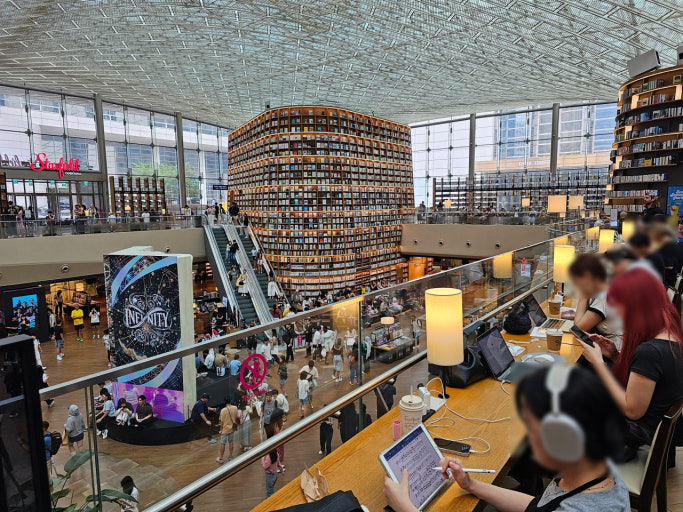
The mall connects to COEX Convention & Exhibition Centre, which hosts major trade shows, K-pop fan events, and international conferences throughout the year. Check the current schedule — if a major K-pop fandom event is running during your visit, the surrounding streets are worth experiencing for the atmosphere if not the event itself.
SM Town Museum
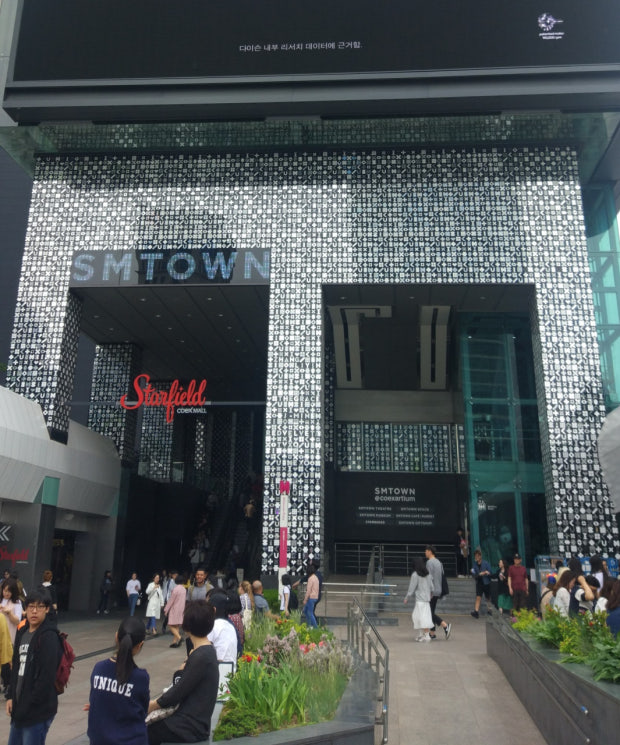
The entertainment company behind K-pop’s most globally successful acts — EXO, Super Junior, Girls’ Generation — operates a museum and fan experience space at COEX. For visitors with any engagement with K-pop culture, this is the most concentrated version of what that industry looks like from the inside. For visitors without existing K-pop investment, the architecture and merchandising alone tell you something about the scale of what Korean entertainment has built.
Bongeunsa Temple
Directly across from COEX, surrounded by glass skyscrapers, sits one of Seoul’s most active Buddhist temples — founded in 794 AD and continuously operating. The contrast is not subtle: ancient wooden prayer halls, lantern-lit paths, and the sound of monks chanting, framed by Gangnam’s glass towers on all sides. The temple grounds are free to walk and open from early morning. Meditation sessions are available for visitors at scheduled times.
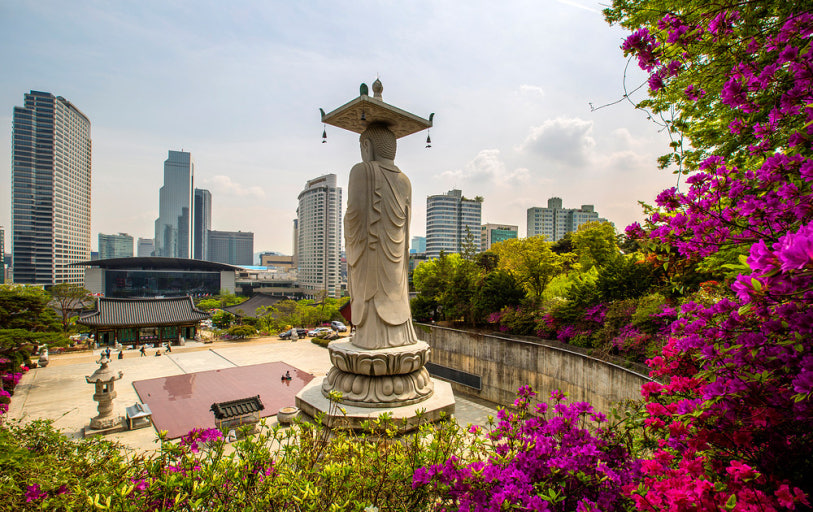
This is my recommendation for the single most Seoul-specific experience in Gangnam — a thousand-year-old temple in the middle of Korea’s most modern district, functioning not as a historical exhibit but as a working religious site where Koreans come to pray.
Apgujeong & Cheongdam-dong: Where the Money Is Visible
The neighbourhoods of Apgujeong and Cheongdam-dong represent the most concentrated luxury retail and dining in Korea. The international fashion brands that have Seoul flagship stores are almost all located here — Louis Vuitton, Chanel, Gucci, and the Korean luxury brands that international visitors rarely know but Korean consumers treat with equivalent reverence.
Garosu-gil — the “tree-lined road” that runs through Sinsa-dong — is the most walkable version of Gangnam’s upscale neighbourhood character. Independent boutiques, design cafés, and restaurants occupy low-rise buildings along a street that was planted with ginkgo trees in the 1980s and has accumulated a specific aesthetic over the decades. More human in scale than Cheongdam’s luxury strip, more interesting for browsing, and the café-to-block ratio is among the highest in Seoul.
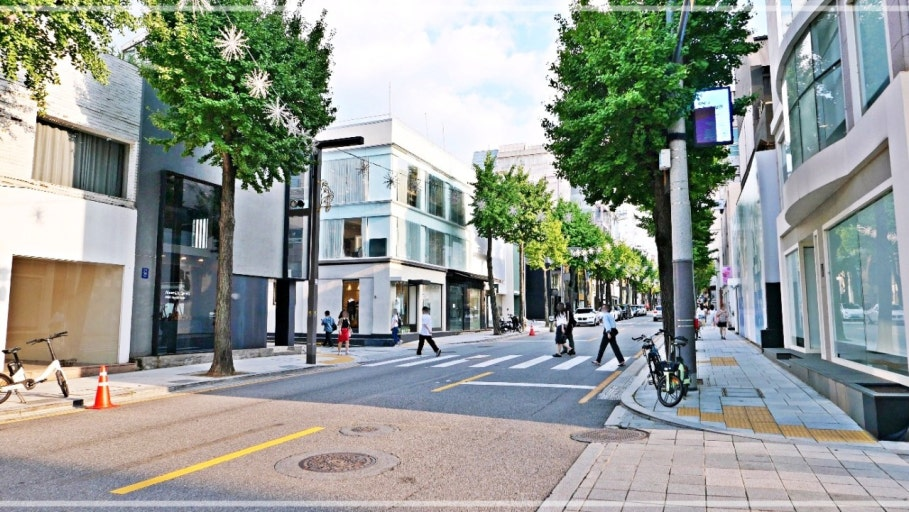
The Rodeo Street area in Apgujeong was Korea’s original luxury retail district — the first place international fashion brands established Seoul outposts in the 1990s. It has since been eclipsed by Cheongdam in terms of brand concentration, but retains a specific character from its early development: broader pavements, more established trees, and the slightly worn elegance of a district that was first rather than newest.
Gangnam’s Medical Beauty District
The streets south of Apgujeong station and east of Sinsa-dong constitute the largest concentration of aesthetic medical facilities in the world. Plastic surgery clinics, dermatology practices, hair transplant specialists, dental veneers — the range of procedures available within a few city blocks is extraordinary.
International medical tourism to this district is significant and professionally organised. Many clinics maintain dedicated international patient coordinators, offer consultations in English and several other languages, and have pricing structures that represent genuine savings compared to equivalent procedures in Western countries — typically 30–60% lower than US or UK prices for comparable procedures by qualified practitioners.
Visitors with no intention of undergoing any procedure will still find the district interesting as a cultural artefact. The density of beauty-related commerce — the before-and-after photographs in clinic windows, the consultation centres, the recovery cafés where patients rest post-procedure over green juice — is a physical manifestation of Korean beauty standards and the economy they have produced.
Eating in Gangnam
Gangnam’s restaurant scene covers the full price spectrum but trends expensive — this is where Seoul’s business entertaining happens, and the restaurant economy reflects it.
For serious Korean dining: The Cheongdam and Apgujeong areas have the highest concentration of premium Korean restaurants — the kind that serve traditional Korean cuisine (한정식, hanjeongsik) in full multi-course format, in private rooms, at prices that reflect the address. These are expensive by Korean standards and extraordinary by any standard. Budget ₩80,000–₩150,000 per person.
For accessible quality: The streets immediately around Gangnam station (the intersection of Lines 2 and Shin-bundang) have a dense restaurant district with Korean chains and local restaurants at more accessible prices. The underground food court beneath the station is functional and cheap. The residential streets east of the station have the local restaurant culture that feeds the neighbourhood’s office workers rather than its clients.
For street food: Gangnam doesn’t have the street food density of Hongdae or the market culture of Jongno — this is a planned district without the organic street commerce that develops over centuries. The convenience stores compensate, and the café culture is extraordinary.
Gangnam Nightlife
Gangnam’s nightlife operates differently from Hongdae’s. Where Hongdae’s club scene is visible, loud, and accessible to walk-ins, Gangnam’s premium nightlife is curated, reservation-oriented, and significantly more expensive.
The Cheongdam and Apgujeong areas have rooftop bars and cocktail lounges that represent the upper end of Seoul’s nightlife economy — beautifully designed spaces where the view over the Gangnam skyline accompanies drinks priced accordingly. The Seoul nightlife guide covers the full spectrum, but for Gangnam specifically: make reservations, dress well, and budget meaningfully.
The club scene in Gangnam clusters around Nonhyeon and the streets south of Apgujeong station — less geographically concentrated than Hongdae but operating at higher cover charges and more selective door policies. The weekend scene peaks later than Hongdae, reflecting the working-professional demographic of the neighbourhood.
Getting to Gangnam
Subway: Line 2 (green) connects Gangnam station directly to Hongdae (30 min), City Hall (15 min), and the city centre. The Shin-bundang Line connects Gangnam to the southeastern suburbs and the tech corridor of Pangyo. Samseong station (Line 2) is the access point for COEX.
From the airport: The Shin-bundang Line runs from Suseo station (near Gangnam) to the eastern suburbs but not directly to Incheon Airport. The AREX from Incheon connects to Seoul Station, from which Line 2 connects to Gangnam in approximately 20 minutes. Alternatively, airport limousine buses serve Gangnam directly and are comfortable for the journey with luggage.
Taxi: Gangnam to central Seoul (Myeongdong, Jongno) costs approximately ₩8,000–₩15,000 by regular taxi depending on traffic. The KakaoTaxi app works reliably and accepts international credit cards.
FAQ
Is Gangnam worth visiting as a tourist? Yes — for specific reasons. COEX and Bongeunsa Temple together constitute a genuinely compelling few hours. Garosu-gil is pleasant for walking and café browsing. The medical beauty district is culturally fascinating even without the intention to visit a clinic. The fine dining scene is excellent. Gangnam rewards visitors who know what they’re looking for.
Is Gangnam expensive? The most expensive neighbourhood in Seoul, yes. Accommodation, dining, and nightlife all price at the premium end of the Seoul market. Budget travellers will find better value elsewhere in the city and can visit Gangnam for the day without the accommodation cost.
What is Gangnam most famous for? Internationally: PSY’s Gangnam Style, which satirised the neighbourhood. Among Koreans: wealth, cosmetic surgery, premium education (the neighbourhood has Korea’s most concentrated private tutoring industry), and the tech and entertainment company headquarters that define the area’s corporate identity.
Where is the best place to stay in Gangnam? The Samseong-dong area near COEX for business travel or convention attendance. The Apgujeong and Sinsa-dong areas for the most neighbourhood character. Gangnam station vicinity for transport convenience and price variety.
Is Gangnam safe? Extremely. Crime in Gangnam is among the lowest of any comparable district in Asia. The neighbourhood’s wealth concentration correlates with extensive private and public security.
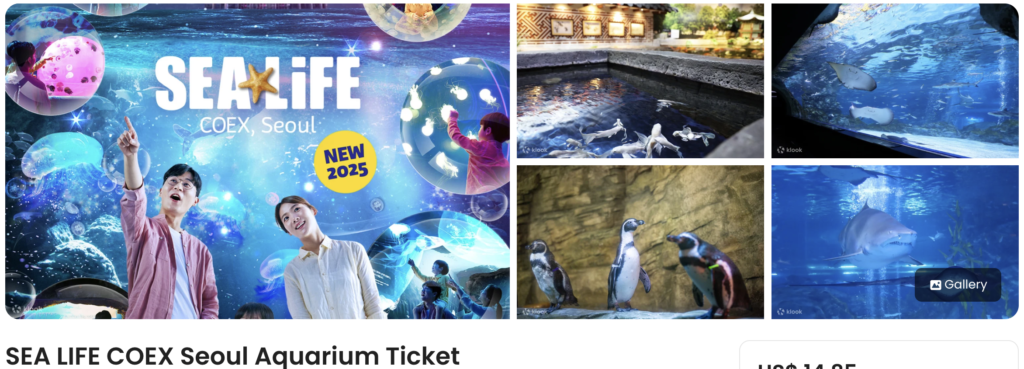
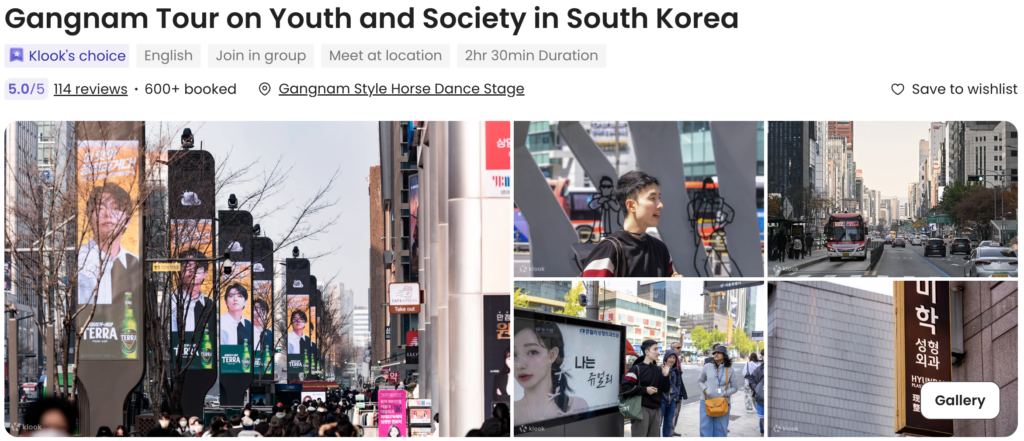
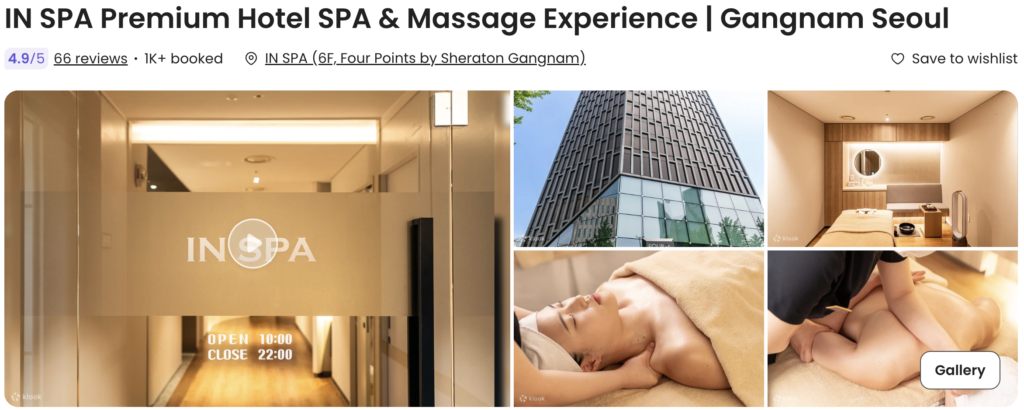
Book These Before You Go

Korea Insider has lived in South Korea for 50 years and worked at international companies for over two decades — explaining Korean culture, food, and society to colleagues from the US, Europe, and Australia.
Internationally married with a Japanese spouse, Korea Insider brings both an insider’s depth and an outsider’s perspective to every topic on My Korea Tip.