
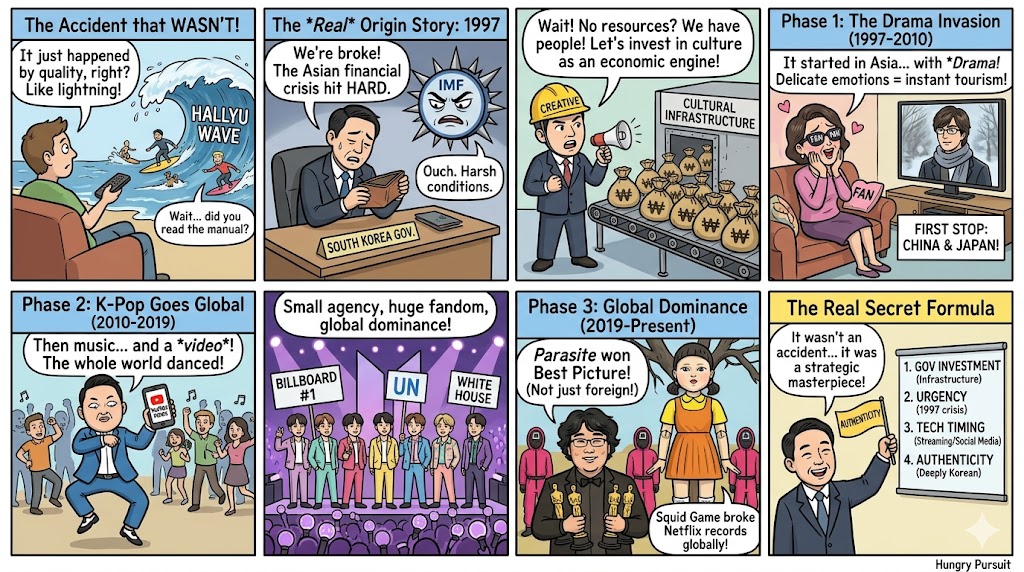
The Hallyu Wave did not happen by accident.
That framing — Korean culture going global as a natural expression of quality and creativity — misses the most interesting part of the story. The full picture is this: a country that was essentially bankrupt in 1997 made a deliberate decision to turn culture into an economic engine, invested heavily in the creative industries over two decades, and produced a string of global cultural moments — Gangnam Style, BTS, Parasite, Squid Game — that rewrote the rules of what non-English-speaking countries can achieve in global entertainment.
Hallyu (한류) is a Chinese term meaning “Korean Wave” — coined by Chinese journalists in the late 1990s to describe the sudden spread of Korean dramas and music across Asia. The irony is that the term was invented by Korea’s neighbors before Koreans had fully registered what was happening. Beginning in the 1990s and proliferating after the mainstream successes of BTS, Psy’s Gangnam Style, the acclaimed film Parasite, and Netflix’s Squid Game, Hallyu draws worldwide attention to South Korean culture and entertainment. Hungry Pursuit

This year alone, K-Pop Demon Hunters became the most-watched animated film on Netflix, the New York Times placed Parasite at the top of its “100 Best Movies of the 21st Century” list, and the Korean musical “Maybe Happy Ending” won six Tony Awards. Last year, Han Kang became the first Korean writer to receive the Nobel Prize in Literature. Dmztours
This is the complete story of how it happened — and why it matters for anyone trying to understand modern Korea.
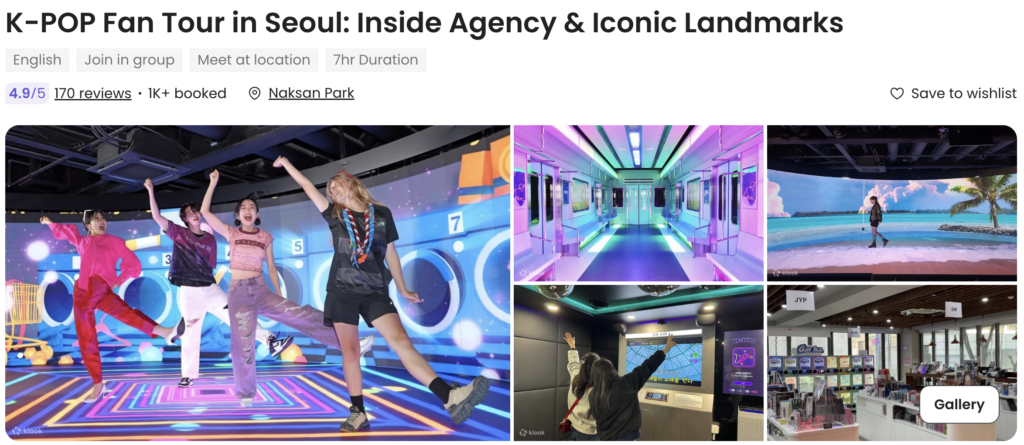
For experiencing Hallyu culture in person, read our K-Pop Experience Seoul Guide and Korean Drama Filming Locations Guide.
Hallyu Wave: Where It Started — The 1997 Crisis
The origin story of Hallyu begins not with a hit song or a viral drama but with a financial catastrophe.
In 1997, the Asian financial crisis hit South Korea harder than almost any other country. The IMF bailout came with severe conditions. Unemployment surged. Companies collapsed. The economy contracted sharply. Korea was, in the language of the time, essentially broke.
The crisis forced a strategic rethink. The South Korean government began consistently investing in and promoting the cultural sector from 1998, recognizing its potential for economic growth and national advancement. The Ministry of Culture’s budget increased dramatically. Government agencies were created specifically to support the entertainment industry. The Korean Film Council, established in 1999, provided funding and infrastructure that would eventually produce Parasite. The system that makes K-pop idols — the trainee model, the agency investment in talent development — received government support as a genuine export industry. Hungry Pursuit
The logic was straightforward: Korea had skilled people, a developed creative culture, and very little natural resources. Culture was the resource.
Hallyu Wave: Phase 1 — The Drama Invasion (1997–2010)
The first wave of Hallyu was not music. It was television.
Korean dramas began spreading through Asia in the late 1990s — first to China, then to Southeast Asia, then to the Middle East. The formula was distinct: delicate storytelling, deeply emotional themes, polished narratives and high production value. Korean dramas looked and felt different from local productions in the markets they entered. Hungry Pursuit

One of the most notable Korean TV series to achieve early and significant success was Winter Sonata in 2002. The drama — a romantic melodrama starring Bae Yong-joon and Choi Ji-woo — became a phenomenon across Asia, triggering what Japanese media called “Yonsama fever” after its lead actor’s nickname. Middle-aged women in Japan, China, and across Southeast Asia were flying to Korea to visit filming locations. The drama tourism industry — which now fills K-pop filming location tours and Gyeongbokgung visits — traces its origins to that moment. Hungry Pursuit
The drama wave established a pattern that would define Hallyu: Korean content enters a new market through emotional resonance, creates a dedicated fanbase, and then pulls consumer interest in Korean food, beauty products, fashion, and tourism behind it.
Hallyu Wave: Phase 2 — K-Pop Goes Global (2010–2019)
The second wave was music — and a YouTube video.
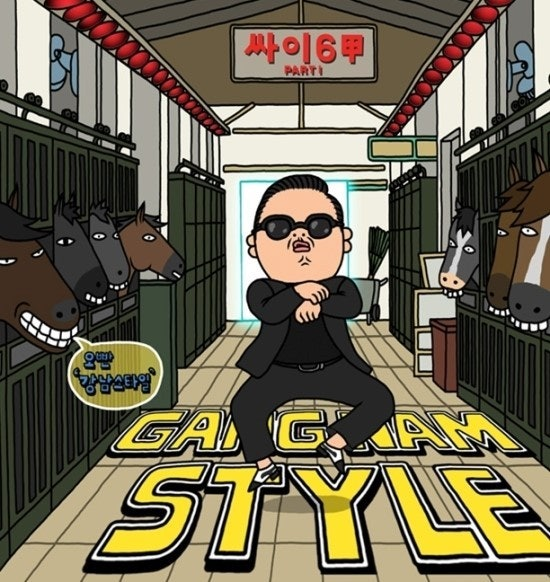
Psy’s “Gangnam Style” in 2012 was Hallyu’s first genuine global viral moment. It became the first YouTube video to reach one billion views and showed the world what could be achieved by K-pop artists creating in a non-English language. It was also, in retrospect, an outlier — a novelty hit that demonstrated global appetite for Korean content without quite predicting what would follow. Aclipse
What followed was BTS.
BTS is widely regarded as the biggest pop band of this generation. Their trajectory — from a small Korean agency to stadium tours on every continent, UN speeches, White House visits, and multiple Billboard number-ones — represents something the global music industry had not seen from a non-English-language act. The ARMY fandom they cultivated is studied in business schools for its engagement mechanics. Their impact on Korean tourism, Korean language learning, and Korean cultural interest globally is measurable in the billions. Dmztours

K-pop as a system — the trainee model, the visual production, the structured parasocial relationship between idols and fans — became globally replicated and studied during this period. For the full breakdown of how the system works, read our K-Pop Idol Training System Guide.
Hallyu Wave: Phase 3 — Global Dominance (2019–Present)
The third phase is the one we are still in — and it is categorically different from what came before.
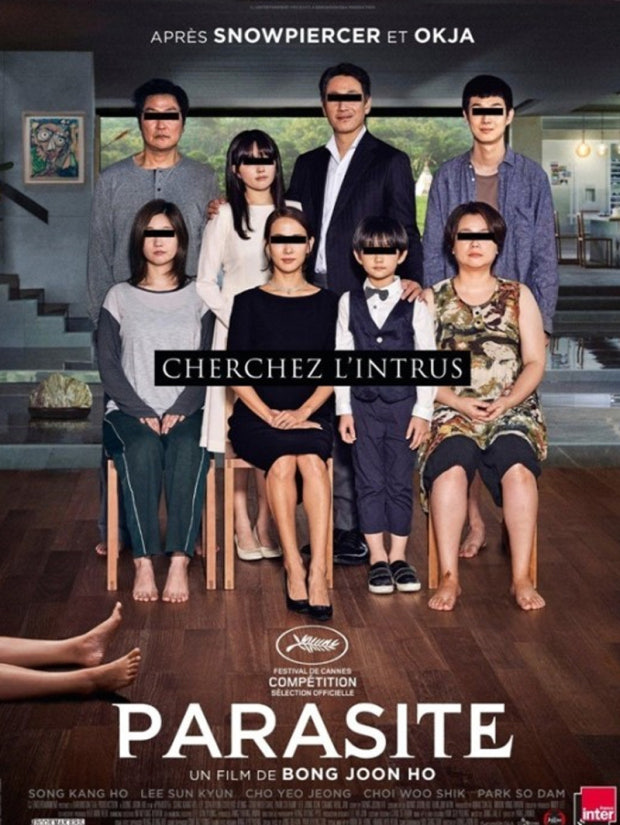
Parasite (2019) Bong Joon-ho’s class satire became the first non-English-language film to win the Academy Award for Best Picture. It won four Oscars, proof of the advancement of Hallyu in the United States. It was not a foreign-language film that crossed over — it was a masterpiece that competed directly with Hollywood on Hollywood’s terms and won. Aclipse
Squid Game (2021) Squid Game became Netflix’s most-watched series in its first 28 days, with over 111 million viewers globally. The series transcended language barriers, proving that great storytelling is universal. It remains Netflix’s most-watched series of all time. Its visual iconography — the pink-suited guards, the giant doll, the honeycomb — became instantly globally recognizable. The show generated an estimated $900 million in value for Netflix in its first month. GetYourGuide

Han Kang (2024) Han Kang became the first Korean writer to receive the Nobel Prize in Literature. The Nobel committee’s recognition of Korean literary fiction — not pop culture, not entertainment, but literature — marked Hallyu’s expansion beyond the commercial into the cultural establishment. Dmztours

Maybe Happy Ending (2025) The Korean musical “Maybe Happy Ending” won six Tony Awards, becoming the first Korean musical to achieve mainstream Broadway success. A Korean story, written in Korea, winning American theater’s highest honor. Dmztours

Hallyu Wave: The Numbers
The 2026 Overseas Hallyu Survey surveyed 27,400 people aged 15 to 59 across 30 countries — the largest and most comprehensive tracking of global consumption of Korean cultural content. VIP Travel
| 지표 | 수치 |
|---|---|
| 한국 문화콘텐츠 호감도 | 69.7% (2025년) |
| Hallyu 수출 총액 | $11.7억 (2021년) |
| 가장 선호하는 한국 드라마 | 오징어 게임 (12.4%) |
| 가장 선호하는 한국 영화 | 기생충 (8.3%) |
| 조사 국가 수 | 30개국 |
Global favorability toward Korean cultural content stood at 69.7% in 2025 — high in absolute terms, though stagnant near 70% since peaking at 77.7% in 2021. Girl on a Zebra
Squid Game holds first place as the most-preferred Korean drama at 12.4%, while Parasite retains the top spot among films at 8.3%. VIP Travel
Hallyu Wave: Why Korea? The Real Explanation
The quality argument — Korean content is good, therefore it went global — is true but incomplete. Many countries produce excellent content that never crosses borders. The full explanation has four components.
① Government investment as infrastructure South Korea has strategically used its cultural exports as an effective instrument of national power. The government has consistently invested in and promoted the cultural sector since 1998. This is not censorship or state control — it is infrastructure investment, the same way governments invest in roads. The Korean Film Council, the Korea Creative Content Agency, and dozens of other bodies fund, train, and export Korean creative work as deliberate policy. Hungry Pursuit
② The 1997 crisis created urgency The financial collapse forced Korea to find new economic engines fast. Culture was one of the answers. That urgency produced an intensity of investment and development that countries without the same pressure never matched.
③ Technology timing Korean content went global precisely as YouTube, Netflix, and streaming made non-English content accessible to Western audiences for the first time. Hallyu did not break down the language barrier — technology did, and Korean content was positioned perfectly to benefit.
④ Authenticity at scale When asked about the most important factor in recognizing content as Korean, “content reflecting Korean cultural elements” ranked first at 23.3%. Hallyu content that succeeded globally did not dilute its Korean identity to appeal to Western tastes. Parasite is a deeply Korean class satire. BTS sings about Korean experiences. Squid Game is rooted in Korean economic anxiety. The authenticity is the product. Girl on a Zebra
Hallyu Wave: What It Means For Korea Tourism
The cultural impact translates directly into visitor numbers. K-pop idols are deliberately leveraged as cultural ambassadors in international relations to foster goodwill, project a positive national image, and strengthen alliances. Hungry Pursuit
The practical result for travelers: every Hallyu entry point — a drama, a K-pop group, a Korean beauty product, a Korean dish — creates potential visitors. People who discovered Korea through BTS visit the HYBE building. People who discovered Korea through Parasite visit the filming locations. People who started making kimchi at home eventually book flights.
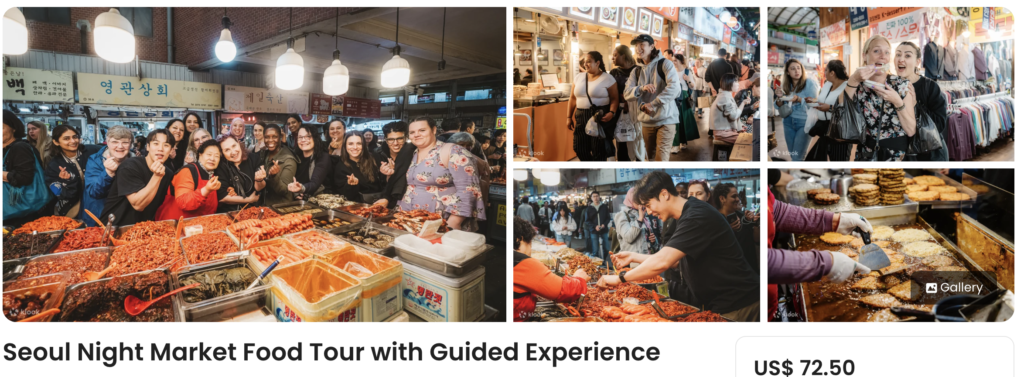
For where to experience Hallyu culture physically in Seoul, read our K-Pop Experience Seoul Guide, Korean Drama Filming Locations Guide, and Gwangjang Market Guide.
Hallyu Wave: FAQ
What does Hallyu mean? Hallyu (한류) is a Chinese term meaning “Korean Wave.” It was coined by Chinese journalists in the late 1990s to describe the spread of Korean dramas and music across Asia. It now refers to the global spread of all Korean cultural content — dramas, music, film, food, beauty, and fashion.
When did the Korean Wave start? The first wave began in the mid-to-late 1990s with Korean dramas spreading across Asia. The government investment that enabled it started after the 1997 Asian financial crisis. The global phase — reaching Western audiences at scale — began around 2012 with Gangnam Style and accelerated dramatically with BTS, Parasite, and Squid Game.
Is the Korean Wave slowing down? Global favorability toward Korean cultural content stood at 69.7% in 2025 — stagnant near 70% since peaking at 77.7% in 2021, signaling the need for new breakthrough content to sustain Hallyu’s global expansion. The wave is at a plateau, not a decline — but the easy growth phase is over. Girl on a Zebra
How much money does Hallyu generate? Direct cultural exports are measured in the billions. In 2021, total exports stimulated by the Korean Wave reached $11.696 billion. This figure includes content exports, tourism, consumer goods (beauty, food, fashion), and the broader economic ripple effects of Korean cultural interest. South Korea Hallyu
How has Hallyu affected Korean tourism? Every major Hallyu moment — a hit drama, a viral song, an award-winning film — generates measurable spikes in Korea tourism searches and bookings. The DMZ, Gyeongbokgung, and Bukchon Hanok Village all receive significant visitor traffic from people whose first exposure to Korea was through Korean cultural content.

Korea Insider has lived in South Korea for 50 years and worked at international companies for over two decades — explaining Korean culture, food, and society to colleagues from the US, Europe, and Australia.
Internationally married with a Japanese spouse, Korea Insider brings both an insider’s depth and an outsider’s perspective to every topic on My Korea Tip.