
The Korean age system is the thing that confuses every foreigner who visits Korea — and until 2023, it confused plenty of Koreans too.
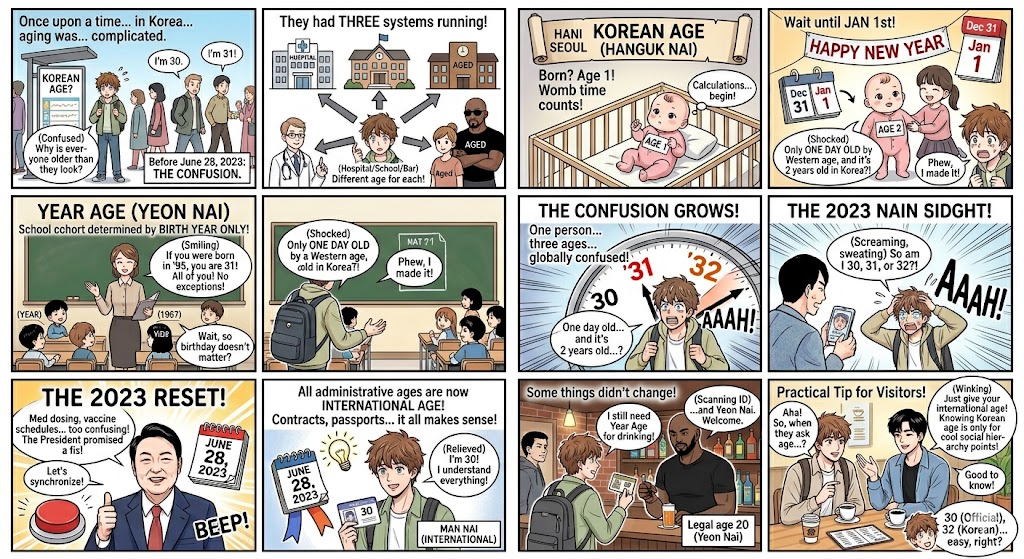
Here is the situation as it stood until June 28, 2023: South Korea was running three different age systems simultaneously. Not as quirky alternatives. As actual, in-use systems that different institutions defaulted to. A doctor would use one age for medication dosing. A school would use another for enrollment. And the person’s friends and family would use a third in conversation. The same person was simultaneously 30, 31, or 32 years old depending on who was asking. Where Goes Rose?
On June 28, 2023, every person in South Korea became one to two years younger overnight. The government standardized the country’s age-counting system to match the rest of the world. Dmztours
But here is what most articles miss: Korean age has not disappeared. The law changed how official documents record age. The way Koreans talk about age in daily conversation is another matter entirely. Understanding both — the system that existed, why it existed, and what actually changed — is one of those things that makes Korea suddenly make more sense.
For the cultural roots of why age matters so much in Korea, read our Korean Culture & Society Guide. For the social dynamics age creates in daily life, read our Korean Dating Culture Guide.
Korean Age System: The Three Systems
Korea did not just have one alternative age system. It had three running simultaneously, each used in different contexts. Klook
1. 한국 나이 (Hanguk Nai) — Korean Age
The traditional system. The one that surprises foreigners most.
In Korean age, you are born at age 1, not age 0. The logic: the nine months you spent in the womb count as the first year of your life. Then, on January 1st of every year — not your birthday — everyone in Korea turns one year older simultaneously. Where Goes Rose?
The result: a baby born on December 31 would turn two years old the very next day. By Western reckoning, that baby would be one day old. Dmztours
The formula:
Korean Age = Current Year − Birth Year + 1Example: Born in 1995, calculating in 2026:
2026 − 1995 + 1 = 32 (Korean age)
International age: 30 or 31 (depending on birthday)
2. 연 나이 (Yeon Nai) — Year Age
The middle system. Yeon nai is calculated by simply subtracting your birth year from the current year, ignoring your birthday entirely. This system was used mostly in schools, for things like determining which grade cohort you belonged to. Klook
The formula:
Year Age = Current Year − Birth YearBorn in 1995, calculating in 2026: Year age = 31 — whether your birthday has happened or not.
3. 만 나이 (Man Nai) — International Age
The system the rest of the world uses. You are 0 at birth, and you gain a year on your actual birthday. This is now the legal and social standard in Korea as of June 2023. VIP Travel
Korean Age System: Quick Comparison Table
| System | Born at | When Age Increases | Used For |
|---|---|---|---|
| Korean Age | 1 | Every January 1st | Casual conversation (still common) |
| Year Age | 0 | Every January 1st | Schools, military, drinking age |
| International Age | 0 | Your birthday | All legal/official (since 2023) |
Why Did the Korean Age System Exist?
The origins of the counting age system are not precisely known, but the most plausible hypothesis is that it’s based on Confucianism, which counts the time a baby spends in the mother’s womb as part of their life. Thegirlwithabigbag
The broader logic makes a certain cultural sense: in a society built on hierarchical relationships defined by age, having a shared annual reset point — everyone ages together on January 1st — creates a cleaner social calendar. Age in Korea is not just a number. It determines speech levels, social hierarchy, who pays at dinner, who bows first, and how relationships are structured. A system where everyone in the same birth year ages together simplifies those calculations.
Similar systems existed historically across East Asia. China, Japan, and Vietnam all abandoned them earlier — Japan officially switched decades ago. Korea held on longest, and the three-system overlap was the result of gradual modernization layered onto a traditional foundation without a clean break. Tripadvisor
Why Korea Finally Changed — The 2023 Reform
The medical confusion was particularly concerning. Age-based medication dosing, vaccination schedules, and screening thresholds could be off by up to two years if a healthcare provider mistakenly used Korean age instead of international age. Dmztours
The breaking point came during COVID-19. Inconsistent use of the two age systems created conflicts in the eligibility criteria for COVID-19 vaccines and vaccine passport rules; some residents were being deemed ineligible for vaccination, but at the same time subject to a proof of vaccination requirement for certain establishments. Tripadvisor
On December 8, 2022, South Korea’s National Assembly passed legislation to standardize age counting. The law took effect on June 28, 2023, making international age the standard for all civil and administrative purposes. Over 80% of South Koreans supported the change. Dmztours
President Yoon Suk Yeol had made the change a campaign promise — framing it as a step toward reducing Korea’s hierarchical age culture as much as a practical administrative fix.
What Actually Changed — And What Didn’t
Many legal and administrative functions — including ages listed on passports, the age at which one can be prosecuted as a juvenile, and those to qualify for retirement benefits and healthcare services — already used actual dates of birth rather than the Korean system. The 2023 law standardized what was already the practice in formal contexts. Korea Experience
What changed:
- All government documents now use international age exclusively
- Medical and insurance contexts use international age
- Legal age references (contracts, civil matters) use international age
What didn’t change:
- School year eligibility still groups children by birth year rather than exact birthday Dmztours
- Military service age still uses year age
- Legal drinking and smoking age (20 in year age) retained the year-age system
What definitely didn’t change: Everyday conversation. Korean age still dominates casual social interaction, introductions, and the dynamics of daily conversation. The law changed paperwork. It did not change how Koreans think about age when they meet someone new. Where Goes Rose?
How to Calculate Your Korean Age (The Fast Way)
Even though Korean age is no longer official, you will encounter it — and knowing your own Korean age is a genuine social asset in Korea.
If your birthday HAS passed this year:
Korean Age = International Age + 1If your birthday HAS NOT passed this year:
Korean Age = International Age + 2Universal shortcut:
Korean Age = Current Year − Birth Year + 1Korean Age System: What This Means When You Visit Korea
Someone asks your age. This still happens — quickly, often, and without the social awkwardness it would carry in Western contexts. It’s not personal. Knowing your relative ages helps Koreans calibrate the speech level and formality level appropriate for the relationship. Age determines a lot about how two people interact, so knowing it early saves awkwardness later. Where Goes Rose?
Give your international age. Since the 2023 reform, giving your international age is perfectly fine and increasingly expected. But if an older Korean person seems surprised you are “so young,” they may be mentally adding a year or two using the traditional system. Where Goes Rose?
If you don’t want to answer. Koreans understand, especially younger Koreans used to internationals finding the question surprising. A simple 비슷해요 (biseutae-yo — “about the same as you”) works if you’re in the ballpark. Where Goes Rose?
The hierarchy angle. In South Korea, it’s very common for someone to assert superiority in a social hierarchy according to their age. Being even one year older than someone establishes a seniority relationship. This is why the question gets asked so quickly — it is genuinely logistical information rather than nosiness. Korea Experience
Korean Age System: FAQ
Is Korean age still used in 2026? Yes — in casual conversation. The 2023 law changed official documents and legal contexts to international age, but Korean age remains common in introductions, social settings, and everyday conversation, particularly among older Koreans.
How do I calculate my Korean age? Subtract your birth year from the current year, then add 1. Example: born in 1995, calculating in 2026 — 2026 minus 1995 plus 1 equals 32. If your birthday hasn’t passed yet this year, your Korean age is your international age plus 2. If it has, it’s plus 1.
Why do Koreans ask your age so quickly? It’s logistical, not intrusive. Korean social interaction is structured around age hierarchy — speech levels, who pays, who defers to whom — so knowing someone’s age early allows both people to calibrate the relationship correctly. It is the equivalent of exchanging job titles in a Western professional context.
Did the 2023 change affect everything? No. Schools, military service, and the legal drinking and smoking age still use the year-age system (birth year minus current year). Only legal and administrative contexts switched fully to international age.
What’s the difference between Korean age and year age? Both add a year on January 1st rather than your birthday. The difference: Korean age starts at 1 at birth, year age starts at 0. Year age is essentially Korean age minus 1, and was used for legal thresholds like school enrollment and the drinking age.

Korea Insider has lived in South Korea for 50 years and worked at international companies for over two decades — explaining Korean culture, food, and society to colleagues from the US, Europe, and Australia.
Internationally married with a Japanese spouse, Korea Insider brings both an insider’s depth and an outsider’s perspective to every topic on My Korea Tip.