
There’s a particular feeling that happens about forty-eight hours into a first trip to Korea — the moment when the initial disorientation gives way to the realization that this country works at a level of efficiency and convenience that most of the world hasn’t caught up to yet. The subway is faster and cleaner than anything you’ve ridden. The convenience stores are open at 3 AM with hot food that’s genuinely good. The streets are safe enough to walk alone at midnight. And everywhere, people are going about their lives with the particular purposeful energy that characterizes Korean cities.
Getting to that feeling, however, requires navigating an arrival process that can be confusing if you’re not prepared. This Korea travel tips guide covers everything first-time visitors need — before the flight, at the airport, and throughout your trip — to skip the costly rookie mistakes and get to the good parts faster.
Before your trip, read our Korea Travel Budget Guide to understand exactly what Korea will cost day-to-day — it’s more affordable than most first-timers expect.
Korea Travel Tips: Before You Leave Home
Visa requirements
Citizens of the United States, United Kingdom, Canada, Australia, and most EU countries do not need a visa for stays under 90 days. You will need to register with the K-ETA (Korea Electronic Travel Authorization) system before arrival — this is a quick online process costing approximately $10 USD and takes 72 hours to process. Do not skip this step; airlines may deny boarding without it.
Check the official K-ETA website at k-eta.go.kr for the most current requirements, as policy changes periodically.
Download these apps before you land
| App | What It Does | Why You Need It |
|---|---|---|
| Naver Maps | Korean navigation | Google Maps is unreliable for Korean addresses |
| Kakao T | Taxi booking | Most reliable English-language taxi app |
| Papago | Translation | Better than Google Translate for Korean |
| KakaoTalk | Messaging | How Koreans communicate; restaurants use it for reservations |
| Coupang Eats | Food delivery | If you’re staying in an apartment |
Download these on home WiFi — your data situation at arrival is uncertain until you sort your SIM card.
Notify your bank
Korean ATMs reliably accept foreign cards, but many banks block international transactions by default. Call your bank before departure or enable international transactions via your banking app.
Korea Travel Tips: Arriving at Incheon Airport
Incheon International Airport (ICN) is consistently ranked among the world’s best airports — and it shows. The facility is enormous, clean, and extraordinarily well-organized. The arrival process, however, has several steps that catch first-timers off guard.
Step 1: Immigration
Follow signs to Immigration. You will need:
- Passport
- Completed arrival card (paper forms available on the plane; electronic entry available via the dedicated kiosks)
- Address of your first night’s accommodation (have it written down or screenshot it)
Lines move quickly. Processing time is typically 10–20 minutes.
Step 2: Get your SIM card or pocket WiFi
Immediately after customs, before you do anything else, sort your data. Two options:
Local SIM card: Available from KT, SK Telecom, and LG U+ counters in Arrival Hall 1 and 2. A 30-day data SIM costs approximately ₩33,000–₩55,000 ($25–$42). This is the most cost-effective option for stays over a week.
Pocket WiFi: Available at the same counters and via Klook pre-booking. Better for groups sharing data; less convenient for individual use.
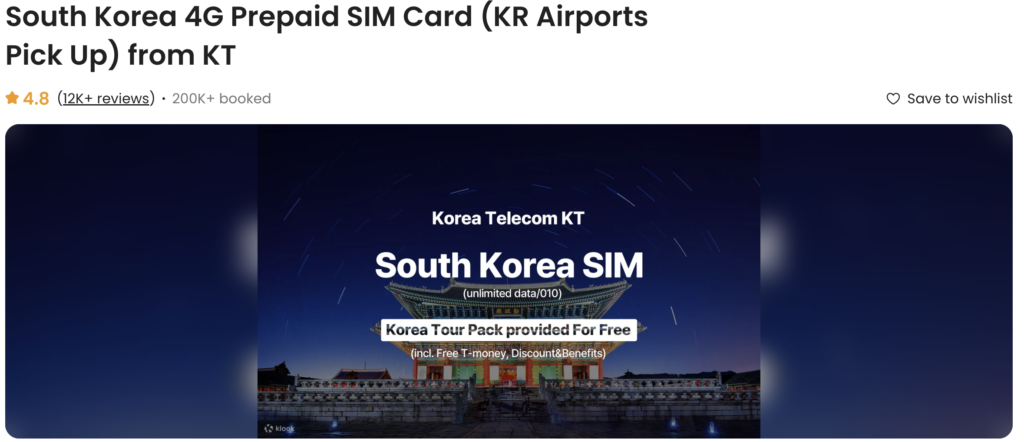
Pre-booking your SIM or pocket WiFi on Klook before departure saves time at the airport and often costs less.
Pre-booking your Korea SIM card or pocket WiFi on Klook before departure guarantees availability on arrival and typically costs 10–15% less than airport counter prices. Options include unlimited data SIMs, pocket WiFi rental, and airport pickup packages.
Step 3: Get cash
Korea is increasingly cashless, but smaller restaurants, markets, and temples still require cash. ATMs at Incheon accept foreign cards reliably — use the Global ATM near the exit, not the exchange booths (their rates are poor).
Withdraw ₩200,000–₩300,000 for your first few days.
Step 4: Get your T-Money card
The T-Money card is a rechargeable transit card used on subways, buses, and taxis across Korea. Available at GS25 and CU convenience stores throughout the airport (and everywhere in Korea) for ₩4,000. Load ₩30,000–₩50,000 initially.
This single card will handle most of your transit for the entire trip. Read our Seoul Subway Guide for complete T-Money guidance.
Korea Travel Tips: Getting Around Korea
Seoul subway
The Seoul Metro is one of the best urban transit systems in the world — 23 lines covering the entire metropolitan area with trains running every 2–5 minutes from approximately 5:30 AM to midnight. Signage is in Korean and English throughout. The system is intuitive enough that most first-timers figure it out within a single day.
Download Naver Maps or Seoul Metro App for real-time navigation — both provide English-language turn-by-turn subway directions.
KTX high-speed train
For travel outside Seoul — Busan, Gyeongju, Jeonju, Gangneung — the KTX is the definitive Korea travel tip: faster than driving, dramatically more comfortable than buses, and priced reasonably enough to make sense for most distances.
| Route | KTX Travel Time | Approximate Cost |
|---|---|---|
| Seoul → Busan | 2h 15min | ₩59,800 |
| Seoul → Gyeongju | 2h 00min | ₩52,700 |
| Seoul → Jeonju | 1h 10min | ₩21,100 |
| Seoul → Gangneung | 1h 50min | ₩27,600 |
Book through Korail’s website (letskorail.com) or via the Korail app. Seats sell out on major holidays — book at least 2 weeks ahead.
Taxis
Korean taxis are safe, relatively affordable, and available everywhere. The biggest challenge for first-timers is communication — most drivers speak minimal English.
Use Kakao T app to book taxis with destination entered in Korean text (Papago can translate your destination) — this eliminates the language barrier entirely. Standard taxis start at ₩4,800 for the first 1.6km.
Korea Travel Tips: Money and Payments
Korea is rapidly going cashless — most restaurants, cafes, and shops accept Visa and Mastercard with no issues. However, these Korea travel tips around payment will save you repeatedly:
- Smaller restaurants and pojangmacha (street food tents) often require cash. Always have ₩30,000–₩50,000 on hand.
- ATM fees are low. Most Korean ATMs charge ₩1,000–₩2,000 per international withdrawal — far less than currency exchange booths.
- Tipping is not practiced in Korea. Do not tip at restaurants, taxis, or hotels — it creates confusion and is not expected.
- Tax refund is available. Purchases over ₩30,000 at stores displaying “Tax Free” signage qualify for a VAT refund of up to 10% at the airport departure terminal.
Korea Travel Tips: Etiquette and Cultural Rules
Korea has a distinct set of social norms that are worth understanding before arrival — not because violations result in anything severe, but because awareness creates dramatically better interactions.
Things that will make you look respectful:
- Use two hands (or right hand with left hand supporting the right forearm) when receiving objects, business cards, or drinks
- Remove shoes when entering a Korean home — always. And many traditional restaurants.
- Bow slightly when greeting — especially to older people
- Wait for the eldest person at a table to begin eating before you start
Things that will make you look like a tourist who did their research:
- Pour drinks for others before filling your own glass
- Pass and receive food with both hands
- Say “잘 먹겠습니다” (jal meok-gesseum-ni-da — “I will eat well”) before meals
- Don’t stick chopsticks upright in rice — this resembles a funeral ritual
Things that genuinely don’t matter:
- Speaking loudly in public — Koreans do it too, especially in busy areas
- Taking photos in most public spaces — it’s expected and fine
- Eating while walking in tourist areas — less frowned upon than in traditional contexts
Korea Travel Tips: Safety and Practicalities
Safety: Korea is one of the safest countries in the world for travelers. Violent crime against tourists is extraordinarily rare. Solo female travelers consistently rate Korea among their safest destinations in Asia. Standard urban awareness applies — watch your belongings in crowded markets — but Korea requires significantly less vigilance than most comparable destinations.
Emergency numbers:
- Police: 112
- Fire/ambulance: 119
- Tourist helpline (English): 1330 (operates 24 hours, 365 days)
The 1330 tourist helpline is one of Korea’s most useful services for first-timers — English-speaking operators help with directions, translation emergencies, and general queries at any hour.
Healthcare: Korea has excellent medical facilities and very affordable healthcare costs. A clinic visit typically costs ₩10,000–₩30,000 without insurance. Pharmacies (약국) are on virtually every block and pharmacists can recommend treatment for minor ailments without a prescription.
Weather and packing: Korea has four distinct seasons with significant temperature variation.
| Season | Months | What to Pack |
|---|---|---|
| Spring | March–May | Light layers; umbrella for rain |
| Summer | June–August | Light clothing; rain jacket for monsoon |
| Autumn | September–November | Layers; this is the best season |
| Winter | December–February | Serious cold weather gear |
Read our Best Time to Visit Korea Guide for complete seasonal guidance.
Korea Travel Tips: What Surprises First-Timers Most
Travelers who’ve done their Korea research consistently report the same surprises:
The convenience stores are extraordinary. GS25, CU, and 7-Eleven in Korea operate at a level entirely different from their Western equivalents — hot food, drinkable coffee, ATMs, printing services, phone charging, and seating areas. Many first-timers end up eating at convenience stores not out of necessity but because the food is genuinely good and inexpensive.
Free public WiFi is everywhere. Subways, buses, tourist sites, and most indoor public spaces have free WiFi — though speeds vary. A SIM card is still worth having.
Restaurants don’t bring the bill until you ask. Hovering waitstaff and preemptive check-dropping don’t happen in Korea. When you’re ready to pay, say “계산해 주세요” (gyesan hae juseyo) or find the dedicated cashier counter — many Korean restaurants pay at the counter rather than the table.
The hiking culture is serious. Koreans hike with the dedication most cultures reserve for professional sports. If you join a trail near Seoul on a weekend morning, you will be overtaken by seventy-year-olds in full technical gear moving at a pace that should be physiologically impossible.
Korea Travel Tips: Essential Korean Phrases
You don’t need Korean to travel in Korea — English is widely available in Seoul tourist areas. But these phrases produce visible appreciation from locals and make dozens of daily interactions smoother:
| Situation | Korean | Pronunciation |
|---|---|---|
| Hello / Hi | 안녕하세요 | An-nyeong-ha-se-yo |
| Thank you | 감사합니다 | Gam-sa-ham-ni-da |
| Excuse me | 저기요 | Jeo-gi-yo |
| How much is this? | 얼마예요? | Eol-ma-ye-yo? |
| Where is the bathroom? | 화장실 어디예요? | Hwa-jang-sil eo-di-ye-yo? |
| Do you have an English menu? | 영어 메뉴 있어요? | Yeong-eo me-nyu i-sseo-yo? |
| Delicious! | 맛있어요! | Ma-si-sseo-yo! |
| Check, please | 계산해 주세요 | Gye-san hae ju-se-yo |
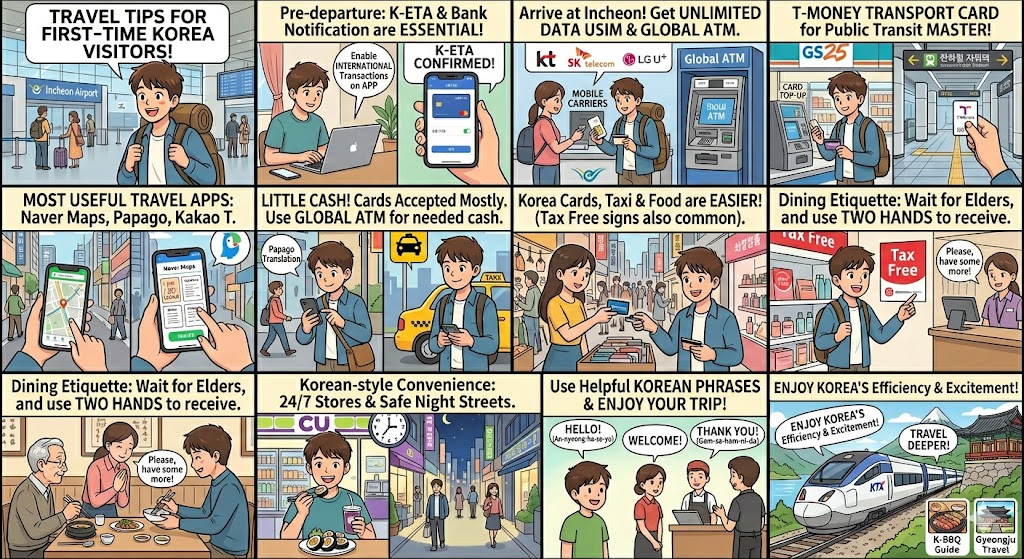
Ready to go deeper? Read our Seoul 3-Day Itinerary to plan your first days, our Korean BBQ Guide for your first essential dining experience, and our Gyeongju Travel Guide if you want to add Korea’s most historically extraordinary city to your itinerary.

Korea Insider has lived in South Korea for 50 years and worked at international companies for over two decades — explaining Korean culture, food, and society to colleagues from the US, Europe, and Australia.
Internationally married with a Japanese spouse, Korea Insider brings both an insider’s depth and an outsider’s perspective to every topic on My Korea Tip.