
The Korean education system is one of the most intense, most competitive, and most misunderstood educational environments in the world.
South Korea consistently ranks among the top nations in global education rankings — PISA scores, university graduation rates, and literacy levels are all world-class. But the Korean education system achieves these results at a cost that shocks virtually every foreigner who learns about it.
These 10 facts about the Korean education system will make you rethink everything you thought you knew about school, studying, and childhood.
Before understanding the Korean education system, read our Korean Work Culture Guide — the intensity of the Korean education system directly produces the intense Korean work culture that foreigners find so surprising.
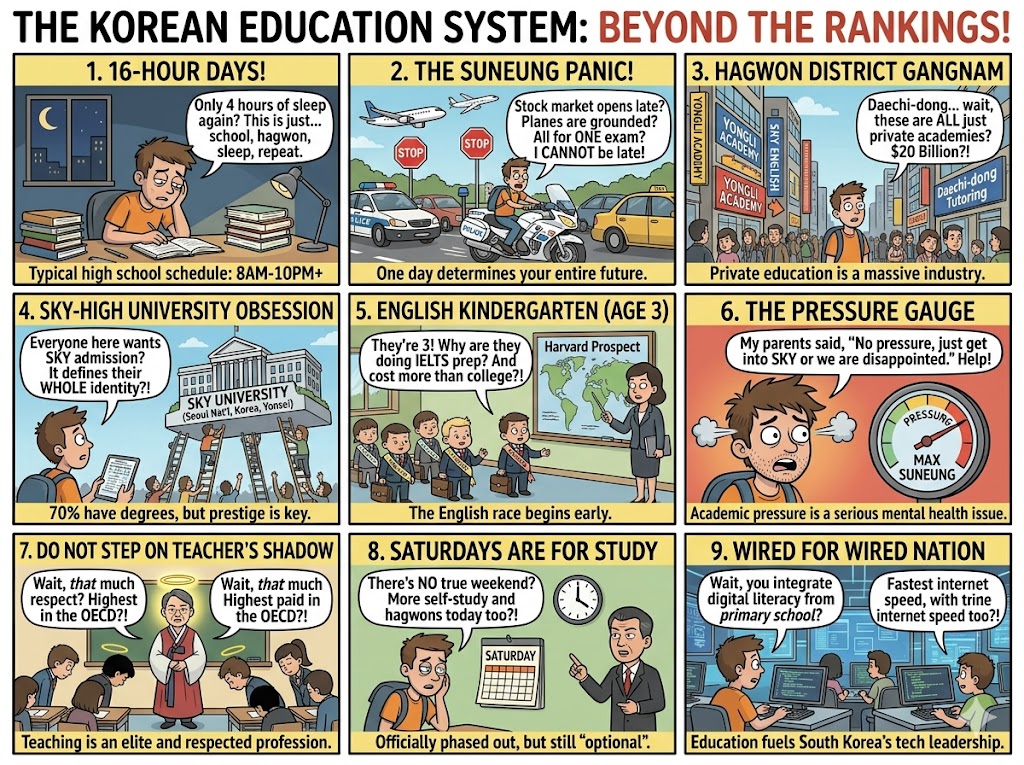
Korean Education System Fact #1 — Korean Students Study Up to 16 Hours Per Day
The single most shocking fact about the Korean education system: Korean high school students regularly study 14–16 hours per day during exam preparation periods.
A typical Korean high school student’s day in the Korean education system looks like this: school from 8 AM to 4 PM, hagwon (private academy) from 5 PM to 10 PM, then self-study until midnight or later. This schedule is not exceptional in the Korean education system — it is the norm for students aiming for top universities.
Korean education system students sleep an average of 5–6 hours per night during peak study periods — significantly below the medically recommended 8–9 hours for teenagers. The physical and psychological toll of the Korean education system’s demands on young people is one of the most debated aspects of Korean society.
Korean Education System Fact #2 — The Suneung Is the Most Stressful Exam in the World
The Korean education system culminates in a single exam that determines the entire trajectory of a student’s life: the 수능 (Suneung) — the College Scholastic Ability Test.
The Suneung is taken once per year on a single day in November. Students in the Korean education system get one chance — one day — to demonstrate everything they’ve spent 12 years preparing for. The exam lasts approximately 8 hours across multiple subjects.
Korean education system Suneung day is treated as a national event. The government reschedules flight paths to avoid noise over exam centers. Police escort late students to testing venues. Stock markets open late. Construction stops near testing centers. The entire country pauses for the Korean education system’s defining moment.
Students who perform poorly on the Korean education system’s Suneung frequently take an entire additional year — called a “repeater year” (재수) — to resit the exam. Approximately 20–30% of Suneung takers in the Korean education system are repeating students, not fresh graduates.
Korean Education System Fact #3 — Hagwons Are a $20 Billion Industry
The Korean education system has spawned one of the most remarkable private education industries in the world: hagwons (학원) — private tutoring academies that Korean students attend after regular school hours.
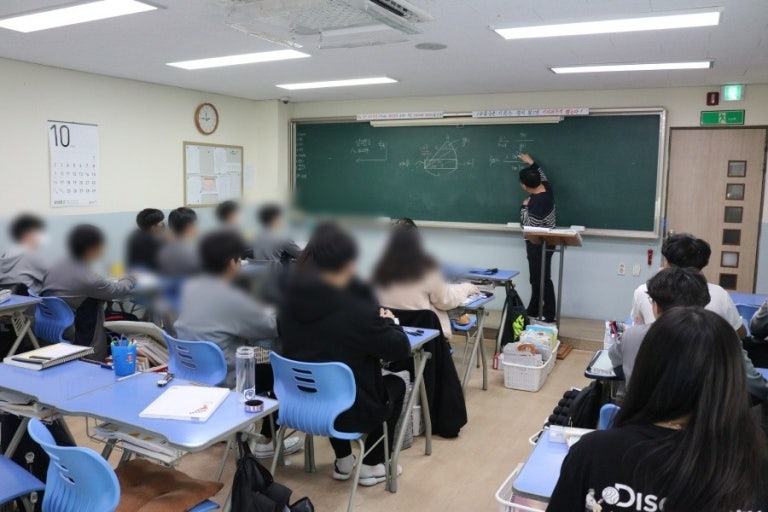
Hagwons in the Korean education system cover every subject imaginable — mathematics, English, science, music, art, coding, and even physical education. Korean families spend an average of ₩300,000–₩1,000,000+ per month per child on hagwons within the Korean education system.
The Korean education system’s hagwon industry generates approximately $20 billion annually — larger than the GDP of many small countries. Hagwons are so central to the Korean education system that the Daechi-dong neighborhood in Gangnam has become globally known as “Korea’s tutoring district” — a single neighborhood with hundreds of hagwons packed into a few city blocks.
The Korean education system’s reliance on hagwons creates a significant equity problem — wealthy families can afford better hagwons, better tutors, and more Korean education system support. The Korean government has repeatedly attempted to regulate hagwon hours — at various points banning hagwons from operating after 10 PM — with limited success.
Read our Cost of Living in Seoul Guide for the full financial picture of raising children within the Korean education system.
Korean Education System Fact #4 — South Korea Has One of the World’s Highest University Graduation Rates
Despite — or perhaps because of — its intensity, the Korean education system produces extraordinary results. South Korea has one of the highest tertiary education completion rates in the OECD — approximately 70% of young South Koreans hold university degrees.
The Korean education system’s university obsession is cultural as much as economic. In Korean society, a university degree — and specifically the university’s prestige ranking — determines social status, marriage prospects, and career trajectory in ways that go far beyond what most Western societies experience.
The Korean education system’s top three universities — Seoul National University, Korea University, and Yonsei University — collectively known as “SKY” — are so prestigious that admission to a SKY school can define a person’s entire social identity for life. Parents in the Korean education system invest everything in pursuit of SKY admission for their children.
Korean Education System Fact #5 — English Education Starts Before Age 5
The Korean education system’s obsession with English begins extraordinarily early. English is introduced in Korean public schools from third grade — but Korean education system families typically begin English education at age 3–4 through private hagwons.
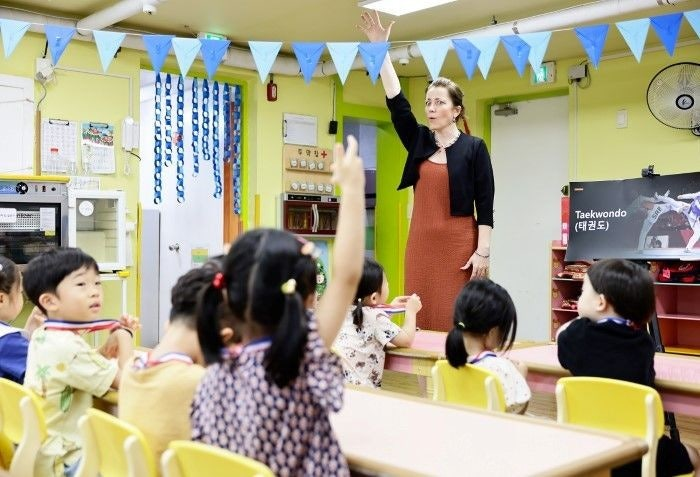
“English kindergartens” — private Korean education system institutions conducted entirely in English — cost ₩1,000,000–₩3,000,000 per month and have waiting lists years long. Admission to the most prestigious English kindergartens in the Korean education system is itself competitive.
The Korean education system’s English obsession has created a unique cultural phenomenon: “early study abroad” (조기유학) — Korean families sending children as young as 8–10 years old to English-speaking countries for education, often with the mother accompanying the child while the father remains in Korea working. These “goose families” (기러기 가족) — named for birds that fly long distances — are a distinctly Korean education system phenomenon.
Korean Education System Fact #6 — South Korea’s Youth Suicide Rate Is Linked to Academic Pressure
Among the most sobering Korean education system facts: South Korea has one of the highest youth suicide rates among OECD countries, and academic pressure within the Korean education system is consistently identified as a primary contributing factor.
Studies of Korean education system students show extremely high rates of anxiety, depression, and burnout — concentrated most heavily in the years leading up to the Suneung. The Korean education system’s stakes are so high and so concentrated in a single exam that the psychological cost on students is measurable and documented.
Korean society is increasingly aware of this Korean education system problem — public debate about reforming the Suneung and reducing Korean education system pressure is ongoing. But structural reform of the Korean education system remains challenging because the underlying social values that created it — hierarchy, credential-based status, collective competition — have not fundamentally changed.
Korean Education System Fact #7 — Korean Teachers Are Among the Most Respected and Highest-Paid in the World
The Korean education system’s intensity extends to its educators. Teaching is one of the most respected professions in Korean society — a direct reflection of the Korean education system’s Confucian heritage, which places teachers in a position of profound social authority.
Korean education system teachers earn salaries competitive with engineers and lawyers. Entry into the Korean education system teaching profession is itself highly competitive — primary school teaching positions require passing a national exam with acceptance rates sometimes below 5%.
The Korean education system teacher’s social status is captured in the traditional Korean saying: “Do not step on a teacher’s shadow” — a reflection of the deep respect Korean culture places on educators.
Korean Education System Fact #8 — Korean Children Attend School on Saturdays
The Korean education system has historically required Saturday attendance — and while official mandatory Saturday school was phased out in public schools between 2005–2012, the Korean education system’s Saturday presence remains through hagwons, self-study programs, and optional school programs.
Korean education system students effectively have no true weekend. Saturday is a study day in the Korean education system — either at school, hagwon, or self-directed study. Sunday provides minimal rest before the Korean education system cycle begins again Monday.
This Korean education system schedule — combined with the 16-hour study days during exam periods — creates a childhood experience dramatically different from what most Western children experience.
Korean Education System Fact #9 — The Korean Education System Has Created the World’s Most Wired Country
The Korean education system’s emphasis on technology — particularly coding and digital literacy — has contributed to South Korea becoming the world’s most digitally connected country.
South Korea has the world’s fastest average internet speeds and near-universal broadband access. The Korean education system integrates digital technology earlier and more comprehensively than almost any other national education system.
The Korean education system’s technology focus reflects a national strategic decision: Korea’s economic competitiveness depends on technological leadership, and the Korean education system is the primary vehicle for producing that leadership.
For the digital infrastructure that the Korean education system helped build, explore Seoul’s subway system — a monument to Korean engineering and technology that the Korean education system’s graduates designed and built.
Korean Education System Fact #10 — Korean Parents Sacrifice Everything for Education
The final and perhaps most humanly significant Korean education system fact: Korean parents — particularly Korean mothers — sacrifice enormous amounts of time, money, and personal ambition for their children’s Korean education system success.
The term “education fever” (교육열, gyoyung-yeol) describes the Korean cultural phenomenon of parents treating their children’s Korean education system success as the primary purpose of family life. Korean families move to specific neighborhoods — particularly Gangnam — specifically for access to better Korean education system resources and hagwons.
Korean mothers who dedicate their lives to managing their children’s Korean education system trajectory are sometimes called “helicopter parents” or more specifically “education managers.” Choosing the right hagwon sequence, tracking Korean education system exam scores, networking with other Korean education system parents — these activities consume enormous portions of Korean mothers’ lives.
This Korean education system parental sacrifice reflects the broader Korean belief that education is the most reliable path to social mobility — and that no sacrifice for a child’s Korean education system success is too great.
The Korean Education System: Is It Worth It?
The Korean education system produces extraordinary outcomes — world-class universities, a highly educated workforce, and an economy that transformed from war-devastated poverty to global technological leadership in a single generation.
But the Korean education system extracts an enormous human cost — lost childhoods, psychological pressure, family financial strain, and a youth mental health crisis that Korean society is only beginning to seriously address.
The Korean education system debate — between those who see it as the engine of Korean success and those who see it as a source of suffering — reflects a deeper Korean social conversation about what success means and what price is acceptable to pay for it.
For more on Korean social culture, read our guides on Korean Work Culture and Korean Blood Type Personality — the same social pressures that drive the Korean education system shape every aspect of Korean life.
Visiting Korea? Start with our Incheon Airport to Seoul Guide and Seoul Subway Guide to navigate the country that built this remarkable education system.

Korea Insider has lived in South Korea for 50 years and worked at international companies for over two decades — explaining Korean culture, food, and society to colleagues from the US, Europe, and Australia.
Internationally married with a Japanese spouse, Korea Insider brings both an insider’s depth and an outsider’s perspective to every topic on My Korea Tip.