
Korean superstitions are some of the most fascinating, most bizarre, and most culturally revealing beliefs you’ll encounter anywhere in the world.
Some Korean superstitions are rooted in ancient Confucian philosophy. Some come from shamanic traditions thousands of years old. Some are so deeply embedded in Korean daily life that most Koreans follow them without even thinking about why.
This guide covers 15 Korean superstitions that will genuinely shock foreigners — and explain what they reveal about Korean culture, history, and psychology.
Why Korean Superstitions Are Worth Understanding
Korean superstitions are not just quirky folklore. Korean superstitions reveal the deep cultural values, historical anxieties, and philosophical frameworks that shape Korean society.
Understanding Korean superstitions gives you insight into Korean attitudes toward death, luck, fate, and social harmony that no textbook explanation can fully capture. Korean superstitions are also practically useful — knowing them prevents you from accidentally offending Korean hosts, colleagues, or friends.
Before diving into Korean superstitions, understand the broader cultural context in our Korean Age Culture Guide — many Korean superstitions are rooted in the same Confucian respect system that governs Korean social life.
1. Never Write Someone’s Name in Red Ink
This is the most widely known of all Korean superstitions — and the one most likely to cause genuine offense if you violate it unknowingly.
Writing a living person’s name in red ink in Korean superstitions tradition means you are wishing that person dead. Red ink was historically used to write the names of the deceased in death registries and ancestral records. Writing a living person’s name in red replicates this death record — and is considered deeply inauspicious.
Korean superstitions around red ink are so strong that many Korean students refuse to write their own names in red pen during exams. Teachers avoid red ink when writing student names. Sending a birthday card with a name written in red is considered one of the worst social errors you can make in Korean superstitions culture.
Practical tip: If you’re writing a Korean person’s name — on a gift tag, a card, or anywhere — use any color except red.
2. The Number 4 Is the Korean Superstitions Version of 13
In Western superstitions, 13 is the unlucky number. In Korean superstitions, 4 is far more feared.
The Korean word for four (사, sa) sounds identical to the Korean word for death (死, also sa). This phonetic coincidence has made 4 one of the most powerful Korean superstitions in daily life.
Korean superstitions around the number 4 are so pervasive that they affect architecture and infrastructure. Many Korean buildings skip the 4th floor entirely — elevator buttons jump from 3 to 5, or label the 4th floor as “F” (for “fourth”). Hospitals are particularly strict about Korean superstitions around 4 — patient room numbers, ward numbers, and floor numbers routinely avoid 4.
Gift sets in Korea rarely come in sets of four because of Korean superstitions. Giving someone a set of four items — four cups, four candles, four anything — is considered bad luck.
Practical tip: When buying gifts in Korea, avoid sets of four. Sets of three, five, or seven are considered lucky in Korean superstitions tradition.
3. Shaking Your Leg Means Luck Will Escape
Korean superstitions hold that shaking or bouncing your leg while sitting causes good luck and prosperity to “shake out” of your body.
This Korean superstition likely has practical origins — leg shaking was associated with nervous or anxious people, and nervousness with poverty or instability. Over time it evolved into a Korean superstition with direct cause-and-effect implications for fortune.
Korean parents routinely tell children to stop shaking their legs based on this Korean superstition. It remains one of the most commonly observed Korean superstitions in daily life.
4. Fan Death — The Most Famous Korean Superstition
Fan death is arguably the most internationally famous of all Korean superstitions — and the one that generates the most disbelief among foreigners.
Korean superstitions around fan death hold that sleeping in a closed room with an electric fan running can cause death. Explanations offered within Korean superstitions tradition include the fan creating a vortex that consumes all oxygen, the fan causing hypothermia, or the fan creating a wind that somehow suffocates the sleeper.
Fan death Korean superstitions are so persistent that many Korean fans come with built-in timers — designed to shut off automatically so users don’t sleep with fans running all night. Korean news outlets have historically reported deaths as potentially caused by fan death.
Scientists and physicians consistently confirm that fan death Korean superstitions have no physical basis whatsoever. No mechanism exists by which an electric fan could cause death in a normal room. Yet Korean superstitions around fan death persist across generations and education levels.
5. Whistling at Night Attracts Ghosts and Snakes
Korean superstitions hold that whistling after dark attracts ghosts, evil spirits, and snakes to your location.
This Korean superstition likely has practical ancient origins — in rural Korea, farmers and villagers used specific whistles to communicate in the dark. Random nighttime whistling could attract unwanted animals or confuse people. Over time the practical concern became a Korean superstition involving supernatural consequences.
Korean superstitions around nighttime whistling are taken seriously enough that many Koreans genuinely feel uncomfortable when they hear whistling after dark — a visceral, reflexive response built by childhood exposure to this Korean superstition.
6. Stepping on Someone’s Shadow Brings Bad Luck
Korean superstitions consider stepping on another person’s shadow deeply disrespectful and potentially harmful to that person.
In Korean superstitions tradition, a person’s shadow is an extension of their soul or spiritual essence. Stepping on it is equivalent to stepping on the person themselves — disrespectful and spiritually damaging.
This Korean superstition reflects the broader Korean spiritual tradition of animism — the belief that humans have spiritual presences that extend beyond their physical bodies. Many Korean superstitions share this underlying assumption.
7. Dreaming of Pigs Means Money Is Coming
Not all Korean superstitions predict misfortune. Korean superstitions around pigs are among the most positive in Korean superstitions tradition.

Dreaming of pigs — especially fat, healthy pigs — is considered one of the luckiest omens in Korean superstitions. A pig dream is so auspicious in Korean superstitions that many Koreans immediately buy lottery tickets after dreaming of pigs.
Korean superstitions connect pigs with wealth and abundance because pigs were historically a sign of agricultural prosperity. Fat pigs meant a successful harvest, enough food, and family security. These practical associations became Korean superstitions over centuries.
Pig imagery appears throughout Korean superstitions lucky charm culture — pig figurines, pig piggy banks, and pig motifs are common good luck symbols rooted in Korean superstitions tradition.
8. Don’t Clip Your Nails at Night
Korean superstitions hold that cutting fingernails or toenails after dark invites ghosts and evil spirits into the home.
The practical origin of this Korean superstition is straightforward — before electric lighting, clipping nails after dark meant nail clippings might be lost in the darkness. Rats would eat the nail clippings, and Korean superstitions held that rats that consumed human nail clippings could transform into demons capable of assuming the human’s appearance.
The practical nail-clipping concern evolved into a Korean superstition about supernatural invasion. While the rat-demon explanation sounds fantastical, Korean superstitions around nighttime nail clipping remain genuinely observed by many Koreans today.
9. Eating Miyeok-Guk on Your Birthday Is Non-Negotiable
Korean superstitions and traditions around birthday food are among the most strictly observed.
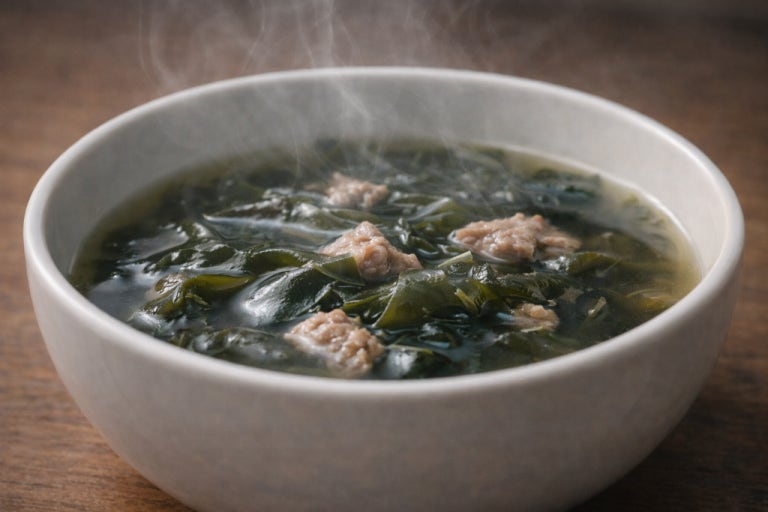
Miyeok-guk (미역국) — seaweed soup — is the non-negotiable birthday food in Korean superstitions tradition. Korean mothers eat miyeok-guk after childbirth for its nutritional properties (seaweed is rich in iodine and minerals essential for postpartum recovery). The child then eats miyeok-guk on every birthday thereafter in a symbolic connection to birth and maternal love.
Not eating miyeok-guk on your birthday in Korean superstitions tradition is considered bad luck for the coming year. Korean superstitions are so firm on this point that Koreans living abroad make genuine efforts to find seaweed soup on their birthdays.
10. Gifting Shoes Means the Recipient Will Walk Away From You
Korean superstitions around gift-giving are numerous, but shoe gifts carry one of the most specific warnings.
Giving shoes as a gift in Korean superstitions tradition means you are giving the recipient the ability — and perhaps the desire — to walk away from the relationship. Shoes = walking away = the relationship ending.
Korean superstitions around shoe gifts apply to romantic relationships most strongly — gifting shoes to a boyfriend or girlfriend is considered a breakup omen in Korean superstitions culture. But the Korean superstition applies to friendships and family relationships too.
The workaround in Korean superstitions tradition: if someone gives you shoes, give them a small amount of money in return. The token payment “purchases” the shoes, negating the Korean superstition’s power.
For more on Korean gift-giving culture, read our Korean Dating Culture Guide — gift-giving is central to Korean romantic relationships.
11. Posting the Same Photo Twice Means a Breakup
Modern Korean superstitions have evolved alongside technology. One of the most widely observed contemporary Korean superstitions holds that posting the same photo twice on social media causes romantic relationships to end.
This Korean superstition is particularly strong among younger Koreans and is taken seriously enough that many Korean social media users carefully check their posting history to ensure they never duplicate photos while in a relationship.
The origin of this Korean superstition is unclear — it appears to have emerged organically from Korean social media culture in the 2010s. Yet it spread rapidly and is now genuinely observed by millions of Koreans.
12. Turning Over Fish at the Dinner Table Causes Boat Capsizing
This Korean superstition originated in Korean fishing communities and remains observed in many Korean families today.
Korean superstitions in fishing communities held that flipping a whole fish over while eating mirrored the motion of a boat capsizing — and would cause actual boats to capsize at sea. Family members of fishermen were strictly forbidden from flipping fish at the table.
While most modern Korean families have no connection to fishing, Korean superstitions around fish-flipping persist as cultural memory. Many Korean grandparents still correct younger family members who flip fish at the dinner table.
13. Ravens and Crows Are Omens of Bad News
Korean superstitions around birds are extensive, but ravens and crows hold the most consistently negative associations.
Hearing a crow call in the morning in Korean superstitions tradition means bad news is coming that day. Crows appearing near a home signal misfortune. The association between crows and death in Korean superstitions mirrors similar beliefs across many world cultures — likely reflecting the practical reality that crows gather around dead animals and battlefields.
Korean superstitions contrast crows sharply with magpies — which are considered lucky, joyful birds. The Korean national bird is the magpie, reflecting positive Korean superstitions associations.
14. Never Sleep With Your Head Facing North
Korean superstitions hold that sleeping with your head pointing north brings illness and death.
North-facing sleep in Korean superstitions tradition mimics the position of the dead — in Korean ancestral burial traditions, bodies were traditionally placed with heads facing north. Sleeping in this position symbolically aligns the living person with death.
Korean superstitions around north-facing sleep are so deeply embedded that many Koreans instinctively check compass directions when arranging bedroom furniture. Hotels and guesthouses catering to Korean guests sometimes note the compass orientation of beds.
15. Giving a Potted Plant to Someone in Hospital Means You Want Them to Stay Sick
Final Korean superstition — and one with the most practical modern implications.
Korean superstitions hold that bringing a potted plant to a hospital patient is deeply inauspicious. Plants take root — a potted plant gift implies you want the patient’s illness to “take root” and become permanent.
Korean superstitions around hospital gifts are so firmly established that Korean hospital gift shops explicitly advise against potted plants. Cut flowers are acceptable; potted plants are not.
This Korean superstition is one of the most practically important for foreigners to know — well-intentioned plant gifts to Korean friends or colleagues recovering in hospital can cause genuine offense.
Why Korean Superstitions Still Matter Today
Korean superstitions persist in a country that is among the world’s most technologically advanced, most educated, and most globally connected societies.
Why? Because Korean superstitions serve social functions beyond their literal claims. Korean superstitions create shared cultural reference points. They provide conversational connection across generations. They offer a framework for processing anxiety about luck, death, and uncertainty.
Most Koreans will tell you they don’t “really believe” Korean superstitions. Then they’ll avoid writing names in red ink, check their dream content after waking up, and quietly tell their children not to shake their legs.
Korean superstitions are alive — not because Koreans are irrational, but because culture is always more powerful than logic.
Want to understand more Korean cultural quirks? Read our guides on Korean Blood Type Personality and Korean Dating Culture for more fascinating insights.


Korea Insider has lived in South Korea for 50 years and worked at international companies for over two decades — explaining Korean culture, food, and society to colleagues from the US, Europe, and Australia.
Internationally married with a Japanese spouse, Korea Insider brings both an insider’s depth and an outsider’s perspective to every topic on My Korea Tip.