
I’ve spent more than 23 years working at an international company in Korea — which means I’ve experienced Korean workplace culture from the inside, across multiple generations of change, while simultaneously explaining it to Western colleagues who arrived with entirely different expectations.
Korean work culture is one of the most intense, most hierarchical, and most misunderstood professional environments in the world. This guide gives you the honest picture — not the sanitized version, and not the horror story either. Just what it actually is, why it works the way it does, and how it’s changing.
Before reading further, check our guide on Why Koreans Always Ask Your Age — the age hierarchy that governs Korean social life is even more present inside Korean offices.
The Foundation: Ppali Ppali (빨리빨리)
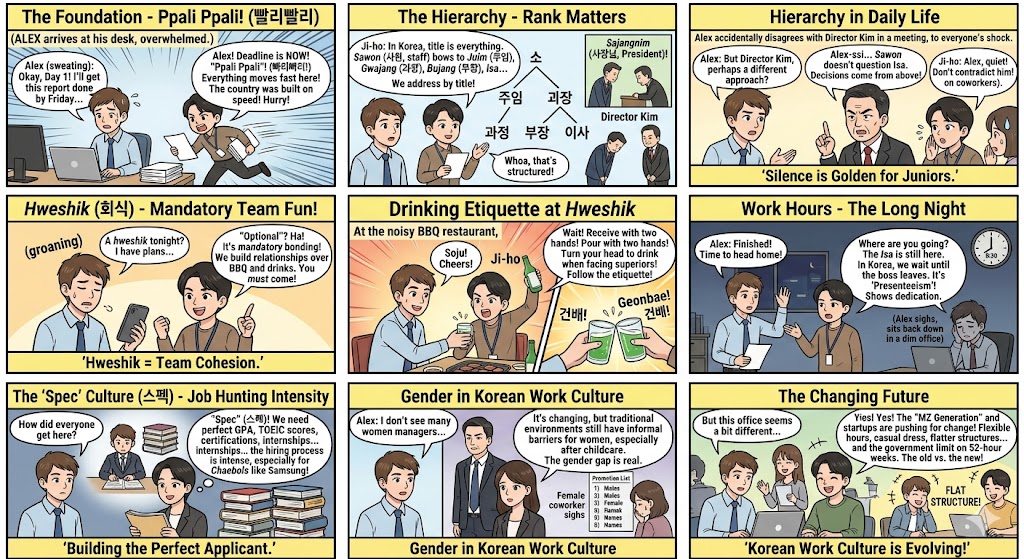
The single most important concept in Korean professional life is ppali ppali — literally “quickly quickly” or “hurry hurry.”
Ppali ppali is not just a workplace attitude. It’s a national philosophy. Koreans move fast, decide fast, build fast, and deliver fast. The ppali ppali mindset explains how Korea transformed from one of the world’s poorest countries to one of its most technologically advanced economies in a single generation. That transformation didn’t happen through careful deliberation. It happened through relentless, sustained speed.
In practice, this means deadlines are taken extremely seriously. Requests are expected to be addressed immediately. Waiting is uncomfortable. Slowness signals a character problem, not a scheduling one.
For foreigners working in Korea for the first time, ppali ppali is almost always the biggest adjustment. The speed of expectation genuinely surprises people from slower-paced professional environments — including those from other fast-moving Asian countries.
The Hierarchy System
Korean corporate culture operates on one of the most formally structured hierarchical systems in the modern professional world. Titles are not ceremonial — they govern every interaction.
The standard corporate rank system from bottom to top:
| Korean Title | English Equivalent |
|---|---|
| 사원 (Sawon) | Entry-level staff |
| 주임 (Juim) | Senior staff |
| 대리 (Daeri) | Assistant manager |
| 과장 (Gwajang) | Manager |
| 차장 (Chajang) | Deputy general manager |
| 부장 (Bujang) | General manager |
| 이사 (Isa) | Director |
| 상무 (Sangmu) | Executive director |
| 전무 (Jeonmu) | Senior executive director |
| 부사장 (Busajang) | Vice president |
| 사장 (Sajang) | President / CEO |
These titles are used constantly — not just in formal settings but in everyday office conversation. Addressing a superior by their title rather than their name is standard practice, and getting this wrong signals a lack of cultural awareness that people notice.
The hierarchy shapes every interaction. Younger employees bow to senior employees. Opinions flow predominantly downward. Decisions require sign-off from multiple seniority levels. Speaking up in a meeting to contradict a superior is genuinely uncomfortable — even when the junior employee is clearly correct.
I’ve watched foreign colleagues — often from flat organizational cultures — struggle significantly with this dynamic. The frustration is understandable. The hierarchy is also real, and pushing against it directly rarely produces good outcomes.
Hweshik (회식) — Company Dining Culture
Hweshik is one of the most distinctive and most debated aspects of Korean professional life. It refers to company-organized group meals and drinking sessions — typically led by senior staff, typically involving multiple venues, and theoretically optional in ways that practice rarely reflects.

A standard hweshik evening begins with dinner — Korean BBQ, samgyeopsal, or a large shared meal. After dinner, the group moves to a bar or norebang (karaoke room). A second or third venue is common. The evening can stretch past midnight on a Tuesday.
Attendance at hweshik is increasingly described as optional in modern Korean companies. In practice, declining — particularly early in your tenure, or regularly — signals that you’re not a team player. Hweshik is where relationships are built, trust is established, and promotions are informally discussed. Missing it has real costs that don’t show up anywhere in writing.
I’ve attended hundreds of hweshik dinners over 23 years. The culture has genuinely softened — pressure to drink excessively is less normalized than it was a decade ago, and younger companies have moved significantly away from the traditional format. But in large traditional Korean corporations, hweshik remains a significant part of professional life.
Read our Korean Soju Guide for the drinking etiquette that applies in these settings — how to pour, how to receive, and how to decline without causing offense.
Working Hours: Why Korean Offices Stay Lit Until 10pm
The reputation for long hours is earned.
South Korea consistently ranks among the highest for annual working hours across OECD countries — approximately 1,900–2,000 hours per year, significantly above the OECD average of around 1,700. Korean offices frequently remain active until 9–10pm. The practice of leaving before your boss is considered poor form — junior staff often wait for senior colleagues to leave first, creating a cascading effect where everyone stays late regardless of whether there’s work to justify it.
Several factors drive this:
Presenteeism — Being visibly at your desk signals dedication regardless of actual output. Leaving early, even after completing all assigned work, can be interpreted negatively.
Hierarchy effects — Junior staff reluctance to leave before superiors creates structural pressure that compounds through every level.
Ppali ppali workload — The expectation of immediate delivery and fast turnaround creates genuine pressure that extends hours beyond what slower-paced cultures would accept.
Collective identity — Staying late with your team is seen as solidarity. Efficiency that allows you to leave at 6pm while colleagues stay until 9pm is not necessarily rewarded.
Is this changing? Yes, meaningfully. The Korean government introduced a 52-hour maximum workweek in 2018. Younger generations — the MZ generation — are pushing back against overwork culture with a directness previous generations didn’t exercise. Startups and internationally-influenced companies have adopted significantly flatter, more flexible structures.
But large chaebols — Samsung, Hyundai, LG, SK — maintain environments that remain substantially more demanding than most Western equivalents. The change is real and ongoing; it’s not complete.
Chaebol Culture
Korean professional culture cannot be understood without understanding chaebols — the massive family-controlled conglomerates that dominate the economy.
Samsung, Hyundai, LG, SK, Lotte, and Hanwha are the most prominent. These groups account for a substantial share of Korea’s GDP and employ millions directly and indirectly. Working for a major chaebol is the gold standard of Korean employment — the most prestigious, most sought-after outcome for top university graduates.
Chaebol culture is hierarchical, demanding, and intensely competitive. The benefits — salary, stability, social status — are real. So are the costs: hours, conformity, and the particular weight of working inside an institution where your rank determines almost everything about how you’re treated.
Korean university students spend years preparing specifically for chaebol entrance exams — the GSAT at Samsung, the LG WAT, and equivalents at other groups. This preparation industry — English academies, certificate courses, spec-building activities — is enormous and reflects how seriously the gateway to chaebol employment is taken.
The SPEC Culture and Job Applications
Korean hiring culture has developed a concept called “spec” (스펙) — short for specifications — referring to the measurable credentials applicants accumulate. Spec includes university ranking, GPA, English test scores (TOEIC/TOEFL), internship experience, extracurricular activities, and certificates.
The credential focus is intense. Applicants invest significant time and money building their spec profile long before they apply for any specific position. The result is a job market where the filtering happens primarily through credentials before any human assessment begins.
Major employers use standardized aptitude tests to filter applicants further, followed by group interviews where candidates are assessed on how they interact with each other as much as on individual answers. The process is structured, competitive, and specifically designed for high-volume candidate evaluation.
Gender in Korean Workplaces
The gender dimension of Korean professional culture is significant and warrants honest treatment.
Korea’s gender pay gap is among the highest in the OECD. Women in Korean workplaces face genuine structural barriers — informal promotion barriers, the expectation of career interruption for childcare, and hweshik culture that can create disproportionate social pressure. Senior leadership at major Korean corporations remains heavily male-dominated.
This is changing, particularly in younger companies and industries where international norms have more influence. The change is real but uneven — a startup in Seongsu-dong operates very differently from a traditional manufacturing chaebol in this regard.
Korean mandatory military service — which all men must complete — creates an early career gap that shapes the age dynamics of offices in ways that take some adjustment to understand. Read our Korean Military Service Guide for how this affects career trajectories.
Practical Tips for Working in Korea
Use titles, not names. Learn the rank system and apply it correctly from your first day. Getting this right signals respect; getting it wrong signals carelessness.
Be early, not just on time. Ppali ppali culture means punctuality is a baseline, not a merit. Arriving slightly early is the professional norm.
Attend hweshik, especially early on. You don’t need to drink heavily — but showing up matters. Absence sends a message you probably don’t intend to send.
Don’t leave before your direct superior without explanation. If you need to leave early, inform them directly and briefly. This is standard practice and expected.
Accept business cards with two hands. Receiving a card requires both hands and a moment of visible respect — not a quick pocket. This reflects the broader respect system in Korean professional culture.
Dress formally until you know the culture of your specific workplace. Traditional companies maintain formal standards. Erring toward formality is always the safer opening position.
How Korean Work Culture Is Changing
Korean professional culture is at a genuine inflection point.
The MZ generation — Millennials and Gen Z — is pushing back against overwork, hweshik pressure, and rigid hierarchy with a directness that previous generations didn’t exercise publicly. Work-life balance language that would have seemed foreign in Korean corporate culture a decade ago is now used openly by young professionals.
Korean startup culture — concentrated in areas like Seongsu-dong, Gangnam, and Mapo — has created workplace environments that look significantly more like Silicon Valley than traditional chaebol offices. Flat structures, flexible hours, casual dress, and results-based evaluation are genuine norms in these environments, not performance.
The tension between traditional and emerging workplace norms is one of the most interesting dynamics in contemporary Korean society — and one that will continue shaping the country significantly over the next decade. Having worked through multiple cycles of this tension over 23 years, I’d say the direction of change is clear. The pace is slower than younger Koreans want, and faster than older institutions are comfortable with. That tension is probably healthy.
FAQ
Do I need to speak Korean to work in Korea? At international companies and many startups, English is the working language or at minimum widely used. At traditional Korean companies, Korean language ability is essential for navigating the social and hierarchical dynamics that matter for career progression.
Is Korean work culture really changing for younger generations? Meaningfully, yes. The 52-hour workweek law, generational pushback, and the growth of startup culture have all created real change. Traditional large corporations change more slowly than newer companies.
How important is university ranking in Korean hiring? Extremely important at major corporations, particularly chaebols. SKY universities — Seoul National University, Korea University, Yonsei University — carry significant prestige advantages in traditional Korean hiring processes.
What is the best way to decline alcohol at hweshik? A health reason is the most socially accepted explanation and requires no further elaboration. Modern Korean professional culture is increasingly accepting of non-drinkers, particularly in younger companies.
How does the military service requirement affect Korean men’s careers? Most Korean men complete military service between university and their first full-time job, creating a roughly 18–21 month gap. This is completely understood and normalized in Korean hiring — it creates no disadvantage in the job market.
For more on navigating Seoul — where most Korean work culture happens — read our Seoul Subway Guide and Cost of Living in Seoul Guide for practical living information.
Curious about Korean social culture beyond the office? Read our guides on Korean Dating Culture and Korean Military Service for the full picture of Korean social life.

Korea Insider has lived in South Korea for 50 years and worked at international companies for over two decades — explaining Korean culture, food, and society to colleagues from the US, Europe, and Australia.
Internationally married with a Japanese spouse, Korea Insider brings both an insider’s depth and an outsider’s perspective to every topic on My Korea Tip.