
I have lived in Korea for fifty years and watched this specific transformation happen in real time — not as a demographic statistic but as a visible shift in the neighborhoods, schools, and apartment buildings around me. I’m also in an international marriage — my spouse is Japanese — which means I’ve had more conversations than most about why young people in Northeast Asia are choosing not to form traditional families. The reasons my Japanese and Korean friends give are remarkably similar: housing costs that make a starting point impossible, work cultures that make parenthood a career penalty, and an education system whose costs follow children from kindergarten through university entrance. The math, they tell me, doesn’t work. And they are not wrong. What I find genuinely surprising — after fifty years of watching Korean society function — is not that the birth rate fell. It’s that it took this long.
Korea birth rate is the lowest ever recorded by any country in modern history — and the story of how it got there tells you almost everything you need to know about contemporary Korean society.
The number: South Korea’s total fertility rate — the average number of children a woman is expected to have in her lifetime — dropped to 0.72 at its lowest point. A rate of 2.1 is required to maintain a stable population without immigration. Korea reached one third of that. Seoul’s fertility rate fell as low as 0.55 — the lowest of any major city on earth.
South Korea’s population of close to 52 million is on track to halve by the end of this century if current trends continue. That is not a fringe projection. That is the official demographic consensus shared by the Korean government, the Bank of Korea, and international institutions.
What makes Korea’s situation uniquely extraordinary is not just the number — it is the fact that the South Korean government spent more than $270 billion trying to reverse the trend, and the trend continued falling for most of that period. No country in history has invested more money in encouraging births with less result.
This is the complete story: how Korea went from one of Asia’s fastest-growing populations to a declared national crisis in sixty years, why every attempted solution fell short, and what the first signs of recovery actually mean.
For the broader context of how Korean society reached this point, read our Korean Work Culture Guide and Korean Education System Guide. For the dating culture that shapes these decisions, read our Korean Dating Culture Guide.
Korea Birth Rate: How Far It Fell
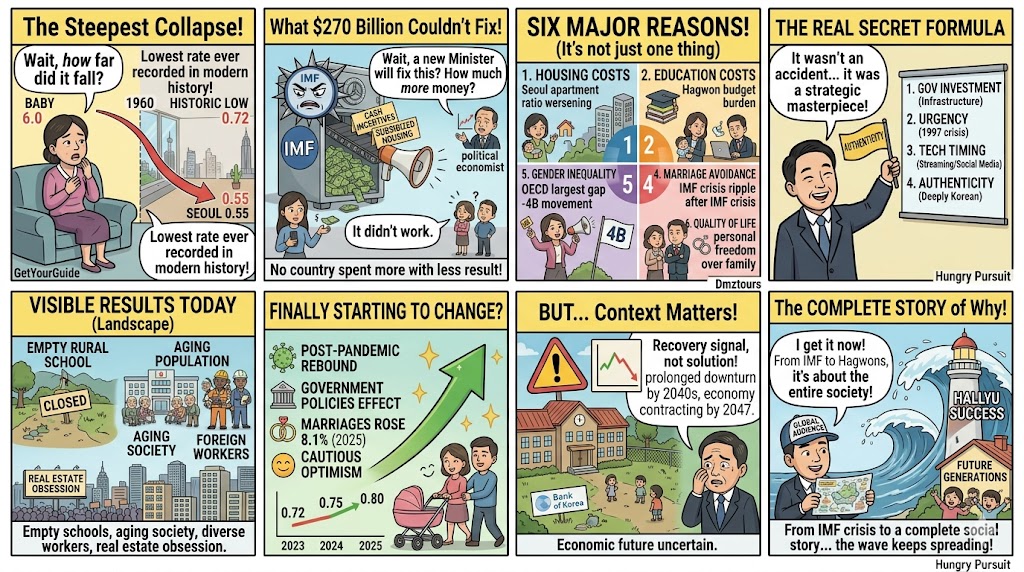
The speed of the collapse is what makes Korea’s situation genuinely unprecedented. The fertility rate dropped from six children per woman in 1960 to 0.72 at its lowest point. That is not a gradual demographic transition over a century. That is the steepest sustained fertility decline ever recorded — compressed into sixty years of industrialization, urbanization, and social transformation.
| Year | Fertility Rate | Context |
|---|---|---|
| 1960 | 6.0 | Post-war baby boom |
| 1983 | 2.1 | Replacement level reached |
| 2002 | 1.17 | Below lowest-low threshold |
| 2018 | 0.98 | Only OECD country below 1.0 |
| 2023 | 0.72 | Historic global low |
| 2024 | 0.75 | First increase in 9 years |
The most recent data shows the rate edging upward for the first time in nearly a decade — driven by a surge in marriages and modest policy improvements. The question is whether this represents a structural shift or a temporary bounce.
Korea Birth Rate: The Six Reasons
There is no single cause. Every Korean under 40 who has decided not to have children is responding to a combination of pressures that reinforce each other in ways specific to how Korean society is structured.
① 집값 (Housing Costs)
Seoul’s housing market is one of the most expensive in the world relative to median income. A median-priced apartment in Seoul requires approximately 20 years of average household income to purchase — a ratio that has worsened significantly over the past decade.
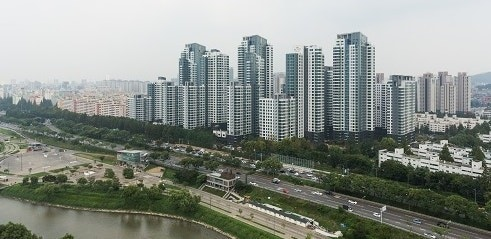
The connection to birth rates is direct: in Korea, having children outside of marriage is statistically negligible — only 2% of births occur outside of wedlock, compared to 30–50% in most Western countries. Having children means getting married. Getting married means needing housing. Housing in Seoul is functionally unaffordable for most young couples without significant family support.
Young Koreans are not choosing to remain childless as a lifestyle preference. Many are making a rational calculation about what having children actually costs in the city where most of them work.
② 교육비 (Education Costs)
Korea’s educational culture — centered on the hagwon system of private tutoring academies — means that raising a child involves a second household budget for education on top of normal living expenses.
The pressure begins before primary school and does not end until university entrance. Korean parents who choose to have children are implicitly committing to a decade-plus of after-school academy fees. The cost of a single child’s education from kindergarten through university preparation, including private tutoring, runs into tens of thousands of dollars per year in major cities.
This creates a powerful rational argument for stopping at one child — or having none. Read our Korean Education System Guide for the full picture of what the hagwon system demands of Korean families.
③ 직장과 육아의 충돌 (Career vs. Family)
Korean workplaces operate on a culture of visible presence — long hours, after-work socializing, and an implicit expectation that career commitment means personal sacrifice. For women in particular, returning to the workforce after having a child has historically meant significant career penalties.
The rational calculus for educated Korean women — who now outnumber men in university enrollment — is increasingly clear: children cost more career advancement than the financial incentives offset. Korea’s gender pay gap remains the largest in the OECD. Women who pursue careers face documented discrimination in hiring, promotion, and return-to-work after maternity leave.
Read our Korean Work Culture Guide for the full picture of what Korean workplace culture actually demands.
④ 결혼 기피 (Marriage Avoidance)
Since Korean births occur almost entirely within marriage, declining marriage rates directly produce declining birth rates. The generation that came of age during and after the 1997 financial crisis — watching parents lose jobs, assets, and stability — internalized a different calculus about financial security before major life milestones.
That internalization compounded across generations. The result is a cohort of young Koreans who delay marriage significantly or avoid it entirely — not because they reject the idea of family but because the financial prerequisites feel unreachable.
⑤ 성 불평등 (Gender Inequality)
The feminist movement that emerged in Korea in the late 2010s — including the 4B movement, which advocates abstaining from dating, marriage, sex, and childbearing — is a direct response to a society that has not adapted its domestic and professional expectations to match women’s educational and career advancement.
Korean women are increasingly unwilling to absorb the career cost of motherhood in a workplace culture that has not meaningfully changed to accommodate it. The government’s framing of the birth rate crisis — frequently centered on incentivizing women to have more children — has itself drawn criticism for ignoring the structural gender inequality that makes motherhood professionally costly.
⑥ 삶의 질 (Quality of Life Expectations)
Underlying all of the above is a generational shift in how young Koreans define a good life. Solo living, personal financial independence, travel, and experience over family formation is not uniquely Korean — it is a pattern across all wealthy East Asian societies. Korea simply expresses it at the most extreme level, in the most expensive urban environment, with the least flexible workplace culture.
Korea Birth Rate: $270 Billion and Counting
The South Korean government established the Framework Act on Low Birth Rate in 2005. Since then, the accumulated investment has exceeded $270 billion — spent on monthly cash payments for newborns, subsidized housing priority for families, extended paid parental leave, IVF subsidies, tax incentives for family-friendly companies, and dozens of other measures.
The results were marginal at best. The fertility rate continued declining through most of this spending period. The consensus among demographers is straightforward: cash incentives do not change the structural conditions that drive the decision not to have children.
A monthly payment of ₩1,000,000 ($770) does not make a Seoul apartment affordable. It does not guarantee a woman’s career survival after maternity leave. It does not reduce a decade of hagwon fees. It is a gesture against a structural problem — and the numbers reflect that.
In response to the ongoing decline, the South Korean government officially declared a “Population National Crisis” and established a dedicated Ministry for Population Strategy and Planning — an acknowledgment that the problem exceeds the capacity of existing policy frameworks.
Korea Birth Rate: What Is Actually Changing
The most recent data shows the fertility rate edging upward for the first time in nearly a decade. Marriages — a leading indicator of births with a one-to-two year lag — have increased significantly, driven by a larger cohort of people in their 30s and modest shifts in social attitudes.
The cautious optimism is real — but context matters. A recovery from 0.72 to 0.75 is meaningful as a directional signal. It is not a solution. The Bank of Korea has projected that the demographic trajectory will push the economy into a prolonged contraction by the 2040s regardless of near-term birth rate fluctuations.
What would constitute a genuine structural recovery involves changes that policy instruments cannot easily produce: affordable housing in major cities, a workplace culture that does not penalize parenthood, and a domestic labor distribution that shares childcare equitably between partners. These are generational shifts, not quarterly policy adjustments.
What This Means For Visitors to Korea
The birth rate crisis is not abstract for visitors. It is visible in the landscape of Korean society.
빈 학교 (Empty Schools): Rural Korean schools are closing at an accelerating rate. In some provinces, elementary schools operate with fewer than ten students. The demographic hollowing of rural Korea is already underway — visible in the shuttered storefronts and aging populations of smaller cities that once thrived.
고령화 (Aging Population): The proportion of Koreans over 65 is rising sharply. The social infrastructure — pension systems, healthcare, elder care — was designed for a population structure that no longer exists and is straining visibly under the mismatch.
외국인 노동자 (Foreign Workers): Korea’s historically homogeneous society is becoming meaningfully more diverse as labor shortages drive immigration at a scale the country has not previously managed. The tension this creates — cultural, political, economic — is ongoing and unresolved.
부동산 집착 (Real Estate Obsession): The conversation about housing costs in Korea is omnipresent — in cafés, offices, and on every major social media platform. The apartment is simultaneously the most important financial asset a Korean family can possess and the primary barrier to forming one.
Korea Birth Rate: FAQ
What is Korea’s birth rate? South Korea’s total fertility rate reached a historic low of 0.72 — the lowest ever recorded by any country in modern history. Recent data shows a modest recovery, with the rate edging upward for the first time in nearly a decade following increases in marriages.
Why is Korea’s birth rate so low? The primary structural reasons are unaffordable housing in major cities, extremely high private education costs, a workplace culture that penalizes parenthood — particularly for women — and a marriage system that ties childbearing to housing accessibility. These factors compound each other in ways that individual policy incentives have not been able to offset.
How much has Korea spent trying to increase the birth rate? More than $270 billion on policies including subsidized housing, paid parental leave, childcare programs, IVF subsidies, and cash payments for newborns. The fertility rate continued declining through most of this spending period.
Is Korea’s birth rate improving? The most recent data shows a modest upward trend driven by an increase in marriages. Demographers note this as a positive directional signal while emphasizing that structural solutions — not cash payments — are what would produce a meaningful reversal.
Will Korea’s population collapse? South Korea’s population of close to 52 million is on track to halve by the end of this century if current trends continue without significant immigration. The economic implications — labor shortages, pension system strain, reduced domestic consumption — are already being formally modeled by the Bank of Korea.
Why do Koreans have children only within marriage? Korean social culture retains a strong connection between marriage and childbearing — only 2% of births occur outside of wedlock, compared to 30–50% in most Western countries. This means that declining marriage rates translate almost directly into declining birth rates, without the buffer that cohabitation and non-marital births provide in other societies.

Korea Insider has lived in South Korea for 50 years and worked at international companies for over two decades — explaining Korean culture, food, and society to colleagues from the US, Europe, and Australia.
Internationally married with a Japanese spouse, Korea Insider brings both an insider’s depth and an outsider’s perspective to every topic on My Korea Tip.