
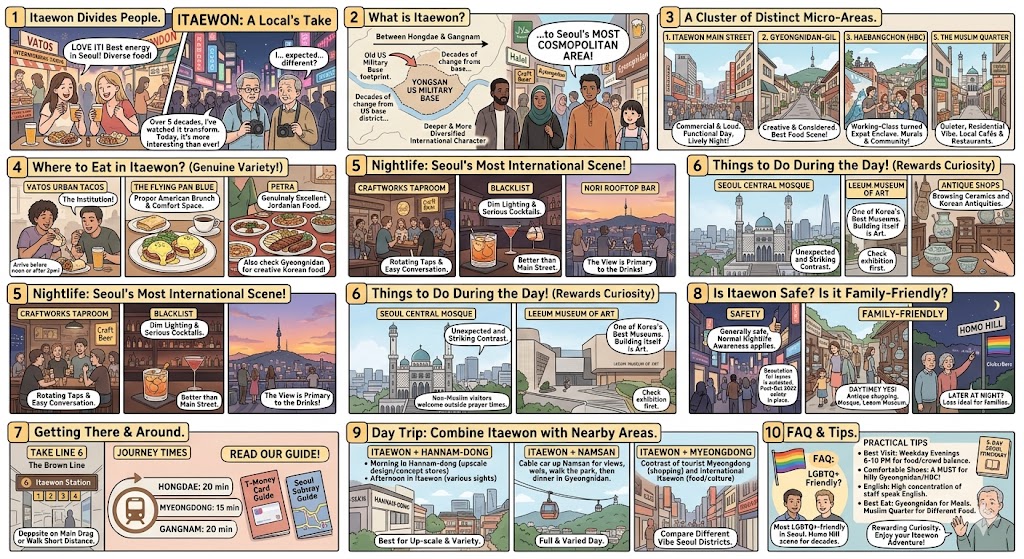
Itaewon divides people. Some visitors love it immediately — the food variety, the international crowd, the energy that feels unlike anywhere else in Seoul. Others arrive expecting something and find something different. I’ve watched this neighborhood transform over five decades, and my honest take is that the Itaewon of today is more interesting than it’s ever been — if you know how to approach it.
This guide covers everything: what Itaewon actually is, where to eat, where to drink, what to do during the day, and how to get the most out of a neighborhood that rewards curiosity more than most.
What Is Itaewon?
Itaewon sits in Yongsan-gu, about halfway between Hongdae and Gangnam on the subway map. Its character has always been shaped by its proximity to the Yongsan US military base — for decades, this made it the place in Seoul where foreign goods, foreign food, and foreign faces were concentrated in ways found nowhere else in the city.
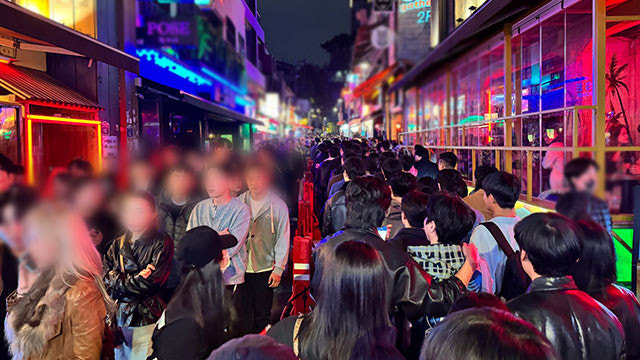
That original function has evolved considerably. The base footprint has shrunk. The neighborhood’s international character has deepened and diversified rather than diminished. What was once primarily a district for US military personnel and the businesses that served them is now one of Seoul’s most genuinely cosmopolitan areas — with a Muslim quarter, a Haebangchon hillside neighborhood popular with long-term expats, a Gyeongnidan-gil stretch of independent restaurants that rivals any food street in the city, and a nightlife scene that remains among Seoul’s most diverse.
I’ve brought foreign colleagues here more times than I can count over the years. The reaction is almost always the same: this doesn’t feel like Korea. That’s precisely the point — and it’s also slightly wrong. Itaewon is distinctly Korean in ways that take a few visits to notice.
Before exploring Itaewon, read our Seoul Neighborhoods Guide for context on how the city’s districts relate to each other.
Getting to Itaewon
Itaewon is straightforward to reach. Take Line 6 (brown line) to Itaewon Station — exits 1, 2, 3, and 4 all deposit you onto the main drag or within a short walk of it.
From central Seoul, journey times are roughly:
- From Hongdae: 20 minutes
- From Myeongdong: 15 minutes
- From Gangnam: 20 minutes
Read our T-Money Card Guide and Seoul Subway Guide before your first trip — both make navigating the city considerably easier.
The Main Areas Within Itaewon
Itaewon is not one neighborhood — it’s a cluster of distinct micro-areas that have merged into a broader district. Understanding which part you’re heading to makes the visit more productive.
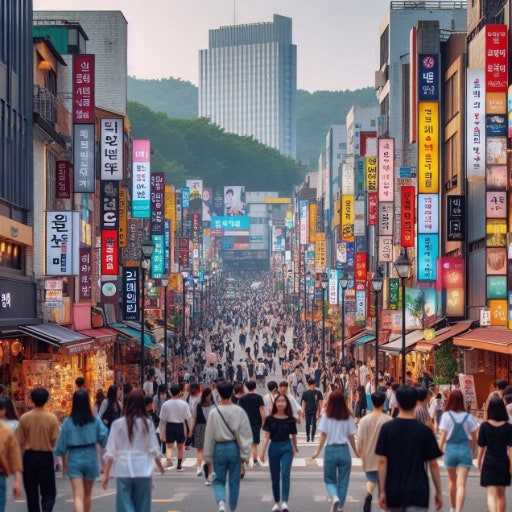
Itaewon Main Street (이태원 메인 거리) The central spine running from the subway station toward Hamilton Hotel. This is the most commercial, most international-facing stretch — restaurants from dozens of countries, bars, clothing shops. Loud and lively at night, functional and walkable during the day.
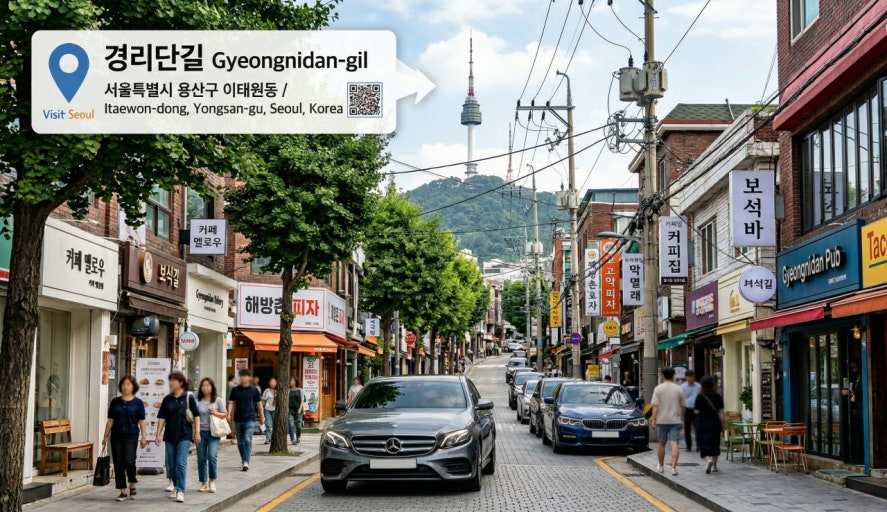
Gyeongnidan-gil (경리단길) The area southeast of the main street, climbing uphill toward Namsan. This is where the more interesting independent restaurants and cafés have clustered — less touristy, more considered, with a creative energy similar to what Seongsu-dong developed more recently. If you’re eating in Itaewon, this is the first place to look.
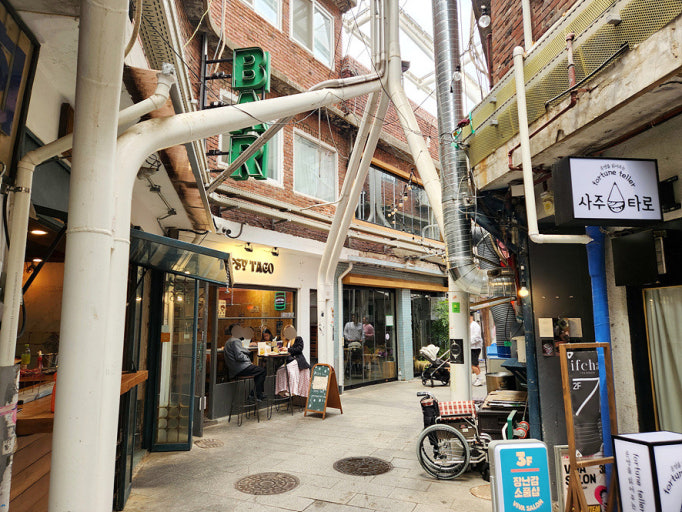
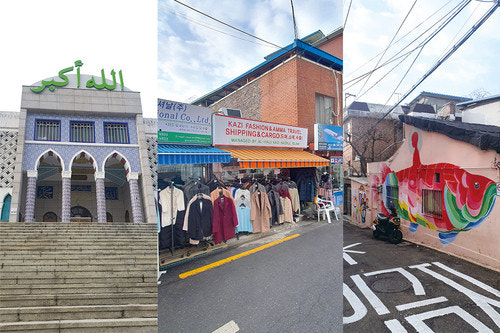
Haebangchon (해방촌 / HBC) Further up the hill toward Namsan, Haebangchon is a working-class neighborhood that became a long-term expat enclave and has developed its own distinct character — murals, independent bars, and a community feel that main-street Itaewon doesn’t have. Worth an afternoon.
Noksapyeong (녹사평) Just one stop southwest on Line 6, Noksapyeong has a quieter, more residential character than Itaewon proper — with some excellent independent cafés and restaurants that attract locals rather than tourists.
The Muslim Quarter (이슬람길) A short walk from the main street toward the Seoul Central Mosque, this area has a genuine concentration of halal restaurants, Middle Eastern grocery shops, and Central Asian eateries. One of the most distinctive eating experiences in Seoul for visitors who haven’t encountered this side of the city.
What to Eat in Itaewon
Itaewon’s food scene is the primary reason to visit during the day and early evening. The variety here is genuine — not the performative international food found near tourist sites, but restaurants opened by people who actually know what they’re cooking.
International food worth seeking:
Vatos Urban Tacos — Korean-Mexican fusion that sounds gimmicky and works completely. The kimchi carnitas burrito has been a Seoul institution for over a decade. Queues are real on weekends; arrive before noon or after 2pm.
The Flying Pan Blue — American-style brunch done properly. Reliably good eggs Benedict, excellent coffee, and a comfortable space that fills up quickly on weekend mornings.
Petra — In the Muslim quarter. Genuinely excellent Jordanian food — mezze, grilled meats, fresh bread — in a setting that feels like a detour to the Middle East.
Organic by John Baker — One of the better bakeries in Seoul, located in Itaewon. Proper sourdough, good pastries, worth stopping at for breakfast or an afternoon coffee.
Korean food in Itaewon:
Despite its international reputation, Itaewon has excellent Korean food. The area around Gyeongnidan-gil has numerous Korean restaurants that attract local diners rather than tourists — dwaeji gukbap (pork rice soup), jokbal (braised pig trotters), and standard Korean BBQ are all available at prices that undercut the tourist-facing spots on the main street.
For a broader introduction to Korean food, read our Korean BBQ Guide and Korean Street Food Guide.
Nightlife
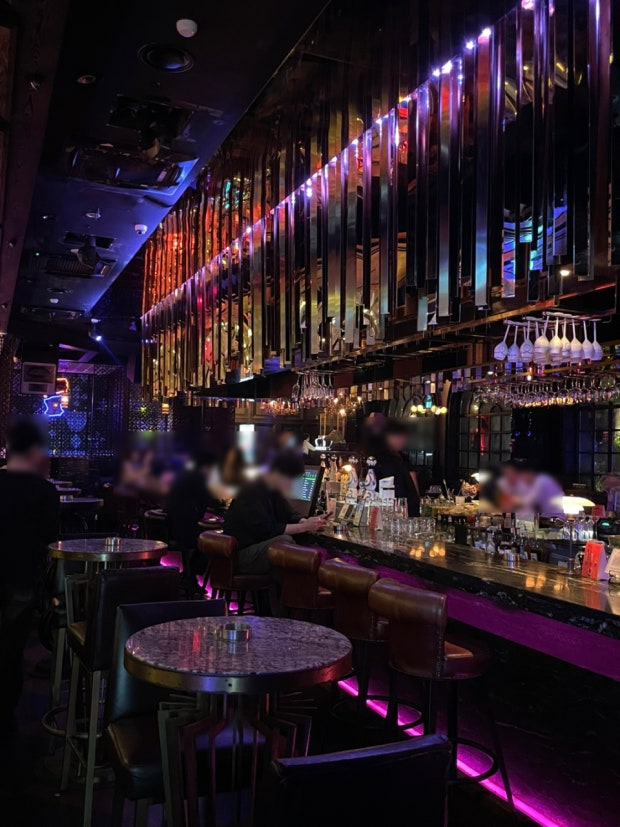
Itaewon’s nightlife is the most international in Seoul — which makes it both the most accessible for foreign visitors and the most genuinely diverse in character.
Bars:
Craftworks Taproom — One of Seoul’s original craft beer destinations. Good rotating tap list, reliable food, and a mixed local-expat crowd that makes for easy conversation. Located on the main street, open until late.
Blacklist — A cocktail bar in the Gyeongnidan area with a serious drinks program and the kind of dim lighting that suits a long evening. Less visible than the main-street options and better for it.
Nori — A rooftop bar with views over the neighborhood. Best visited at sunset before it gets crowded. The drinks are secondary to the view.
Clubs:
Itaewon’s club scene is smaller than Hongdae’s but more diverse. Venues range from mainstream chart music to underground electronic, and the crowd is more internationally mixed than in other Seoul nightlife areas. The LGBTQ+ scene is centered primarily in Itaewon — the Homo Hill area (우사단로) has been the heart of Seoul’s LGBTQ+ nightlife for decades.
For a broader picture of Seoul’s nightlife, read our Seoul Nightlife Guide and Hongdae Seoul Guide.
Things to Do During the Day
Itaewon rewards daytime exploration more than its nightlife reputation suggests.
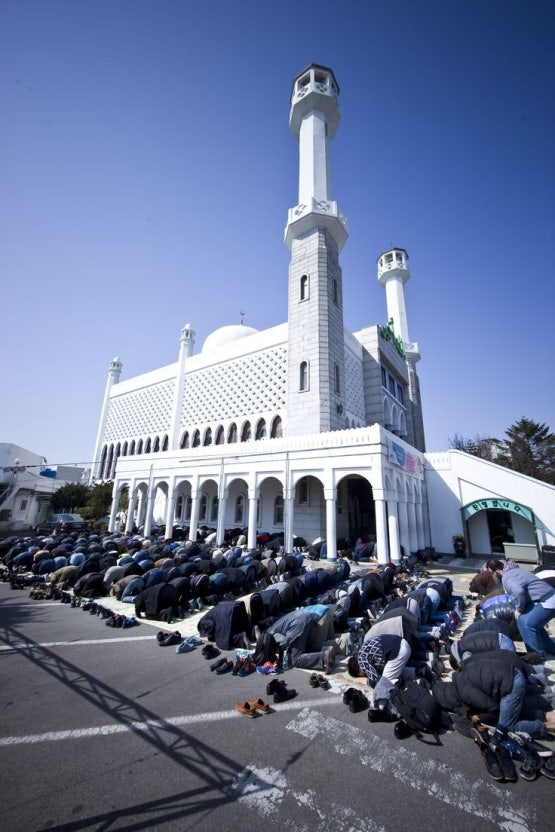
Seoul Central Mosque (서울중앙성원) Korea’s largest mosque, located on the hillside above the main street. Built in 1976, it’s an architecturally interesting building in an unexpected location — the contrast between the mosque and the surrounding Seoul cityscape is genuinely striking. Non-Muslim visitors are welcome outside prayer times. Free to visit.
Leeum Samsung Museum of Art One of the best art museums in Korea, located at the edge of Itaewon in Hannam-dong. The building itself — designed by three different architects for three different sections — is worth visiting independently of the collection. The permanent collection spans traditional Korean ceramics and paintings through contemporary international work. Admission approximately ₩10,000–₩20,000 depending on exhibition.
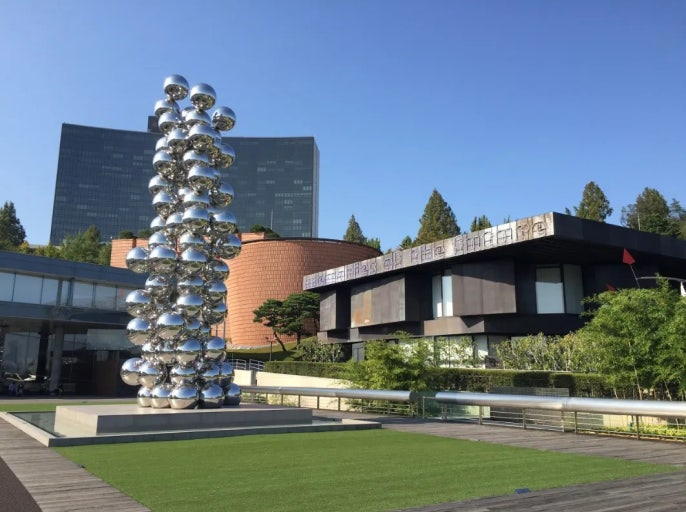
Antique shops on Itaewon main street The stretch between the subway station and Hamilton Hotel has a cluster of antique and vintage shops — Korean ceramics, furniture, and decorative objects, alongside imported goods. Worth browsing if you have time, particularly for ceramics.
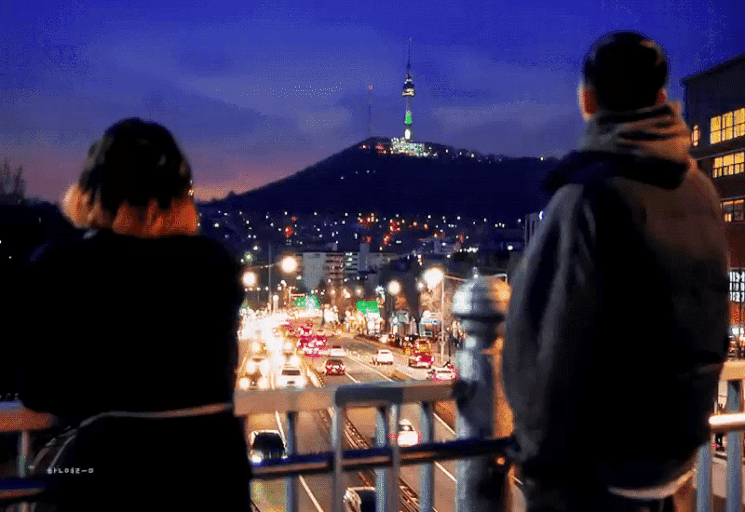
Haebangchon murals and viewpoints Walking up through Haebangchon toward Namsan provides increasingly good views over the city. The neighborhood has developed a street art presence over the past decade, and the combination of hillside walking and views makes for a genuinely pleasant afternoon.
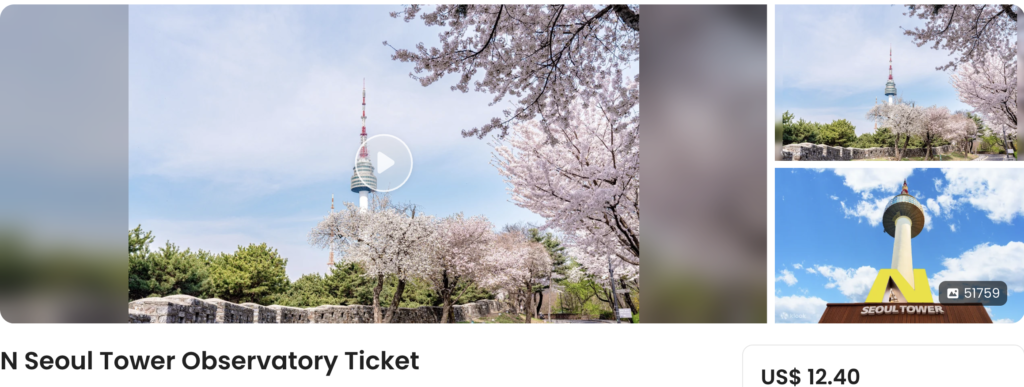
Namsan Seoul Tower Technically adjacent to Itaewon rather than in it, but easily reached on foot from Haebangchon or by cable car from the Namsan Cable Car station. The views over Seoul from the tower are among the best in the city.
Book your Namsan Cable Car tickets on Klook in advance to skip the queue, particularly on weekends.
Practical Tips for Visiting Itaewon
Best time to visit: Weekday evenings from 6–10pm hit the sweet spot — restaurants are operating fully, the crowd is manageable, and the neighborhood’s character is most apparent. Weekend nights are busier and louder.
Daytime visits: Saturday and Sunday afternoons are good for the food and café scene. The main street is quieter during the day than you might expect.
Safety: Itaewon is generally safe. Normal nightlife awareness applies on weekend nights in the entertainment areas — the same precautions you’d take in any major city’s bar district. Read our Is Korea Safe for Tourists Guide for the full picture.
Language: Itaewon has the highest concentration of English-speaking staff in Seoul — most restaurants and bars on the main street can communicate comfortably in English. This is the area of Seoul where language is least likely to be a barrier.
Getting between areas: The walk from Itaewon Station to Gyeongnidan-gil takes about 10–15 minutes on foot. Haebangchon is another 10 minutes uphill from there. Comfortable shoes make a significant difference.
Day Trip: Combining Itaewon with Nearby Areas
Itaewon pairs well with several adjacent neighborhoods for a full day out.
Itaewon + Hannam-dong: Hannam-dong, just east of Itaewon, has developed into one of Seoul’s most interesting upscale neighborhoods — concept stores, design studios, and some of the city’s best independent restaurants. A morning in Hannam-dong followed by afternoon in Itaewon works well.
Itaewon + Namsan: The cable car up Namsan from near Itaewon, a walk around the tower and down through the park, then dinner in Gyeongnidan-gil makes for a full and varied day.
Itaewon + Myeongdong: Both are on or near Line 4/6 interchange at Samgakji. The contrast between tourist-heavy Myeongdong and international Itaewon on the same day is itself interesting. Read our Myeongdong Seoul Guide for what to cover there.
For a comprehensive Seoul itinerary, read our 5-Day Seoul Itinerary and Seoul 3-Day Itinerary.
FAQ
Is Itaewon safe to visit? Yes. The neighborhood’s reputation for safety issues is somewhat outdated. Normal nightlife precautions apply on weekend nights, but daytime and early evening visits are completely comfortable. The October 2022 crowd crush tragedy was a specific and exceptional event — the neighborhood has since implemented safety measures including crowd management systems on busy weekend nights.
Is Itaewon good for families? During the day, yes — the Seoul Central Mosque, antique shopping, and Leeum Museum are all family-accessible. The nightlife focus of the evening makes it less ideal for families after 9pm.
Is Itaewon LGBTQ+-friendly? It’s the most LGBTQ+-friendly area in Seoul. The Homo Hill area has been central to Seoul’s LGBTQ+ scene for decades and remains the most visible and welcoming space in the city.
How long should I spend in Itaewon? A focused half-day covers the main areas. A full day with a proper sit-down lunch in Gyeongnidan-gil, afternoon in Haebangchon, and evening at a bar or two is a comfortable and varied itinerary.
What’s the best thing to eat in Itaewon? Gyeongnidan-gil for a proper meal — the concentration of independent restaurants there is genuinely excellent. The Muslim quarter for something completely different from the standard Seoul food experience.

Korea Insider has lived in South Korea for 50 years and worked at international companies for over two decades — explaining Korean culture, food, and society to colleagues from the US, Europe, and Australia.
Internationally married with a Japanese spouse, Korea Insider brings both an insider’s depth and an outsider’s perspective to every topic on My Korea Tip.