
Bukchon Hanok Village is the most photographed neighborhood in Seoul. It is also, as of 2025, the most regulated one — and the gap between what visitors expect and what they find is wider than ever.
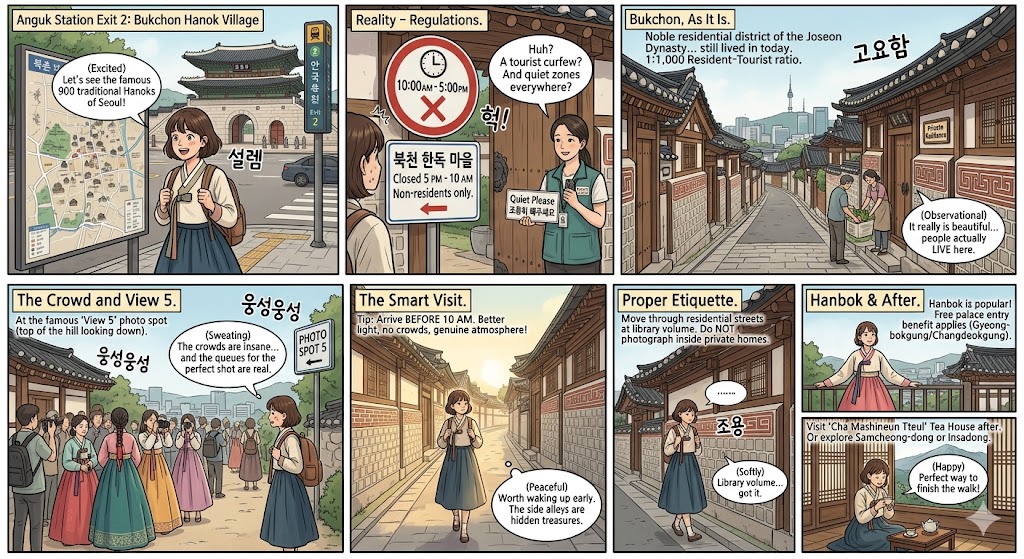
Here is what Bukchon actually is: a hillside residential neighborhood tucked between Gyeongbokgung Palace and Changdeokgung Palace, containing approximately 900 traditional wooden houses — hanok — that date back to the Joseon Dynasty. Today, 6,100 people live here. In 2024, 6.4 million tourists visited. That is a resident-to-tourist ratio of roughly 1 to 1,000. Soko Glam
The result of that ratio is visible the moment you arrive: signs everywhere asking for quiet, volunteers monitoring noise levels in the alleys, and residents who have, in many cases, given up and moved away. New for 2025, there is now a tourist curfew for Bukchon Hanok Village — tourists are not allowed to visit after 5PM or before 10AM, or risk a fine of up to ₩100,000. KoreaToDo
None of this makes Bukchon less worth visiting. The neighborhood is genuinely beautiful — a landscape of curved tiled roofs, narrow stone alleys, and wooden gates that frames the modern Seoul skyline behind it in a way that stops you mid-step. It is one of the few places in Seoul where you can stand still for a moment and understand what this city looked like before the apartment towers arrived.
But visiting it correctly — early, quietly, and with realistic expectations about the crowds — is the difference between an experience worth having and an hour of shuffling through a queue of other people’s cameras.
For combining Bukchon with the nearby palace, read our Gyeongbokgung Palace Guide. For where Bukchon fits into a full Seoul day, read our Seoul Neighborhoods Guide.
Bukchon Hanok Village: Essential Information
| Detail | Info |
|---|---|
| Location | Gahoe-dong, Jongno-gu, Seoul |
| Nearest subway | Anguk Station, Line 3, Exit 2 |
| Walk from station | 10 minutes uphill |
| Entry fee | Free |
| Tourist hours (2026) | 10AM – 5PM daily |
| Curfew fine | Up to ₩100,000 |
| Charter bus access | Banned since January 2025 |
| Best time to visit | Weekday, arrive before 10AM |
| Time needed | 1.5–2.5 hours |
| Nearest palace | Gyeongbokgung (15 min walk west) |
The 5PM closing rule is the most important logistical fact for any 2026 visit. Due to large tourist numbers, Bukchon Hanok Village is closed to non-residents between the hours of 5PM and 10AM every day. Plan your itinerary around this — afternoon arrivals after 4PM leave almost no time. Mykoreatip
Bukchon Hanok Village: What It Actually Is
Bukchon (북촌) means “northern village” — named for its position north of Cheonggyecheon Stream and Jongno. During the Joseon Dynasty, nobles and royalty lived here. The hanoks that remain today date back to that era — traditional Korean houses characterized by curved tiled roofs, wooden beams, courtyard layouts, and natural materials. Korean-Skincare
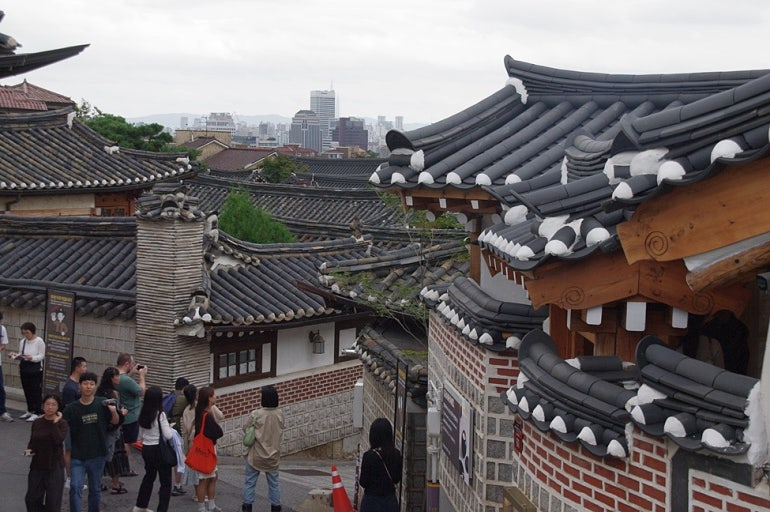
What distinguishes Bukchon from reconstructed heritage sites — the kind you find at folk villages outside the city — is that it is not reconstructed. This is not a theme park. People live here. Those beautiful hanoks you’re photographing? Families wake up there. Kids do homework. Elderly people try to sleep. Seoul Magic
Understanding that changes how you move through the neighborhood. You are a guest in someone’s residential street, not a customer in a tourist attraction. The experience is better when you treat it accordingly — slower, quieter, more observational.
A hanok is not simply an old house. It is a scientific architectural solution developed during the 1400s Joseon Dynasty to survive Korea’s harsh climate — frigid winters, hot and humid summers. The coexistence of ondol (underfloor heating) and maru (ventilated wooden floors) in one structure represents Korean architectural ingenuity found nowhere else in the world. Soko Glam
Bukchon Hanok Village: How to Get There
By subway (recommended): Anguk Station, Line 3, Exit 2. Walk straight uphill along Bukchon-ro for approximately 10 minutes. The main alley entrance becomes obvious — follow the uphill slope and the other visitors.
From Gyeongbokgung Palace: Gyeongbokgung and Bukchon are a 15–20 minute walk apart. From Gyeongbokgung, take the east exit and head along Bukchon-ro 5-gil, then turn left onto Bukchon-ro. This is the most efficient combined itinerary — palace in the morning, Bukchon immediately after. Mykoreatip
What not to do: Charter buses have been banned from entering Bukchon since January 2025 due to illegal parking and traffic congestion. Arrive by subway or on foot. Taxis can drop you at Anguk Station; they cannot navigate the narrow residential alleys. Soko Glam
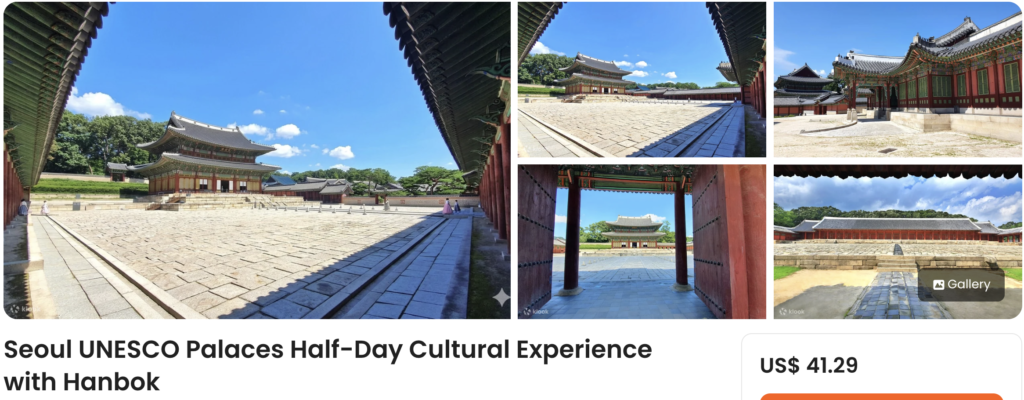
Bukchon Hanok Village: The 8 Photo Spots
The Seoul Metropolitan Government officially designated 8 photography viewpoints throughout the village. They are numbered and signposted — finding them is straightforward if you follow the main uphill route from Anguk Station.
View 5 — Bukchon-ro 11-gil (The Famous One) The most popular place for photos is at the top of Bukchon-ro 11-gil — one of the longest and most picturesque streets in the village, lined with traditional hanok and with a view of Namsan Mountain and Seoul Tower in the distance. Sephora
This is the shot everyone comes for: a steep narrow alley descending between two continuous rows of hanok rooftops, with the modern city skyline visible at the bottom. It is genuinely beautiful. It is also the most crowded point in the entire neighborhood at any hour after 10AM.
Best time: Early morning, before 9AM. Worst time: Weekend afternoons — expect a queue of people waiting for their turn at the exact same angle. Seoul Magic
View 5 (Alternative) — Bukchon-ro 11-ga-gil The next street east of the famous alley is another excellent street for portrait photos with nice spots at both the top and bottom. This street often has fewer people posing. Essentially the same visual without the crowd. Worth knowing. Sephora
The Bukchon Hanok Observatory The observatory is higher on the hill, closer to the Bukchon-ro photo spots. Walk up to the 3rd floor of the building — there is a small air-conditioned balcony area with a beautiful view of the rooftops and the Seoul skyline in the distance. Difficult to find; use Naver Map to locate it specifically. Worth the effort on a clear day. Sephora
The Approach: What Most Visitors Miss The famous viewpoints are packed. But most of Bukchon is quiet. The best spots are the ones you find yourself — there is a tiny alley between spots 4 and 5 that most tourists walk right past. Fewer people, equally beautiful, better light in the afternoon. Seoul Magic
The general principle: leave the marked route and walk into the side alleys. The deeper you go into the residential streets, the fewer people you encounter and the more the neighborhood feels like what it actually is — a place where people live, not a backdrop for photographs.
Bukchon Hanok Village: The Correct Way to Visit
Arrive before 10AM. Early morning before 9AM gives you the famous alley in relative quiet — golden light on the rooftops, almost no other visitors, and the feeling of actually being in a neighborhood rather than a tourist corridor. The curfew lifts at 10AM; the crowds arrive by 10:30. The window is real and worth using. Seoul Magic
Wear comfortable shoes. The entire neighborhood is uphill. The alleys are stone, uneven, and steep. Heels are a disaster. Flip-flops are difficult. Running shoes are the correct footwear regardless of what you’re planning to photograph. Oliveyoung
Keep your voice down — genuinely. This is not a suggestion on a sign. The resident-to-tourist ratio is 1:1,000. Over 10,000 visitors daily in narrow alleys mean residents cannot avoid being photographed at their own doorsteps and endure noise until late in the day. Speak at the volume you would in a library. Move through residential streets quickly rather than lingering in front of private homes. Soko Glam
Don’t photograph through windows or over gates. You can take photos of the architecture and streetscapes. Avoid taking intrusive photos of residents or their private property. The hanok gates and walls are the correct subject. What is behind them is not. OLIVE YOUNG
The walking route that works: Anguk Station Exit 2 → Bukchon Information Center (free maps, English available) → uphill along Bukchon-ro → Views 1–8 → Bukchon-ro 11-gil viewpoint → down through side alleys → Samcheong-dong. Total: 2–2.5 hours at a comfortable pace.
Bukchon Hanok Village: Wearing Hanbok
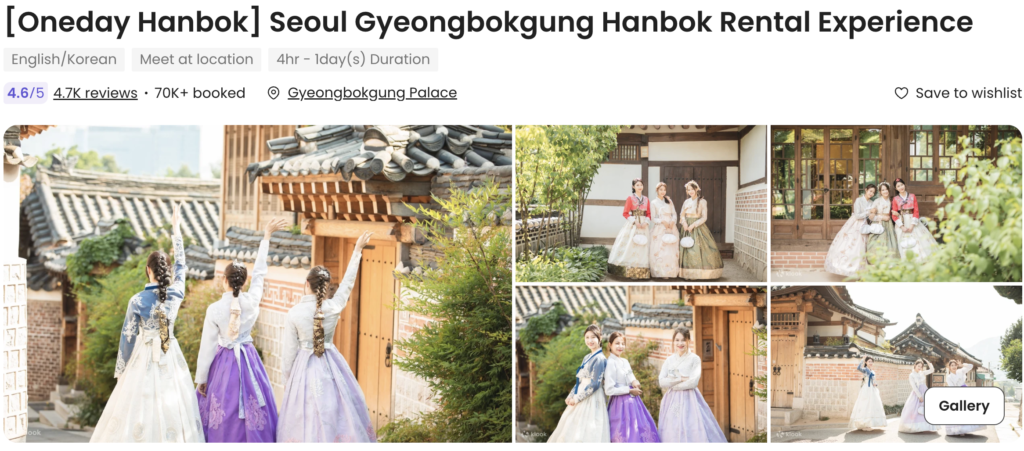
It is popular to visit Bukchon Hanok Village wearing hanbok — traditional Korean clothing — for photos against the hanok backdrop. Hanbok rental shops line the main road, Bukchon-ro, on the way to the most popular photo spots. Rentals run ₩15,000–₩30,000 for two hours. Substack
The free palace entry benefit applies here too — hanbok wearers enter Gyeongbokgung and Changdeokgung free. The logical sequence: rent hanbok near Anguk Station, walk through Bukchon, continue to Gyeongbokgung for the afternoon with free entry. Both locations in one outfit, one rental fee.
One practical note: the hills of Bukchon are steep. Wearing hanbok while climbing repeatedly is manageable — the full-length skirt of the women’s hanbok covers your feet entirely, so wearing running shoes underneath is invisible and strongly recommended. Seoul Magic
Bukchon Hanok Village: Where to Go After
삼청동 (Samcheong-dong) The natural continuation of a Bukchon walk — head downhill from the village’s south side and you emerge onto Samcheong-ro, a street of independently owned cafés, galleries, and design shops in a mix of hanok and modern buildings. Samcheongdong is a chic popular suburb of boutique stores, cafes, restaurants, art galleries, and small museums. The best post-Bukchon coffee in Seoul is here. Substack
London Bagel Museum (런던베이글뮤지엄) — Anguk A few minutes’ walk from Bukchon, London Bagel Museum is the number-one most-queued-for café chain in Korea based on 2025 queue app statistics. The queue is almost always massive. Worth noting because it is immediately adjacent to your exit route — either plan for the queue or walk past it. The bagels are genuinely good. KoreaToDo
차 마시는 뜰 (Cha Mashineun Tteul) Tea House Considered the best tea house in Bukchon and one of the best in Seoul — approximately 100 years old, situated lower on the hill with mountain views. They offer a variety of traditional teas and rice cakes. The correct place to sit after the walk, before continuing to Insadong or Gyeongbokgung. Sephora
인사동 (Insadong) 15 minutes south of Bukchon — Seoul’s traditional arts and crafts district. The Bukchon → Insadong walk covers the full historical core of Jongno-gu in a single afternoon. Read our Korean Drama Filming Locations Guide for where this area appears on screen.
Bukchon Hanok Village: FAQ
Is Bukchon Hanok Village free? Yes. Entry to the neighborhood is free. The hanbok rental, tea houses, and cultural programs inside individual hanok buildings have their own pricing.
What are the visiting hours in 2026? Bukchon Hanok Village is closed to non-residents between 5PM and 10AM every day. The visiting window is 10AM–5PM. Plan accordingly — afternoon arrivals cut your time significantly. Mykoreatip
How long should I spend in Bukchon? Most travelers spend 1.5 to 3 hours here. Bukchon is best enjoyed as a scenic walking experience rather than a long, activity-filled attraction. Two hours is the right benchmark for a thorough but unhurried visit. Into The Gloss
Can I visit Bukchon and Gyeongbokgung on the same day? Yes — and this is the recommended approach. Bukchon first (9:30–11:30AM), then Gyeongbokgung for the 2PM guard ceremony. Both are 15 minutes apart. Read our Gyeongbokgung Palace Guide for the palace logistics.
Is Bukchon worth visiting despite the crowds? Bukchon deserves a visit. It’s stunning — a glimpse of how Seoul looked before modernization. But visit like a guest, not a customer. Speak softly. Move quickly. Don’t treat someone’s home like your photo studio. Arrive early on a weekday and it is worth every minute. Arrive at 2PM on a Saturday and you will spend an hour in a slow-moving queue for a photograph you’ve already seen a hundred times online. Seoul Magic

Korea Insider has lived in South Korea for 50 years and worked at international companies for over two decades — explaining Korean culture, food, and society to colleagues from the US, Europe, and Australia.
Internationally married with a Japanese spouse, Korea Insider brings both an insider’s depth and an outsider’s perspective to every topic on My Korea Tip.