
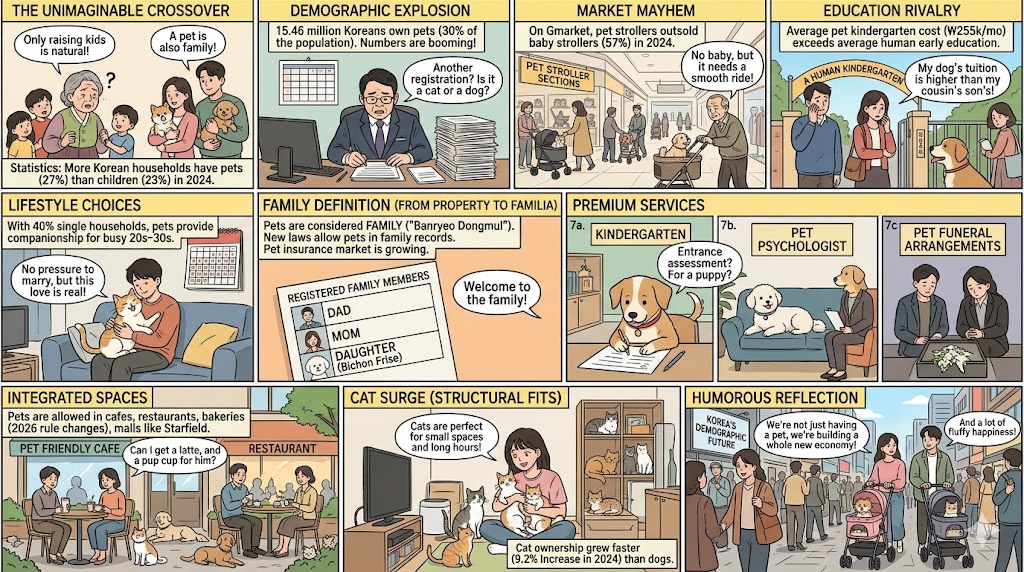
Korean pet culture has crossed a threshold that would have been unimaginable a generation ago — more Korean households now own pets than raise children.
The numbers: as of the end of 2024, 15.46 million Koreans own pets — approximately 30% of the total population. Nearly 27% of all Korean households include a companion animal. By comparison, only 23% of Korean households have children living in them. The crossover happened quietly, statistically, without a single announcement — but it represents one of the most significant social transformations in modern Korean history.
The market that has grown around this transformation is staggering. The Korean pet industry is projected to reach ₩6 trillion ($4.4 billion) by 2027 and ₩21 trillion by 2032. On the online shopping platform Gmarket, pet strollers outsold baby strollers for the first time in 2024 — accounting for 57% of all stroller sales. Dog kindergartens in Seoul charge an average of ₩255,000 ($180) per month — more than the average cost of early childhood education.
Korea has not simply discovered that it likes animals. It has constructed an entirely new economic and emotional ecosystem around them — one that is, in significant part, a direct response to the conditions that have made human family formation feel impossible or undesirable for millions of Koreans.
For the demographic crisis that accelerated this shift, read our Korea Birth Rate Guide. For the work-life pressures that make pet ownership more manageable than parenthood, read our Korean Work-Life Balance Guide.
Korean Pet Culture: The Numbers
| 지표 | 수치 |
|---|---|
| 반려동물 보유 인구 | 1,546만 명 (인구의 30%) |
| 반려동물 보유 가구 | 591만 가구 (전체 가구 26.7%) |
| 반려동물 보유 vs 자녀 보유 | 30% vs 23% |
| 월평균 반려동물 지출 | 19만 4,000원 ($142) |
| 펫 시장 규모 (현재) | ₩4.5조 |
| 펫 시장 규모 (2032년 전망) | ₩21조 |
| 반려동물 양육 만족도 | 76% (전년 대비 8.7%p 증가) |
The satisfaction figure is particularly striking. Seventy-six percent of Korean pet owners report contentment with raising a companion animal — a number that rose nearly nine percentage points in a single year. For context: surveys of Korean parents about satisfaction with raising children consistently show lower numbers, with a significant proportion citing regret or ambivalence about the decision to have children given the financial and professional costs involved.
Korean Pet Culture: Why It Happened
저출산과 1인 가구 (Low Birth Rate and Solo Living)
The demographic forces driving Korean pet culture are the same ones driving everything else unusual about contemporary Korean society. A population that is not forming families at replacement rate is a population with surplus emotional capacity, surplus disposable income (no children means significantly higher discretionary spending), and a genuine need for connection and daily purpose.
Korea’s single-person household rate has surpassed 40% of all households. Young Koreans in their 20s and 30s — living alone in small Seoul apartments, working long hours, navigating expensive cities — are the fastest-growing segment of pet owners. For this demographic, a cat or small dog is not a substitute for something else. It is a deliberate, rational choice about how to structure daily life.
핵가족의 해체 (Breakdown of the Extended Family)
A generation ago, Korean households were multigenerational by default — grandparents, parents, and children living together or in close proximity. That structure provided built-in emotional support, connection, and purpose. As urbanization concentrated Korea’s population in apartment cities far from extended family networks, and as the multigenerational household gave way to nuclear and single-person households, pets filled a structural emotional vacancy.
The government’s own reports have acknowledged this directly: “With increasing loneliness in society, the domestic pet industry is expected to grow even further.”
반려동물의 가족화 (Pets as Family Members)
The Korean cultural framework for pets has shifted from “property” to “가족” (family member) with a speed that has surprised even industry observers. Korean pet owners now:
- Register pets in family records (a legislative option introduced as pet culture normalized)
- Purchase pet insurance (Korea’s first dedicated pet insurer, MyBrown, launched 2025)
- Enroll pets in kindergartens with entrance assessments
- Hire pet psychologists and behavioral therapists
- Plan pet funerals and pay for pet cremation
- Take paid bereavement leave for deceased pets at progressive employers
The phrase 반려동물 (banryeo dongmul) — which replaced the older 애완동물 (aewan dongmul, “pet”) — is itself significant. 반려 means “companion” or “life partner.” The linguistic shift encodes the relationship change.
Korean Pet Culture: The Industries It Created
펫 유치원 (Pet Kindergartens)
Dog kindergartens — full-day facilities where dogs attend classes in obedience, socialization, and group play — are one of the most distinctly Korean developments in global pet culture. At facilities like Dog Us Planet in Seoul, dogs undergo a three-hour entrance assessment before admission. The monthly fee of ₩255,000 exceeds the average cost of early childhood education for human children.
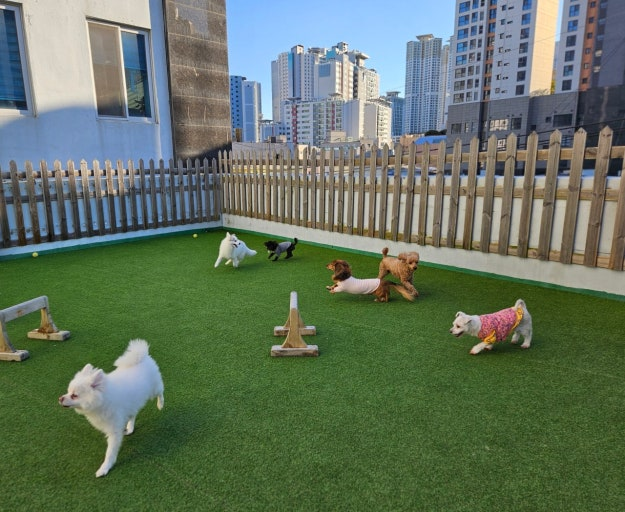
The kindergarten sector is one of the fastest-growing employment categories in Korea, with job postings rising 21% from 2021 to 2025. The parallel to human education culture — with its entrance assessments, academic tracks, and parental investment — is not coincidental.
펫 의료 (Pet Healthcare)
Veterinary costs in Korea rose 78% from 2023 to 2025 — a reflection of both increased demand and an expanding range of available treatments. Korean veterinary medicine has adopted technologies that were recently available only in human healthcare:
SK Telecom의 X Caliber: An AI-powered veterinary diagnostic service that analyzes pet X-rays to assist veterinarians in making more accurate diagnoses — a direct application of the same AI infrastructure that powers Korean consumer technology.
펫 보험 (Pet Insurance): Korea’s pet insurance market generated $129 million in 2024 and is projected to reach $380 million by 2030. MyBrown — Korea’s first insurance company built entirely around pet-specific risk models — launched in 2025, signaling the sector’s maturation into a standalone financial category.
Medical expenses for pets nearly doubled over recent years, climbing from ₩577,000 to over ₩1 million per year for the average pet-owning household.
펫 프렌들리 공간 (Pet-Friendly Spaces)
Korean retail and dining infrastructure is adapting to pet culture at speed.
Shopping mall Starfield Suwon opened a dedicated rooftop space for dogs in 2024. Starfield Anseong provides pet stroller rentals, a designated pet lounge near the food court, and an on-site pet park. Lotte Premium Outlet opened a 14,200 square foot pet park and dining area.
From March 2026, Korean regulation changes will allow pets into general restaurants, cafes, and bakeries — a structural shift that will further integrate pets into Korean public life and further reshape the dining and café industries.
펫 스트롤러 (Pet Strollers)
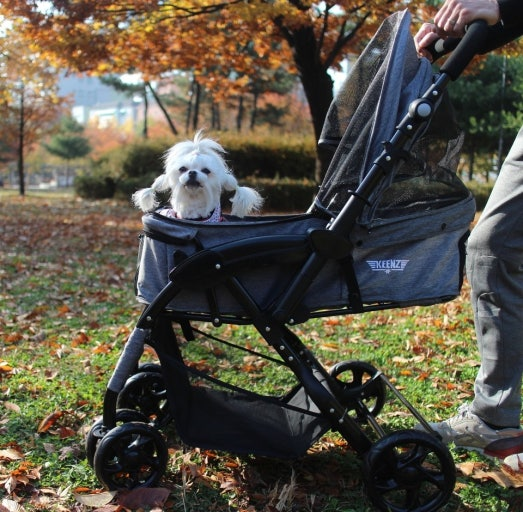
The pet stroller — a wheeled carriage for dogs and cats that mirrors a baby stroller in form and function — is perhaps the single most visible symbol of Korean pet culture’s trajectory. In 2024, pet strollers outsold baby strollers on Gmarket for the first time. The product category is not a niche. It is mainstream Korean consumer behavior, visible in every park, shopping center, and apartment complex in major cities.
Korean Pet Culture: The Dog Meat Ban
On January 9, 2024, the Korean National Assembly passed the Special Act on the Protection of Dogs — effectively banning the dog meat industry, which had existed in Korea for centuries.
The legislation was significant for what it revealed about the speed and depth of the cultural shift. Dog meat consumption had been declining for decades as younger Koreans — who grew up with dogs as household companions — found the practice incompatible with their relationship to the animals. The 2024 ban formalized a cultural reality that had already substantially arrived: a country that once ate dogs had, within a generation, reframed them as family members deserving legal protection.
The ban passed with broad political support and minimal effective opposition. The dog meat industry had already shrunk significantly — not through legislation but through cultural change. The law ratified what Korean society had largely already decided.
Korean Pet Culture: The Cat Surge
While dogs remain the most owned pet in Korea — approximately 5.5 million dogs versus 2.17 million cats — cat ownership is growing significantly faster. Cat populations rose 9.2% year-on-year in 2024. The majority of new cat owners are in their 20s and 30s.
The reasons are structural. Cats require less space than dogs, are more compatible with long working hours, do not require outdoor exercise, and can be left alone during 12-hour workdays without significant welfare concerns. In a country where most young people live in small apartments and work extreme hours, cats are the more practically compatible companion.
Korean Shorthair dominates at 44.7% of owned cats, followed by Russian Blue at 12.8% and Persian at 9.6%. Cat cafes — spaces where customers pay hourly fees to spend time with resident cats — remain a thriving industry that has influenced café culture globally, originating in Taiwan but finding its most commercially developed form in Korea.
Korean Pet Culture: What Visitors Will Notice
Walking through any major Korean neighborhood makes the scale of pet culture immediately visible:
카페 (Pet Cafes): Cat cafes, dog cafes, and increasingly rabbit, otter, and raccoon cafes exist throughout Seoul — particularly in Hongdae, Insadong, and Sinchon. The format has been exported globally but remains most densely concentrated in Korean cities.
한강공원 (Han River Parks): The riverside parks are significant dog-walking destinations on weekends, with dedicated dog areas and an informal social culture among pet owners.
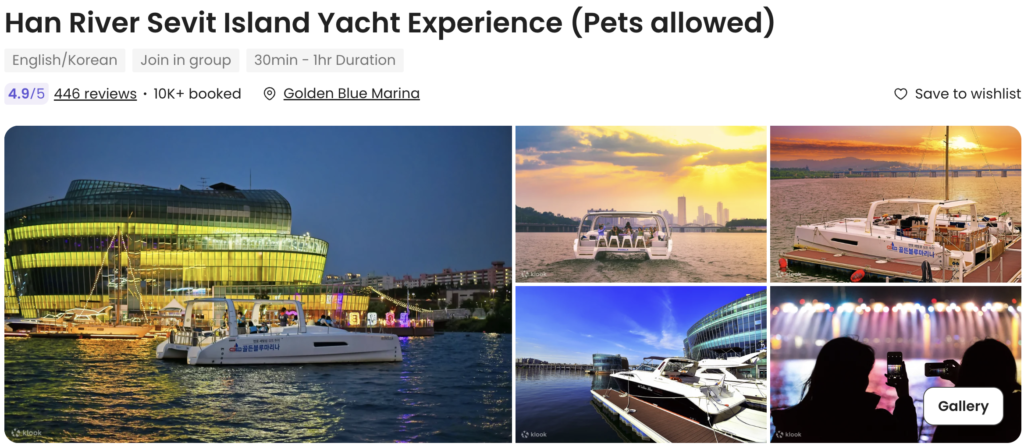
반려동물 동반 매장 (Pet-Friendly Stores): Major retail chains now explicitly market pet-friendly policies. Starbucks Korea offers pet-friendly outdoor seating at most locations. Department stores increasingly provide pet amenities at entrances.
펫 스트롤러 (Pet Strollers): Visible in virtually every commercial district, park, and shopping center — pushed by owners who consider their pets’ comfort with the same care they would apply to a young child’s.
Korean Pet Culture: FAQ
Do Koreans really have more pets than children? Yes. As of recent data, approximately 27% of Korean households own pets while only 23% have children. Pets outnumber children across Korean households — a demographic crossover that reflects both rising pet ownership and declining birth rates simultaneously.
How much do Koreans spend on pets monthly? The average Korean pet-owning household spent ₩194,000 ($142) per month on pets in 2024 — a figure that has risen significantly over recent years and is projected to continue growing. Medical expenses for pets nearly doubled from 2023 to 2025.
Is dog meat still eaten in Korea? The Korean National Assembly passed a ban on the dog meat industry in January 2024, effectively ending commercial dog meat production and sale. Consumption had already declined substantially before the ban, particularly among younger Koreans.
What pet cafes can visitors experience in Seoul? Cat cafes, dog cafes, and specialty animal cafes exist throughout Hongdae, Insadong, Sinchon, and most major tourist districts. Most charge hourly fees of ₩8,000–₩15,000 which typically include a drink. No reservation is required at most locations.
Why do Koreans treat pets like children? The shift reflects multiple factors: declining birth rates, rising single-person household rates, the breakdown of extended family networks, and a generational change in how Koreans conceptualize relationships with animals. The term 반려동물 (companion animal) encodes this — 반려 means “life companion,” not simply “pet.”
What is the Korean pet market projected to be worth? The Korean pet market is projected to reach ₩6 trillion ($4.4 billion) by 2027 and ₩21 trillion by 2032 — making it one of the fastest-growing consumer sectors in Korea and one of the most significant pet markets in Asia.

Korea Insider has lived in South Korea for 50 years and worked at international companies for over two decades — explaining Korean culture, food, and society to colleagues from the US, Europe, and Australia.
Internationally married with a Japanese spouse, Korea Insider brings both an insider’s depth and an outsider’s perspective to every topic on My Korea Tip.