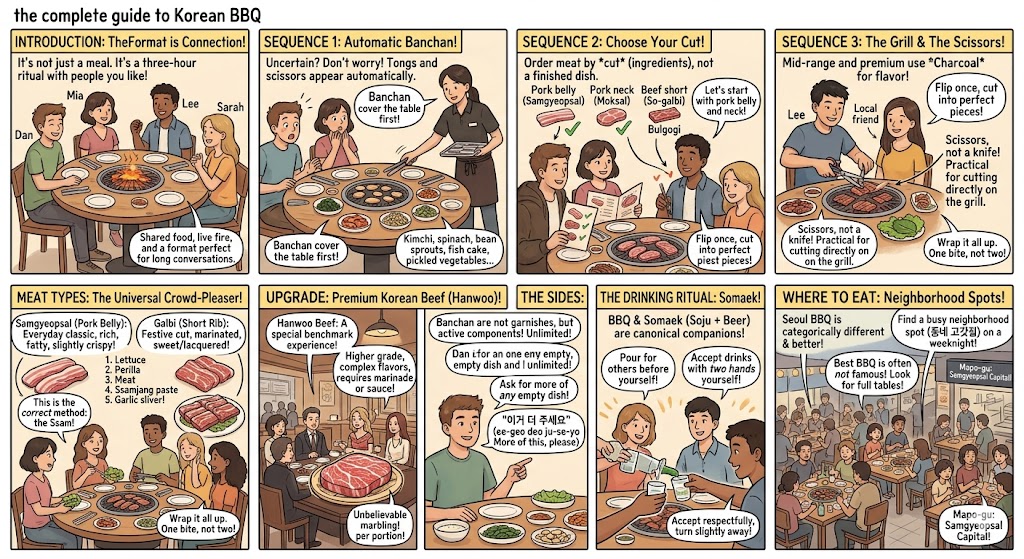
Korean BBQ is not a meal — it is a format for spending three hours with people you want to spend three hours with.
The structure is this: raw meat arrives at your table, you grill it yourself over a live fire built into the center of the table, you eat it as it comes off the grill in small pieces wrapped in lettuce with garlic and fermented paste, and you repeat this process until everyone is full and happy and the table is covered in empty glasses. Side dishes — unlimited and refillable — arrive without being ordered. The meat is paid for. Everything else is included.
This format explains why Korean BBQ has become one of the most globally replicated dining concepts of the past decade, with over 2,000 Korean BBQ restaurants now operating in the United States alone, and the category growing at 8.3% annually through 2025 according to food industry data. What you get in Seoul, however, is categorically different — better meat, better banchan, better price, and the full ritual performed correctly in a country where the ritual was invented.
This guide covers everything: which meat to order, how the grill works, what to do with the side dishes, how much it costs, and where to go in Seoul for the definitive version.
For the full Korean food picture, read our Korean Street Food Guide — BBQ sits at one end of a dining culture that runs from street pojangmacha to Michelin-starred hansik.
Korean BBQ: How It Actually Works
Most first-timers walk into a Korean BBQ restaurant and immediately feel uncertain. The uncertainty is reasonable — there is a grill in the table, tongs appear, scissors materialize, and no one explains anything because everyone around you already knows.
Here is the sequence:
1. You sit down, side dishes arrive automatically. Banchan — small shared plates of kimchi, spinach, bean sprouts, fish cake, pickled vegetables — cover the table before you order anything. These are unlimited and refillable. Ask for more of anything by pointing at the empty dish and saying “이거 더 주세요” (ee-geo deo ju-se-yo / “more of this, please”).
2. You order meat by cut. The menu is organized by cut and grade, not by “dish.” You are choosing ingredients, not a finished plate. Start with one or two cuts, assess, order more.
3. The grill is lit. Charcoal or gas depends on the restaurant. Charcoal (숯불구이, sut-bul-gu-i) is considered superior — higher heat, smokier flavor, more traditional. Most mid-range and premium restaurants use charcoal. Budget restaurants typically use gas. Both work. Charcoal is worth seeking out.
4. The server often grills for you at premium restaurants. At casual spots, you grill yourself. There is no wrong answer. If the server offers to grill, accept — they know the timing better than you do. If you’re at a self-grill spot, the technique is: place meat on the hot grill, don’t move it until it releases naturally, flip once.
5. Scissors, not a knife. Koreans cut grilled meat with kitchen scissors directly on the grill — a practical solution to the problem of transferring hot meat to a cutting board. The server or a member of your group will cut. Do not resist the scissors.
6. Assembly: the ssam wrap. Take a lettuce leaf (상추, sangchu) or perilla leaf (깻잎, kkaennip) in your palm. Add a small piece of grilled meat. Add a small amount of ssamjang (fermented soybean-chili paste). Add a sliver of raw garlic. Add a small piece of grilled garlic if available. Fold the leaf around everything and eat in one bite. This is the correct method. One bite — not two.
Korean BBQ: The Cuts You Need to Know
| Korean Name | What It Is | Flavor Profile | Best For |
|---|---|---|---|
| 삼겹살 (Samgyeopsal) | Thick-cut pork belly | Rich, fatty, slightly crispy | First-timers, universal crowd-pleaser |
| 목살 (Moksal) | Pork neck | More complex than belly, less fatty | Second order after samgyeopsal |
| 소갈비 (So-galbi) | Beef short rib, bone-in | Deep, beefy, slightly sweet from marinade | Special occasion, premium |
| 불고기 (Bulgogi) | Thinly sliced marinated beef | Sweet, soy-forward, tender | Approachable entry point |
| 항정살 (Hangjeonsal) | Pork jowl | Rare, intensely flavorful, fatty | Order when available, locals’ favorite |
| 꽃등심 (Kkot-deungsim) | Ribeye, beef | Premium, marbled, buttery | Highest tier beef experience |
The correct first order for two people: One portion of samgyeopsal (삼겹살) and one portion of pork neck (목살). This covers the fat-forward classic and a more complex alternative. Add beef on a second visit when you understand what you’re comparing.
The upgrade order: Korean beef (한우, Hanwoo) is a separate and significantly more expensive category — marbling grades similar to Japanese wagyu, flavors that require no marinade and no sauce. A portion of Hanwoo ribeye at a premium restaurant runs ₩40,000–₩80,000 per portion. It is worth ordering once.
Korean BBQ: The Banchan (Side Dishes)
Banchan are not garnishes. They are active components of the meal, consumed between bites of meat to reset the palate and add variety to each mouthful.
The core banchan you will find at almost every Korean BBQ restaurant:
- 김치 (Kimchi): Fermented napa cabbage. The baseline. Eat it between every few bites of pork.
- 깍두기 (Kkakdugi): Cubed radish kimchi — crunchier and cleaner than napa kimchi, ideal with fatty pork belly.
- 된장찌개 (Doenjang-jjigae): Fermented soybean paste stew — often served as a side at the end of the meal. The complexity of the fermented soybean against the grilled meat is one of the essential Korean flavor combinations.
- 계란찜 (Gyeran-jjim): Steamed egg soufflé — arrives in a stone pot, soft and savory. One of the most requested side dishes by first-time visitors.
- 공깃밥 (Gonggi-bap): Steamed white rice — usually ordered separately (₩1,000–₩2,000 per person) and used to add bulk toward the end of the meal.
The rule: Banchan are communal and refillable. Asking for more is normal and expected — you are not being demanding, you are participating correctly.
Korean BBQ: Samgyeopsal vs. Galbi vs. Bulgogi
The three terms most Westerners already know before arriving — and frequently confuse:
삼겹살 (Samgyeopsal) is the Korean BBQ experience as most Koreans actually eat it. Thick-cut pork belly, unmarinated, grilled over charcoal, eaten with ssamjang and garlic. No marinade means the flavor is entirely the meat and the fire. This is the everyday version — ordered at neighborhood gopchang spots on Tuesday nights, not reserved for special occasions.
갈비 (Galbi) is short rib, typically marinated in a soy-sesame-sugar sauce before grilling. Beef galbi (소갈비) is a celebratory cut — the one ordered at family gatherings and business dinners. Pork galbi (돼지갈비) is more casual and significantly cheaper. The marinade caramelizes on the grill, creating a lacquered, slightly sweet exterior.
불고기 (Bulgogi) is thinly sliced beef marinated in a sweet soy sauce. Technically a pan dish — the thin slices cook better in a pan than on a grill, which is why many BBQ restaurants serve it separately rather than at the grill. The version you’ve had outside Korea — at Korean-American restaurants — is almost always a version of bulgogi. The Korean original is more complex.
Korean BBQ: How Much It Costs
| Item | Price Range |
|---|---|
| Samgyeopsal (pork belly, 1 portion ~200g) | ₩12,000–₩18,000 |
| Galbi (beef short rib, 1 portion) | ₩20,000–₩40,000 |
| Hanwoo beef (premium Korean beef, 1 portion) | ₩40,000–₩90,000 |
| Steamed rice (per person) | ₩1,000–₩2,000 |
| Korean beer (500ml) | ₩4,000–₩6,000 |
| Soju (bottle) | ₩5,000–₩8,000 |
| Total for two (pork + drinks, casual restaurant) | ₩45,000–₩70,000 |
| Total for two (beef + drinks, premium restaurant) | ₩100,000–₩180,000 |
Banchan and lettuce wraps: always included, always free, always refillable.
The price difference between casual and premium is entirely in the meat grade. Service, atmosphere, and banchan quality improve at higher price points, but the format is identical.
For complete Korea travel spending context, read our Korea Travel Budget Guide.
Korean BBQ: The Drinking Ritual
Korean BBQ and alcohol are inseparable — the combination has its own cultural logic.
소맥 (Somaek): The canonical Korean BBQ drink. Soju poured into a glass of beer — approximately 1 part soju to 3 parts beer — creating something lighter than soju and stronger than beer. Most tables at a Korean BBQ restaurant operate on somaek. The ratio is personal; the concept is universal.
The pouring etiquette:
- Pour for others at the table before pouring for yourself. Ideally, you never pour your own drink.
- Accept drinks with two hands, or with your right hand while touching your right forearm with your left hand — the respectful receiving gesture.
- When drinking with someone older or more senior, turn slightly away from them and cover your mouth with your hand while drinking. This is not required for foreigners but is noticed and appreciated.
- Empty glasses get refilled. Keep attention on the glasses of people across from you.
For the complete guide to Korean drinking culture and the games that go with it, read our Korean Drinking Games Guide.
Korean BBQ: Where to Eat in Seoul
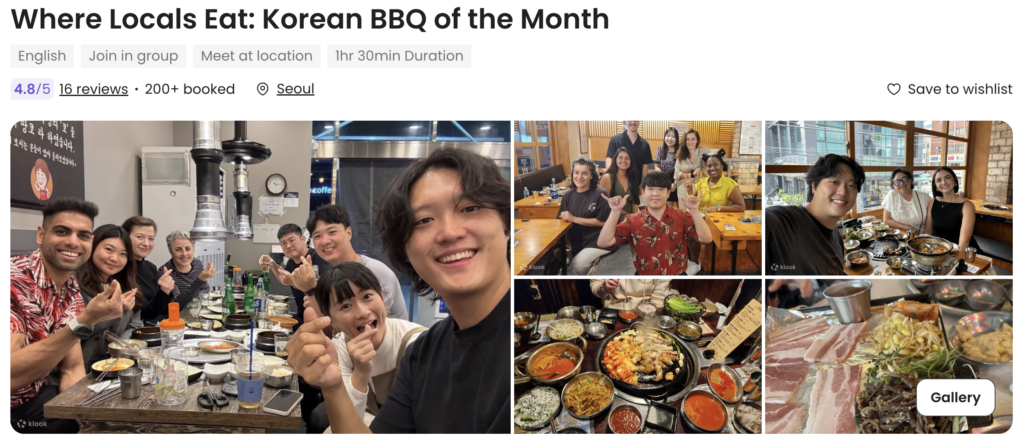
“Want to skip the guesswork and eat Korean BBQ with a local guide who knows exactly which restaurant to go to and which cuts to order? A Seoul Korean BBQ experience on Klook includes a curated restaurant, ordering guidance, and the full samgyeopsal ritual — the fastest way to eat like you’ve been doing this for years.”
Mapo-gu (마포구) — The Samgyeopsal Capital
The Mapo district, particularly the area around Mapo Station and Gongdeok Station, is considered the spiritual home of Seoul samgyeopsal culture. The density of high-quality pork belly restaurants per square block is unmatched anywhere in the city. Mapo Jeong-dae-po and the surrounding side streets are the correct starting point for anyone serious about pork belly.
Mapo Galmaegi-sal Alley (마포 갈매기살 골목)
A narrow alley near Mapo Station lined entirely with restaurants specializing in galmaegi-sal (pork skirt meat) — a thinner, more intensely flavored cut that is nearly impossible to find outside Korea. One of the most distinctive neighborhood dining experiences in Seoul.
Hanwoo Restaurants near Hannam-dong
The premium Hanwoo beef experience is concentrated in the wealthier districts — Hannam-dong, Cheongdam-dong, and Apgujeong. Expect to spend ₩80,000–₩150,000 per person. The correct context is a special occasion or a deliberate benchmark experience.
Neighborhood spots (동네 고깃집)
The best Korean BBQ in Seoul is frequently not famous. The correct strategy: find a busy neighborhood spot (full tables at 7 PM on a Tuesday is the signal), look at what the tables around you are ordering, and order the same thing. This approach consistently produces better results than tourist-facing restaurants.
For the full neighborhood guide to Seoul’s best eating districts, read our Seoul Neighborhoods Guide.
Korean BBQ: Useful Phrases for Ordering
| What You Want | Korean | Pronunciation |
|---|---|---|
| Pork belly, one portion | 삼겹살 1인분 주세요 | Sam-gyeop-sal il-in-bun ju-se-yo |
| More of this, please | 이거 더 주세요 | Ee-geo deo ju-se-yo |
| Soju, one bottle | 소주 한 병 주세요 | So-ju han byeong ju-se-yo |
| Beer, please | 맥주 주세요 | Maek-ju ju-se-yo |
| The bill, please | 계산해 주세요 | Gye-san-hae ju-se-yo |
| Delicious | 맛있어요 | Ma-shi-sseo-yo |
Korean BBQ: FAQ
Do I have to grill the meat myself? Not necessarily. At premium restaurants, the server grills for you. At mid-range and casual spots, you grill yourself — the staff will usually intervene if you’re doing it wrong, which is a courtesy, not a criticism.
Is Korean BBQ vegetarian-friendly? The banchan are mostly vegetarian (check individual dishes — some contain seafood or anchovy broth). The grill itself is a meat environment. Vegetarians are better served by dedicated Korean vegetarian restaurants (채식당) than by attempting to navigate a BBQ restaurant.
Is tipping expected at Korean BBQ restaurants? No. Tipping is not customary in Korea. Attempting to leave a tip often causes confusion. The price on the bill is the price. Read our Korea Travel Tips Guide for the full etiquette picture.
What’s the difference between Korean BBQ in Korea vs. outside Korea? Primarily: meat quality, banchan variety, grill type (charcoal vs. gas), and price. A comparable meal in Seoul costs 40–60% less than the equivalent in New York or Los Angeles, with better meat and more side dishes. The format is the same; the execution is better at the source.
Can I make a reservation? Most casual and mid-range Korean BBQ restaurants do not take reservations — you walk in and wait if there’s no table. Premium Hanwoo restaurants typically do. Arriving before 6:30 PM avoids the main dinner rush.
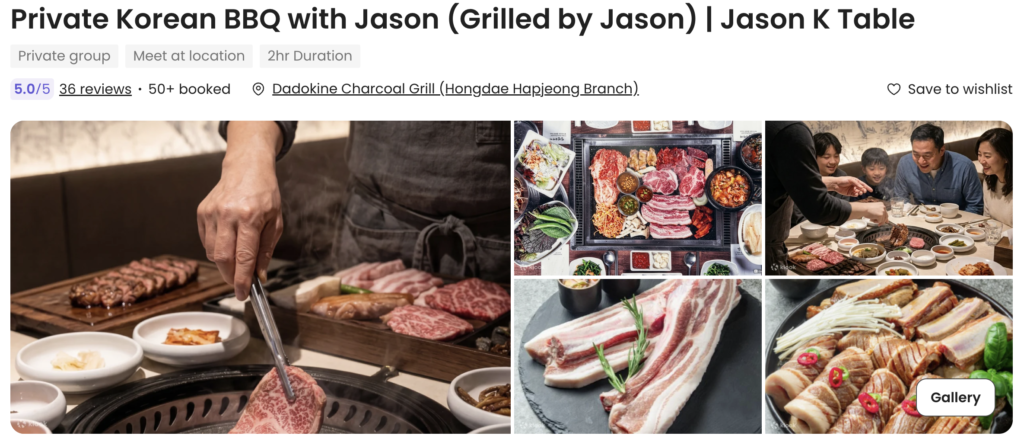
Korean BBQ is the best possible introduction to how Koreans actually eat and socialize — the combination of live fire, shared food, and unlimited refillable sides creates a format that other cuisines have tried and failed to replicate. Eat it at least twice: once to understand it, once to enjoy it.
For the complete Korean food and drink picture, read our Korean Fried Chicken Guide for the chimaek culture that follows a BBQ dinner, and our Korean Street Food Guide for the daytime eating that bookends it.