
Korean ramen — called ramyeon (라면) by locals — is one of the most beloved foods in the country, and understanding it properly takes more than reading the packet.
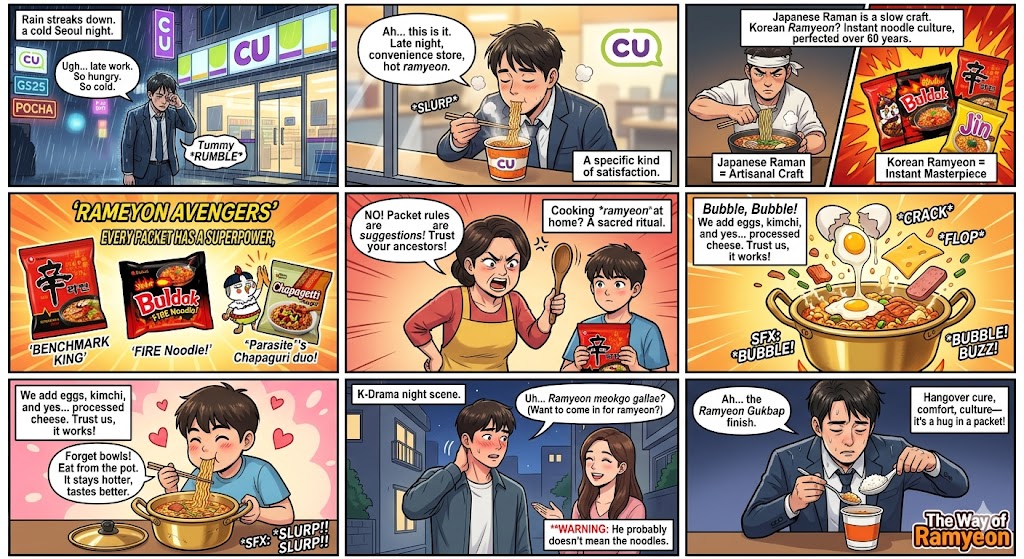
Koreans don’t call it ramen. They call it ramyeon (라면) — a distinction that matters more than it sounds. Japanese ramen is fresh noodles, carefully made broth, and considered craft food. Korean ramyeon started as instant noodles in the 1960s and evolved into its own culture — one that encompasses convenience store cups, restaurant bowls, home cooking rituals, and now a global export that fills grocery store shelves from Los Angeles to London.
This guide covers all of it: the best Korean ramyeon brands, where to eat it properly, how Koreans actually cook it at home, and why it became one of the most beloved foods in the country.
For more on Korean food culture, read our Korean Food for Beginners Guide and Korean Street Food Guide.
Korean Ramyeon vs Japanese Ramen: What’s the Difference?
The confusion is understandable — both words trace back to the Chinese lamian. But the eating experiences are entirely different.
Japanese ramen is a fresh-noodle dish built around a slow-cooked broth — tonkotsu, shoyu, miso, or shio — with carefully selected toppings. A bowl at a good Tokyo ramen shop represents hours of preparation and is treated as serious food.
Korean ramyeon is primarily an instant noodle culture. The noodles are dried and fried, the flavoring comes from a powder or paste packet, and the whole thing is ready in three minutes. This sounds like a criticism. It isn’t. Korean instant ramyeon is genuinely excellent — the flavors are bolder, spicier, and more complex than equivalent products anywhere else in the world, and the culture around eating it has developed its own rituals and preferences over six decades.
There are also proper Korean ramyeon restaurants — called ramyeon jip (라면집) — where fresh or semi-fresh noodles are cooked in house-made broths with proper toppings. These exist in a middle space between Japanese ramen craft and instant noodle culture, and they’re worth seeking out.
The History of Korean Ramyeon
Korean ramyeon has a specific origin story. In 1963, Samyang Foods introduced the first Korean instant noodle — modeled on Japanese instant ramen technology — as a solution to post-Korean War food shortages. The product was positioned as an affordable, filling meal at a time when rice was scarce.
It worked. Within a decade, ramyeon had become embedded in Korean daily eating culture in a way that went far beyond its original utilitarian purpose. By the 1980s, Nongshim had entered the market and launched Shin Ramyun — the product that would eventually become the best-selling instant noodle in Korea and one of the most recognized Korean food exports globally.
I grew up eating ramyeon in the 1980s when it was genuinely considered a staple, not a guilty pleasure. My mother had specific opinions about which brands were worth buying and which weren’t. That level of engagement with instant noodle culture is still completely normal in Korean households today.
The Best Korean Ramyeon Brands
Shin Ramyun (신라면) — Nongshim
The benchmark. Launched in 1986, Shin Ramyun is the most widely consumed instant noodle in Korea and the standard against which everything else is measured. The broth is spicy beef-based with mushroom notes — not overwhelmingly hot, but with a clean, persistent heat that builds gradually. The noodles have good chew. It’s available in original, black (richer beef broth), and cup versions.
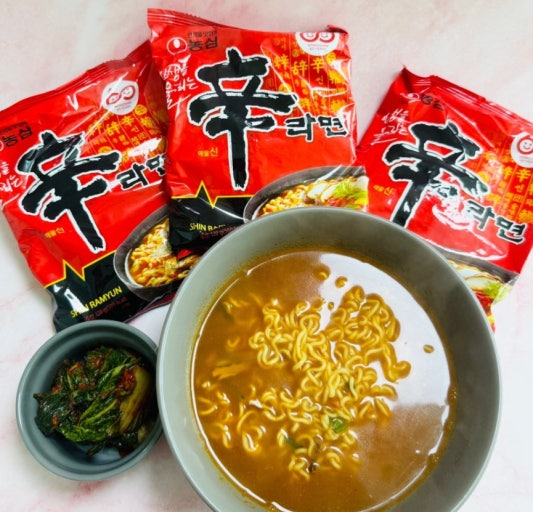
If you try one Korean ramyeon, this is the one.
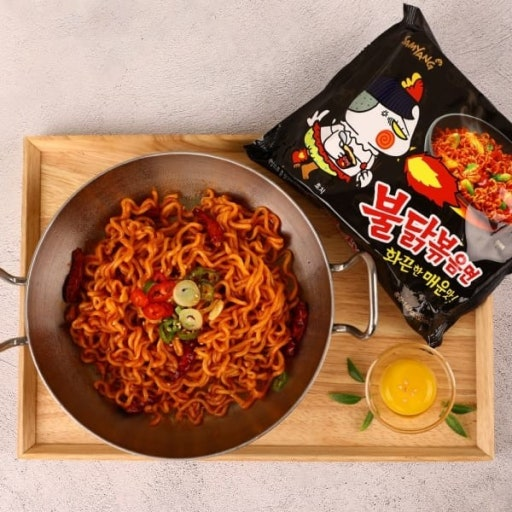
Buldak Bokkeummyeon (불닭볶음면) — Samyang
The fire noodle. Launched in 2012, Buldak became a global phenomenon after the fire noodle challenge spread across YouTube. The heat level is genuinely intense — significantly hotter than Shin Ramyun — and the sauce-based format (stir-fry style, not broth) is different from most Korean ramyeon. Available in original, carbonara, curry, jjajang, and several other variations. Read our full Buldak Korean Spicy Noodles Guide for the complete breakdown.
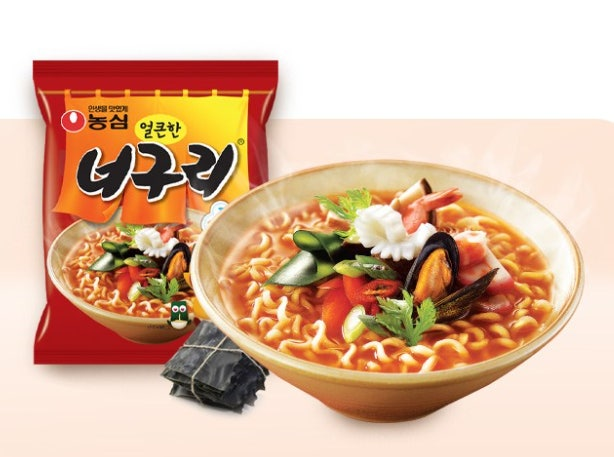
Neoguri (너구리) — Nongshim
Seafood-based spicy broth with thick, chewy udon-style noodles. Neoguri has a devoted following in Korea — the noodle texture is distinctive and the seafood flavor is genuine. A classic choice for people who want something different from the standard beef broth profile.
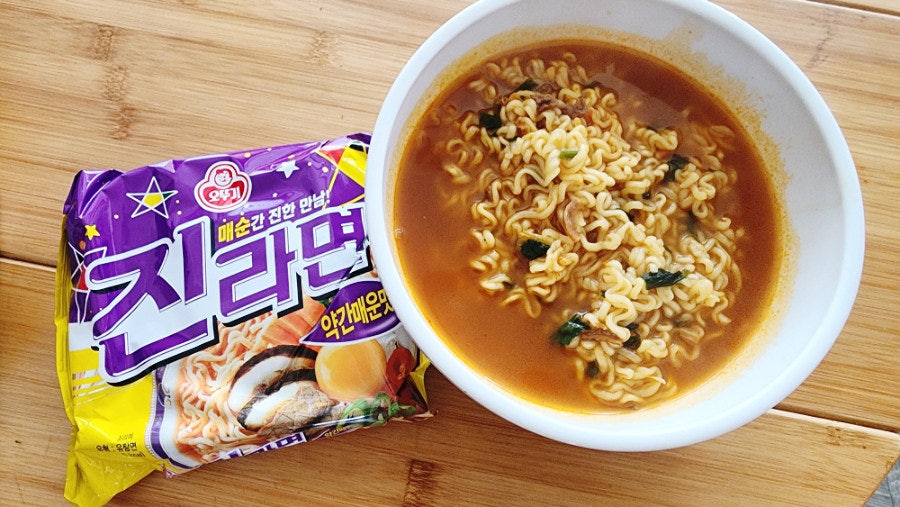
Jin Ramen (진라면) — Ottogi
Available in mild and spicy versions. Jin Ramen is the go-to for people who find Shin Ramyun too intense — the mild version has a clean, savory flavor that works well as a base for adding ingredients. The spicy version is solid without being overwhelming. Widely eaten for breakfast in Korean households.
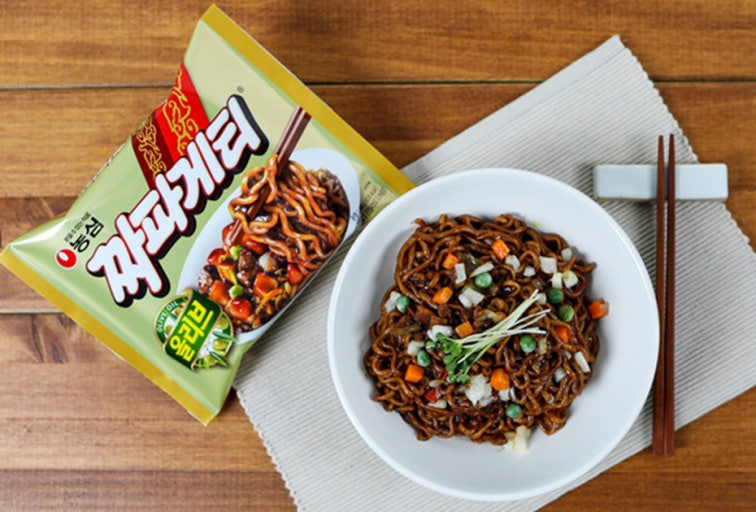
Chapagetti (짜파게티) — Nongshim
Korean jjajangmyeon in instant form — black bean sauce noodles that are stir-fried rather than served in broth. Chapagetti is a completely different eating experience from spicy ramyeon. Rich, savory, slightly sweet. The famous “Chapaguri” (Chapagetti + Neoguri combined) appeared in the film Parasite and briefly caused a global shortage of both products.
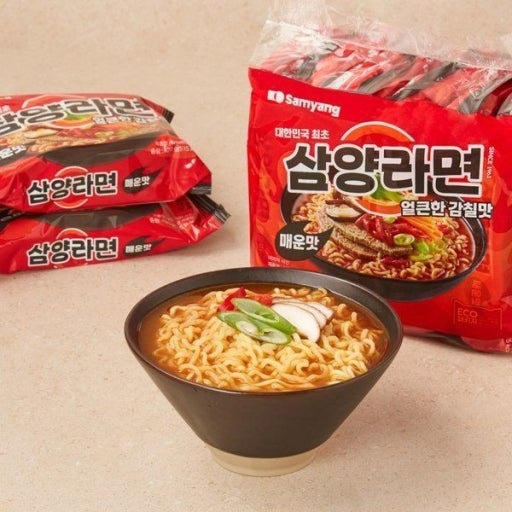
Samyang Ramen (삼양라면) — Samyang
The original. The first Korean instant noodle, still in production, with a milder and more nostalgic flavor profile than modern Korean ramyeon. Older Koreans often have a particular attachment to this one — it tastes like the 1960s in a meaningful way.
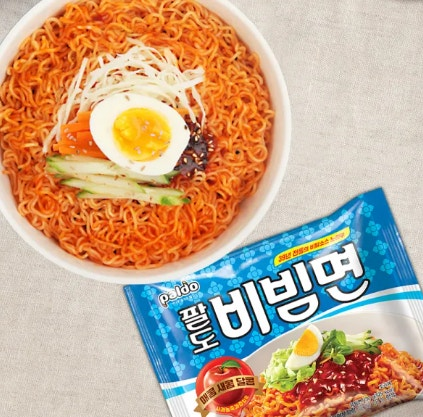
Paldo Bibimmyeon (팔도 비빔면) — Paldo
Cold noodles with a sweet and spicy sauce — eaten without broth after draining the cooking water. A summer staple in Korea. The flavor is quite different from standard ramyeon — tangier, fruitier, with a different kind of heat. Best eaten cold, ideally with a hard-boiled egg and cucumber slices.
How Koreans Actually Cook Ramyeon at Home
The packet instructions are a starting point, not a recipe. Koreans have strong opinions about how ramyeon should be cooked, and the variations are worth knowing.
The standard Korean method:
- Bring water to a full rolling boil — 550ml for most brands
- Add the noodles and flavor packet simultaneously (not after)
- Cook for exactly the time specified — 4 minutes for most brands
- The goal is noodles that are cooked through but still have chew, with broth that’s neither too thick nor too thin
Common additions Koreans make:
- Egg — cracked directly into the pot in the last minute of cooking, either stirred through or left as a poached egg on top
- Cheese — a slice of processed cheese placed on top of the finished bowl, allowed to melt into the broth. This sounds wrong. It isn’t.
- Kimchi — added during cooking for extra depth and fermented sourness
- Rice — added to the leftover broth after the noodles are eaten. This is called ramyeon gukbap (라면국밥) and is considered the correct way to finish a bowl
- Spam or sausage — sliced and added during cooking
- Tteok (rice cakes) — added for extra texture and substance
- Green onions — always, as a finishing garnish
The pot debate: Koreans have strong opinions about whether ramyeon tastes better eaten directly from the pot rather than transferred to a bowl. The consensus is yes, it does — and there’s actual science behind this. Eating from metal (the pot) keeps the noodles hotter longer and the thermal conductivity changes the perceived flavor slightly. Ramyeon pots — small single-serving metal pots — are sold specifically for this purpose.
Where to Eat Ramyeon in Korea
Convenience Store Ramyeon
The Korean convenience store ramyeon experience is genuinely essential. CU, GS25, and 7-Eleven all have hot water dispensers and microwaves, seating areas, and a full selection of cup and packet ramyeon. The ritual of eating cup ramyeon at a convenience store counter, particularly late at night, is one of the most authentic Korean food experiences available to visitors.
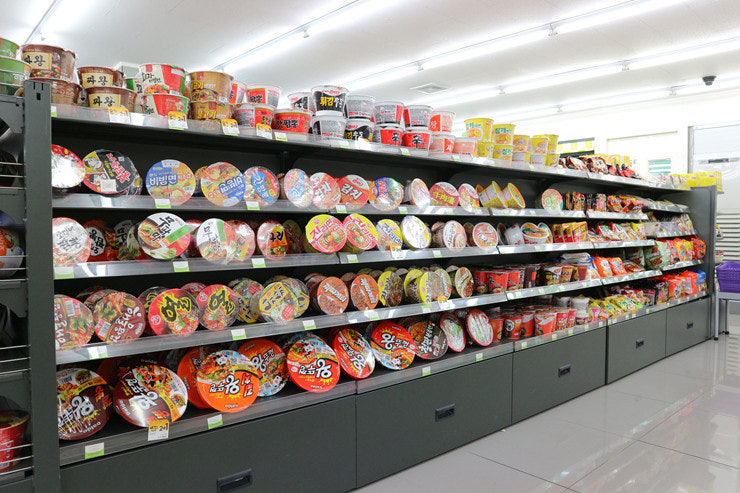
Cup Noodle at a convenience store costs ₩1,200–₩2,000. Read our Korean Convenience Store Guide for the full picture.
Ramyeon Restaurants (라면집)
Dedicated ramyeon restaurants exist throughout Korea — from simple pojangmacha-style spots to more considered establishments. The format varies: some serve instant noodles elevated with proper toppings and house-made additions, others cook fresh noodles in scratch-made broths.
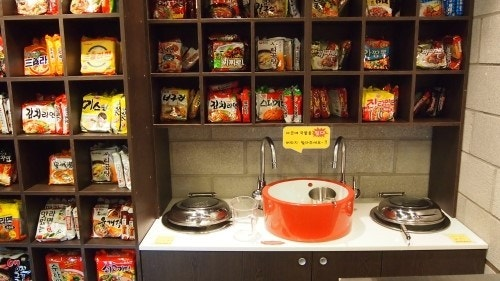
In Seoul, look for ramyeon restaurants in university areas — around Hongik University, Korea University, and Sinchon — where the combination of student budgets and food enthusiasm produces concentrated clusters of good-value ramyeon spots.
Army Stew (부대찌개 / Budae Jjigae)
Technically a separate dish, but deeply connected to ramyeon culture. Budae jjigae — army stew — was created in the area around US military bases after the Korean War, combining American surplus foods (Spam, hot dogs, canned beans) with Korean broth and kimchi. Ramyeon noodles are a standard component. The result is one of the most interesting and historically loaded dishes in Korean food culture.
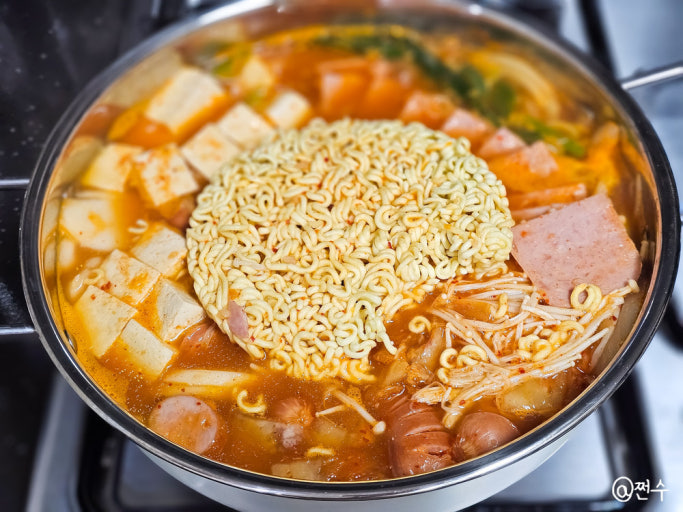
The best budae jjigae in Korea is found in Uijeongbu (의정부) and Songtan (송탄), the cities most historically associated with US military bases. Both are accessible as day trips from Seoul. Read our Seoul Day Trips Guide for how to get there.
Jjigae-style Ramyeon
Many Korean restaurants — particularly those serving Korean homestyle food — offer ramyeon cooked in a clay pot (뚝배기) with kimchi, tofu, and pork. This is significantly more substantial than standard instant ramyeon and occupies a middle ground between home cooking and restaurant dining.
Ramyeon in Korean Culture
Ramyeon’s place in Korean culture goes beyond food. It’s embedded in specific social rituals that non-Koreans sometimes find confusing.
“Ramyeon meokgo gallae?” (라면 먹고 갈래?) Literally “Do you want to come in for ramyeon?” — one of the most well-known Korean euphemisms for romantic interest. The phrase became culturally codified through its use in Korean dramas and now functions as both a genuine invitation and a knowing reference. If a Korean says this to you at the end of an evening, they probably don’t mean ramyeon.
Late-night eating culture Ramyeon is deeply associated with late-night eating in Korea — after studying, after drinking, after work. The combination of easy preparation, satisfying heat, and low cost makes it the default late-night food. Convenience store ramyeon at midnight is a cultural institution.
Hangover food Spicy ramyeon is widely considered an effective hangover remedy in Korea — the heat, the sodium, and the broth are thought to restore the body after a night of drinking. Whether this is physiologically accurate is debatable. That Koreans believe it and act on it is not.
Korean Ramyeon Internationally
Korean instant ramyeon is now one of the most widely distributed food products globally. Shin Ramyun is sold in over 100 countries. Buldak’s international distribution expanded dramatically after the fire noodle challenge. Korean convenience stores in major cities worldwide stock the full domestic range.
For visitors to Korea, the best souvenir shopping for ramyeon is at large supermarkets — E-Mart, Lotte Mart, or Homeplus — where the full range of flavors, limited editions, and multipack options is available at lower prices than convenience stores or airport shops. Olive Young also stocks select popular varieties.
How to Order Ramyeon in Korea
Most ramyeon restaurants have picture menus or food models. The vocabulary worth knowing:
| Korean | Pronunciation | Meaning |
|---|---|---|
| 라면 | Ra-myeon | Ramyeon (standard) |
| 곱배기 | Gop-bae-gi | Large portion |
| 덜 맵게 | Deol maep-ge | Less spicy |
| 더 맵게 | Deo maep-ge | More spicy |
| 계란 추가 | Gye-ran chu-ga | Add egg |
| 치즈 추가 | Chi-jeu chu-ga | Add cheese |
For a broader Korean language introduction, read our Korean Phrases for Travelers Guide.
FAQ
What is the most popular Korean ramyeon? Shin Ramyun by Nongshim has been the best-selling instant noodle in Korea for decades. It’s the standard benchmark for the category.
Is Korean ramyeon the same as Japanese ramen? No. Korean ramyeon is primarily an instant noodle culture — dried noodles with powder or paste flavoring, ready in minutes. Japanese ramen is a fresh-noodle restaurant dish built around slow-cooked broth. Both are excellent, but they’re different foods with different cultures around them.
How spicy is Korean ramyeon? It varies considerably. Jin Ramen mild is genuinely mild. Shin Ramyun is moderately spicy — noticeable heat but manageable for most people. Buldak is seriously hot and not suitable for people with low spice tolerance. Most products indicate their heat level on the packaging.
Can I buy Korean ramyeon outside Korea? Yes. Shin Ramyun and Buldak are available globally. Korean supermarkets in major cities stock the full range. Amazon and specialty Asian food retailers carry most popular varieties.
What do Koreans add to instant ramyeon? Most commonly: egg, cheese, kimchi, green onions, and tteok (rice cakes). The additions vary by personal preference and what’s available — the base packet is treated as a starting point rather than a finished product.
Is there a right way to eat ramyeon? From the pot, immediately, while it’s very hot. Letting ramyeon sit until the noodles go soft is considered a minor tragedy in Korean households.

Korea Insider has lived in South Korea for 50 years and worked at international companies for over two decades — explaining Korean culture, food, and society to colleagues from the US, Europe, and Australia.
Internationally married with a Japanese spouse, Korea Insider brings both an insider’s depth and an outsider’s perspective to every topic on My Korea Tip.