
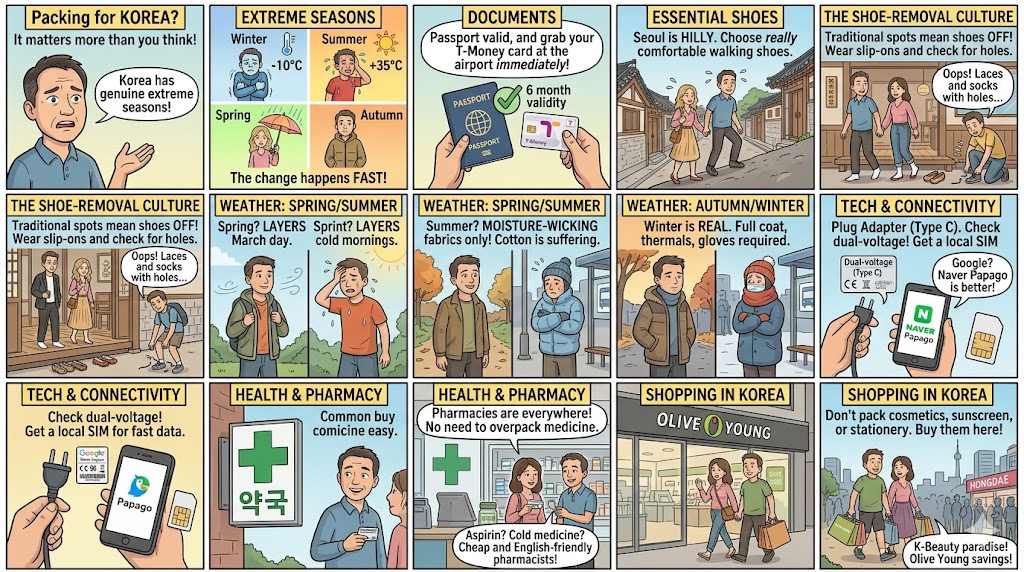
Knowing what to pack for Korea matters more than it does for most destinations, for reasons that aren’t immediately obvious. Korea has four genuinely extreme seasons — the summer humidity will ruin clothes that seemed fine in Europe, the winter cold arrives faster than most visitors expect, and the spring and autumn windows where everything is perfect are narrow enough that arriving dressed for the wrong one is a real possibility.
Beyond the climate, Korea has a culture of removing shoes in certain spaces, streets that involve far more walking than most city trips, and a pharmacy and convenience store network so comprehensive that packing half of what you’d normally bring is genuinely the right call. I’ve been watching foreign visitors arrive in Seoul my entire life — since 1975 — and the packing mistakes follow predictable patterns. Here is what I’d tell someone before they leave.
Documents & Money: The Non-Negotiables
Passport with at least six months validity remaining from your travel dates. Korean immigration enforces this.
Visa documentation if required for your nationality. Most Western passport holders (US, UK, EU, Australia, Canada) enter Korea visa-free for stays up to 90 days. Check current requirements close to your travel date as policies can change. My Korea visa guide covers the current rules by nationality.
Credit and debit cards — Visa and Mastercard are accepted almost everywhere in Seoul and in tourist areas across the country. Smaller traditional markets and some older restaurants remain cash-only. Carry the equivalent of ₩50,000–₩100,000 in Korean won for these situations.
Travel insurance documentation — Korea’s healthcare system is efficient and the costs are reasonable by international standards, but having documentation accessible saves time if you need a hospital visit.
T-Money card — technically you buy this in Korea, but knowing to do it immediately at the airport is worth noting here. The rechargeable transit card works on all Seoul subway lines, city buses across the country, and even convenience stores. My T-Money card guide covers where to get one and how much to load.
Clothes: Pack for the Season You’re Actually Going
Korea’s four seasons are genuinely distinct, and the gap between packing correctly and incorrectly has real consequences for your comfort. Check my best time to visit Korea guide for detailed month-by-month conditions — here is the practical version.
Spring (March–May) Layers. Mornings and evenings are cold (5–12°C), afternoons can reach 20°C+, and the change happens fast. A light down jacket or insulated layer for evenings, a mid-layer for variable daytime temperatures, and a couple of lighter tops for warm afternoons. March in particular catches visitors expecting spring and delivering early winter.
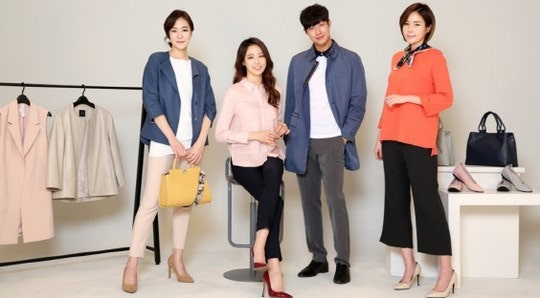
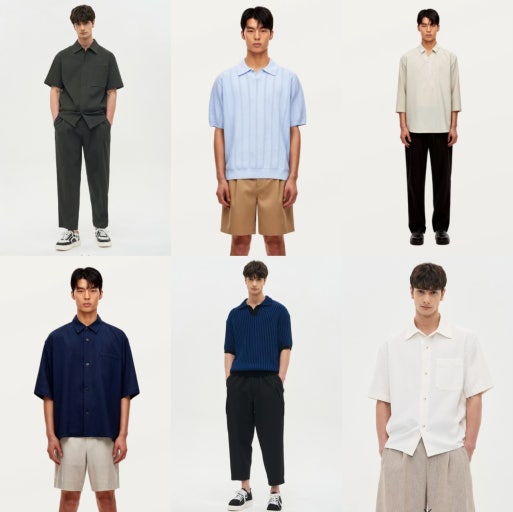
Summer (June–August) The most demanding season to pack for. July and August are hot (30–35°C), extremely humid, and punctuated by heavy monsoon rain. Lightweight, moisture-wicking fabrics are essential — cotton that feels fine in London becomes uncomfortable in Seoul summer within an hour. Two or three times more changes of clothes than you’d normally bring for the same trip length. A compact umbrella that actually works in heavy rain rather than a drizzle-resistant one. And sandals or breathable footwear — your feet will thank you.
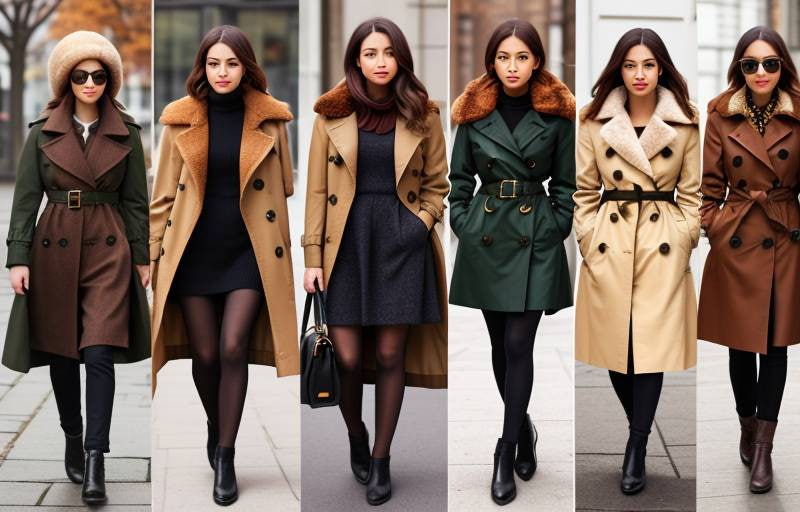
Autumn (September–November) The most straightforward season to dress for. September is warm and clear. October is cool and perfect. November turns cold quickly toward the end of the month. A medium-weight jacket with a packable layer underneath covers the full range. The easiest Korea packing situation of the four seasons.
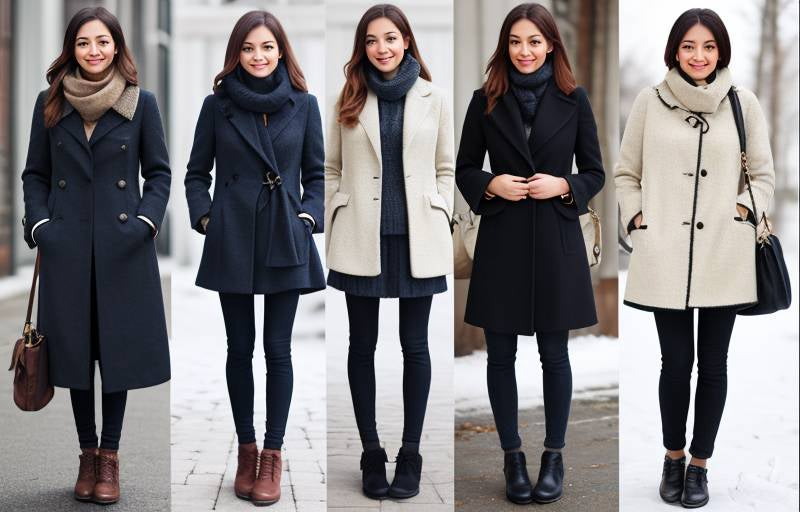
Winter (December–February) Korea winters are cold — genuinely cold, not European-mild-cold. Seoul temperatures regularly drop to -10°C in January with wind chill making it feel colder. A proper winter coat, thermal underlayers, warm socks, gloves, and a hat are not optional. The buildings, restaurants, and subway are all heated aggressively, which means you’ll be constantly removing and adding layers — a packable or foldable outer layer is more practical than a heavy parka that’s difficult to carry around indoors.
Shoes: The Decision That Affects Everything
Comfortable walking shoes are the highest-priority clothing item for any Korea trip. Seoul in particular involves far more walking than most city destinations — the combination of large palace grounds, hillside neighbourhoods like Bukchon and Gamcheon, and subway station corridors that sometimes require 10-minute walks between lines means your feet are working constantly.
The shoe-removal situation: Traditional restaurants, some accommodation, and certain cultural sites in Korea require removing shoes at the entrance. This means two things practically: wear shoes that are genuinely easy to slip on and off, and make sure your socks are acceptable. Arriving at a traditional restaurant with shoes that require untying, or socks with holes in them, is a minor but avoidable embarrassment.
A second pair of footwear for evenings or rest days is worth the luggage space. If you’re visiting in summer, sandals or slides serve as both the second pair and the humidity-appropriate footwear for daytime.
Electronics & Tech
Plug adapter: Korea uses Type C plugs (the standard European two-round-pin format) at 220V. US visitors need both a plug adapter and a voltage converter for any 110V-only devices, though most modern electronics (laptops, phone chargers) are dual-voltage — check the label on your device before assuming.
Portable charger: Korean cities are well-supplied with charging points in cafés and transport hubs, but the volume of map-checking, navigation, and photography that a Korea trip involves drains phone batteries fast. A 10,000–20,000mAh power bank is one of the most-used items in my wife’s travel kit regardless of destination.
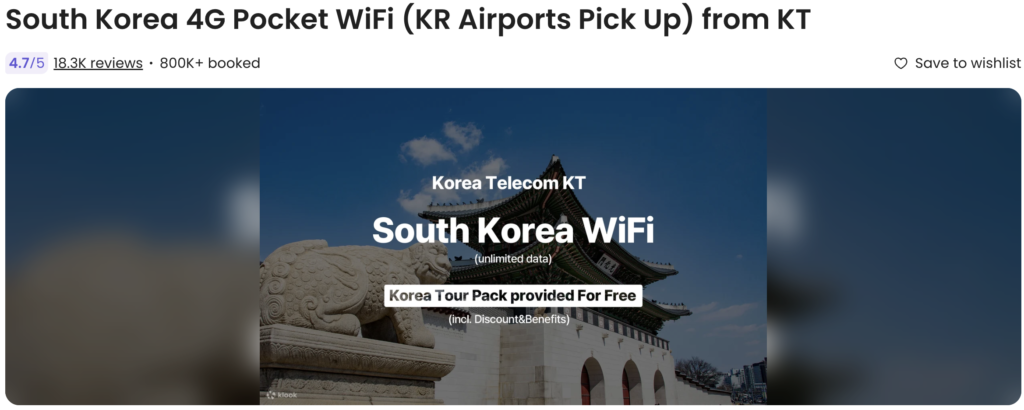
Data: Do not rely on roaming from your home carrier. Prices are high and speeds are inconsistent. Pick up a Korean SIM card at Incheon Airport immediately on arrival — the airport has multiple vendors and the process takes five minutes. Pocket WiFi devices are an alternative if you’re travelling in a group. Korea has some of the world’s fastest mobile internet and having reliable data makes navigation, translation, and general travel logistics dramatically easier.
Translation app: Naver Papago outperforms Google Translate for Korean in most situations. Download both with offline Korean language packs before you fly.
Health & Medications
Korea’s pharmacy network is extraordinarily comprehensive. There is a pharmacy (약국, yakguk) — identifiable by the green cross sign — within short walking distance of virtually any point in Seoul and most cities. Korean pharmacists are trained to dispense advice and common medications efficiently, many speak functional English in urban areas, and prices are low.
The practical implication: you do not need to bring a full pharmacy from home. Pain relievers, antihistamines, cold medications, and most over-the-counter treatments are available without prescription and cheaper than Western equivalents.
What to bring regardless:
- Any prescription medications you take regularly, in quantities exceeding your trip length plus five days buffer, in original labelled packaging
- Contact lenses and solution if you wear them — Korean brands are good but your specific prescription may not be stocked
- Sunscreen in summer — Korean sunscreen is actually excellent and worth buying there, but having some for the first day is practical
- Any skincare products you’re particular about — Korean alternatives are exceptional, but transition reactions are real
What not to over-pack: First aid kits beyond a few plasters, cold and flu medication in quantity, antacids, allergy tablets. All available cheaply at any pharmacy.
What to Buy in Korea (Don’t Pack These From Home)
Several categories of products are significantly better and cheaper in Korea than their equivalents elsewhere. Packing these from home wastes both luggage space and money.
Skincare and cosmetics: Olive Young — the dominant Korean beauty retail chain — stocks an extraordinary range of K-beauty products at prices that make buying at home look expensive. Budget an empty 3–5 litre section of your luggage for the return journey.
Sunscreen: Korean SPF formulations are lighter, more cosmetically elegant, and more effectively UV-protective than most Western equivalents at the same or lower price point.
Snacks for the return journey: Korean convenience store snacks — specifically the seaweed snacks, the various ramen flavours, and the packaged confectionery — are worth space in your bag going home.
Stationery and phone accessories: Seoul’s Hongdae area and the Dongdaemun underground shopping malls stock phone cases, cables, and stationery at prices that make buying before you go seem unnecessary.
Packing for Specific Korea Experiences
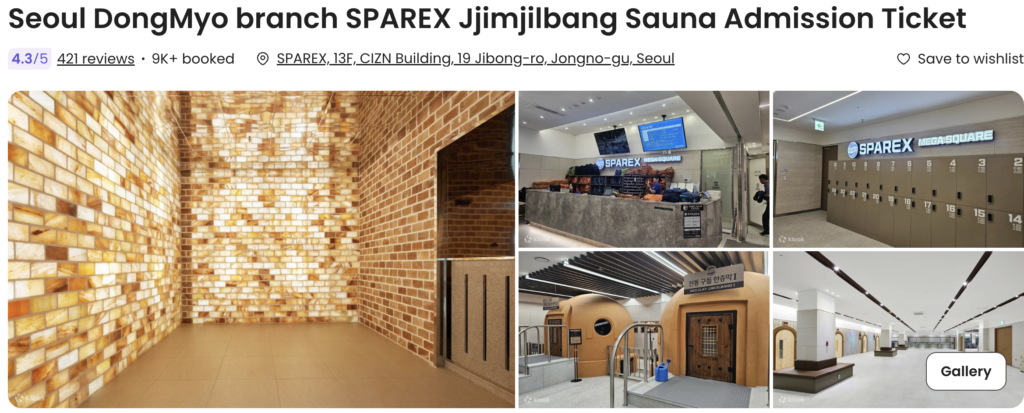
Jjimjilbang (Korean bathhouse): Most jjimjilbang provide towels, shorts, and a t-shirt for the communal areas as part of the entry fee. You need to bring: a change of underwear, any personal toiletries you’re particular about (shampoo, conditioner, skincare), and a small bag to carry them. Do not bring valuables — lockers are standard but the communal nature of the space means keeping valuables minimal is good practice. My jjimjilbang guide covers the full etiquette.
Hiking (Bukhansan, Hallasan, Namsan): A light day pack, trail-appropriate footwear (trail runners at minimum, hiking shoes better for Bukhansan), water, and snacks. Korean hiking culture takes the gear seriously — you’ll see people summiting Bukhansan in full technical mountain equipment — but for day hikes at moderate trails, ordinary athletic footwear is adequate.
Temple visits: No specific dress code is enforced at most Korean Buddhist temples, but covering shoulders and knees is respectful and expected at the more devout sites. A light layer carried in your bag covers this without dedicated packing.
What Not to Pack
Hair dryers: Every hotel and most guesthouses provide them. Hostels less reliably so — check if it matters to you.
Laundry concerns: Laundromats (코인빨래방, coin laundromats) are ubiquitous in Korean cities, clean, cheap, and easy to use. For trips of a week or more, planning one laundry day is more practical than packing for the full duration.
Formal business wear (unless you need it): Korean business culture is formal in meetings and smart-casual at most other times. Visitors rarely need to dress more formally than they would for a European city dinner.
Excessive cash: Korea is one of the world’s most card-friendly societies. Beyond the market cash allowance mentioned above, carrying significant amounts of won is unnecessary and slightly risky.
FAQ
Do I need a visa to visit Korea? Citizens of the US, UK, EU countries, Australia, Canada, and most Western nations can enter Korea visa-free for up to 90 days. Some nationalities require advance registration through Korea’s K-ETA system. Check current requirements before travel.
What plug adapter do I need for Korea? Type C (two round pins), 220V. US visitors need a voltage converter for any 110V-only devices, though most modern electronics are dual-voltage. Check the label on your device chargers.
Is it safe to drink tap water in Korea? Yes. Seoul tap water meets WHO standards and is safe to drink directly from the tap. Many Koreans choose to filter or boil it out of preference rather than necessity, but there is no health reason not to drink it unfiltered.
What should I not bring to Korea? Items to leave at home: excessive medication (pharmacies are comprehensive), heavy winter clothing beyond what you need (buildings are heated), and large amounts of cash (Korea is highly card-friendly). Also, avoid packing full-size toiletries — Korean drugstores and convenience stores stock everything you’ll need at better prices.
Can I buy Korean SIM cards at the airport? Yes — multiple vendors operate in the arrivals hall of both terminals at Incheon International Airport. Purchase immediately on arrival rather than after you’ve exited the arrivals zone. Prices are comparable to online pre-booking with the advantage of immediate setup.
Before You Leave Home — Book These

Korea Insider has lived in South Korea for 50 years and worked at international companies for over two decades — explaining Korean culture, food, and society to colleagues from the US, Europe, and Australia.
Internationally married with a Japanese spouse, Korea Insider brings both an insider’s depth and an outsider’s perspective to every topic on My Korea Tip.