
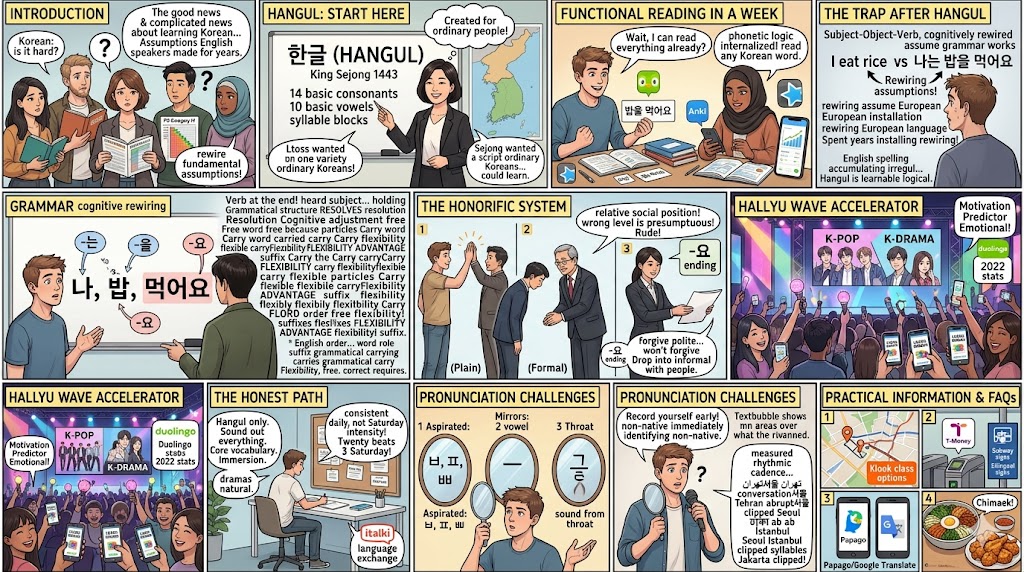
If you want to learn Korean, I have good news and complicated news. The good news is that the Korean writing system — Hangul — is genuinely one of the most logical and learnable scripts ever designed, and you can read it competently within a week of serious effort. The complicated news is that everything after Hangul requires you to rewire some fundamental assumptions about how language works — assumptions that English, and most European languages, have spent years installing in your brain.
I’ve spent over 23 years working inside multinational corporations in Korea. In that time I’ve watched hundreds of foreign colleagues attempt to learn Korean — some successfully, most not, and almost all of them making the same predictable mistakes in the same predictable order. I’ve also watched my wife, who is Japanese, navigate the language from a starting point that is simultaneously closer to Korean than English and further from it in ways that surprised both of us. What follows is what I would tell someone at the beginning of that process, if I were being completely honest rather than politely encouraging.
First: Is Korean Actually Hard?
The US Foreign Service Institute classifies Korean as a Category IV language — its most difficult category — for native English speakers, alongside Arabic, Japanese, and Mandarin Chinese. The estimated time to professional proficiency is 2,200 classroom hours. For context, Spanish sits at around 600 hours.
That number is real, and I’d rather you knew it at the beginning than discovered it six months in when your motivation is already depleted. But it obscures something important: proficiency for professional diplomacy and functional communication for travel, relationships, and daily life are very different targets. You can reach a level of Korean that makes your time in Korea qualitatively different — that gets you a different reaction in restaurants, markets, and taxis — in three to six months of consistent effort. That target is achievable. The diplomat’s proficiency is a different project entirely.
Hangul: Start Here, Finish Faster Than You Expect
Hangul (한글) was created in 1443 by King Sejong the Great, which makes it one of the few writing systems in history with a known inventor, a known date, and a documented design intention. Sejong wanted a script that ordinary Koreans — not just scholars trained in Chinese characters — could learn and use. He succeeded beyond anything he could have imagined.

The system uses 14 basic consonants and 10 basic vowels, combined into syllable blocks. Each block represents one syllable. The letters within each block follow positional rules that, once you internalize them, allow you to read any Korean word — even one you’ve never seen — within the time it takes to sound it out.
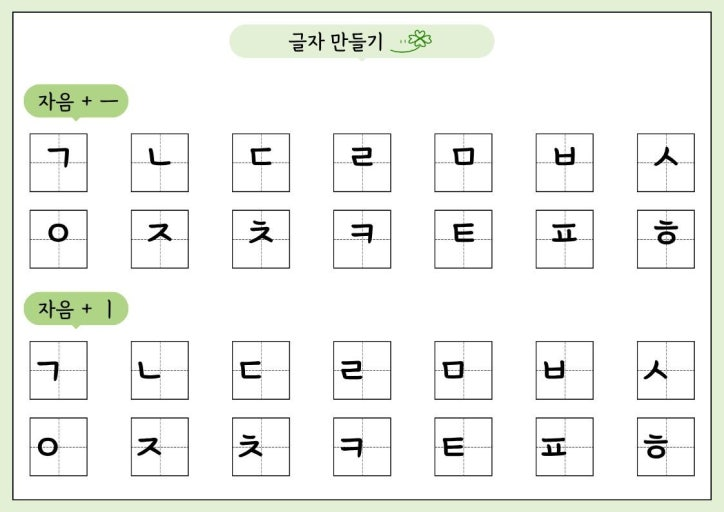
This is genuinely unusual. English spelling has centuries of accumulated irregularity built into it; Korean spelling is almost entirely phonetic. My wife learned to read Hangul in four days. A motivated adult learner with a decent study resource can achieve functional reading ability in a week. This is not an exaggeration, and it is the most encouraging true thing I can tell you about learning Korean.
What Hangul won’t give you: being able to read Korean text doesn’t mean you’ll understand it. Reading the sounds and knowing the meaning are two separate things, and Korean vocabulary — particularly the relationship between native Korean words, Sino-Korean words borrowed from Chinese, and recent English loanwords — takes considerably longer. But the mechanical ability to decode written Korean is a week away for anyone who approaches it seriously.
What Actually Makes Korean Hard: The Grammar
Korean is a Subject-Object-Verb language. English is Subject-Verb-Object. This is not a minor difference.
In English: I eat rice. In Korean: I rice eat. (나는 밥을 먹어요.)
The verb comes at the end of the sentence, always. This means that in Korean, you hear the subject and everything that happens to it before you find out what actually happens. For extended sentences — subordinate clauses, qualifiers, conditions — this requires holding the grammatical structure open in your mind until the verb arrives to resolve it. The cognitive adjustment is real, and it takes longer than most learners expect.
Korean also uses particles — small grammatical markers attached to nouns — to indicate the role each word plays in the sentence. Subject markers, object markers, topic markers, directional markers. English does this work through word order; Korean does it through suffixes. The advantage is flexibility — Korean word order is relatively free because the particles carry the grammatical information. The challenge is that those particles must be correct, and their correct use requires understanding distinctions that English simply doesn’t make.
The Honorific System: The Part That Takes Years
If I had to identify the single feature of Korean that takes the longest to master — and the one that most directly reflects Korean culture — it would be the honorific system.
Korean has multiple speech levels, ranging from formal polite to informal to plain to deferential, and the appropriate level depends on the relative social position of the speaker and listener. Age, professional rank, familiarity, and context all factor into which level you use. Using the wrong level is not a neutral error. It reads as rude, presumptuous, or condescending depending on the direction of the mistake.
I’ve written separately about the Korean age system and the social hierarchy it reflects. The honorific system is the linguistic expression of that hierarchy. When my foreign colleagues at work learned Korean, the ones who progressed fastest were invariably the ones who grasped early that learning the language meant learning the social logic underneath it — not just the vocabulary and grammar on top.
The practical implication for learners: start with formal polite speech (the -요 ending). It is appropriate in most situations you’ll encounter as a foreigner, it signals respect, and Koreans will almost universally forgive errors from non-native speakers when the baseline register is polite. What they won’t forgive — and what will close doors faster than speaking no Korean at all — is dropping into informal speech with people who haven’t invited you to.
Why the Hallyu Wave Changed Language Learning
Something significant happened to Korean language learning around 2012 and accelerated sharply after 2018. The Hallyu Wave — the global spread of Korean pop culture — created a generation of motivated language learners who came to Korean through K-pop, K-drama, and Korean food content rather than through academic or professional channels.
This matters pedagogically. Motivation is the primary predictor of language learning success, and emotional motivation — the desire to understand what BTS is actually saying, or to watch a K-drama without subtitles — is among the most durable forms. Duolingo reported that Korean was its fastest-growing language in 2022, with over 9.8 million learners on the platform. The majority cited K-pop and K-drama as their primary motivation.
The content ecosystem that now exists for Korean learners — YouTube channels, apps, podcasts, drama-based learning resources — is far richer than it was ten years ago, and it is largely a product of this demand. If you’re starting Korean now, you have access to learning resources that didn’t exist when the Foreign Service Institute calculated its 2,200-hour estimate.
The Honest Learning Path
Based on watching people do this successfully and unsuccessfully for over two decades, here is what I’d recommend:
Month 1: Hangul only Learn the writing system before anything else. Use it to sound out everything you encounter. Don’t romanize Korean. Romanization is a crutch that slows acquisition and creates pronunciation habits that are difficult to unlearn.
Months 2–6: Core vocabulary and formal polite speech Apps like Anki for vocabulary, a structured course like Talk To Me In Korean or the TTMIK workbooks for grammar. Target the 1,000 most common Korean words. Learn the -요 speech level first and use it for everything.
Simultaneously: Immersion content K-dramas are useful for listening and natural speech patterns, but the speech levels in dramas vary dramatically and informal speech dominates — which is the opposite of what a beginning learner should be practicing. Supplement with podcasts designed for learners, and with Korean content that uses the speech level you’re actually working on.
As soon as possible: Speaking with Koreans This sounds obvious and is consistently the step people delay longest. The adjustment from understanding Korean in controlled study conditions to understanding it in actual conversation — at natural speed, with regional variation, over background noise — is significant, and you cannot close that gap without practice. Language exchange partners, iTalki tutors, or simply the conversations that happen naturally if you visit Korea are all valid routes.
The one thing that separates people who reach functional Korean from those who plateau: consistent daily exposure over months and years, not intensive study sessions with long gaps. Twenty minutes daily beats three hours on a Saturday.
What Korean Sounds Like to a Native Speaker
Foreigners often ask me whether Korean sounds beautiful. It’s not a question I’d thought to ask about my own language before hearing it from outside. My honest answer: Korean at its most formal — the measured cadence of a traditional speech or a well-constructed sentence — has a rhythmic precision I find genuinely satisfying. Korean at its most casual — the clipped syllables, the dropped endings, the speed of a Seoul conversation between friends — sounds, to an outside ear, quite abrupt. Neither version is more authentic; they’re registers of the same language.
The sounds that consistently challenge English speakers: the aspirated consonants (the difference between ㅂ, ㅍ, and ㅃ), the vowel sounds that don’t exist in English (ㅡ in particular), and the tensed consonants that require a specific throat engagement that takes time to produce naturally. Recording yourself early and often is useful — Korean speakers can identify non-native pronunciation immediately, and the gap between what you think you’re saying and what you’re producing is often larger than you’d expect.
FAQ
Is Korean hard to learn for English speakers? Yes, by most objective measures — the US Foreign Service Institute rates it among the most difficult languages for English speakers. That said, Hangul is learnable in a week, conversational basics are achievable in months, and the learning resources available now are better than they’ve ever been. Difficulty is real but not prohibitive.
How long does it take to learn Korean? Functional conversational Korean — enough to navigate daily life in Korea, hold simple conversations, and make your travel experience qualitatively different — is achievable in six to twelve months of consistent daily study. Professional or academic fluency takes considerably longer.
Is Korean similar to Japanese or Chinese? Korean grammar is similar to Japanese in structure (both SOV, both use particles, both have honorific systems). Korean shares a significant vocabulary layer with Chinese through Sino-Korean borrowings, and the writing system historically used Chinese characters before Hangul replaced them. But Korean is not mutually intelligible with either language.
What’s the best app for learning Korean? Duolingo is useful for building habit and basic vocabulary. For serious learning, Talk To Me In Korean (TTMIK) offers structured grammar instruction at all levels. Anki with a Korean frequency deck is the most efficient tool for vocabulary acquisition. Use multiple tools rather than depending on one.
Do I need to learn Korean to visit Korea? No. English signage in Seoul is extensive, younger Koreans in tourist areas generally have functional English, and the subway system is fully bilingual. But learning even basic Korean — a few essential phrases — changes your reception in Korea noticeably. Koreans respond warmly to foreigners who make the effort.
Can I learn Korean through K-dramas alone? Dramas are excellent supplementary input but insufficient as a primary learning method. The speech is fast, informal registers dominate, and passive watching without active engagement produces minimal acquisition. Use dramas alongside structured study, not as a replacement for it.
Learn It Properly — Then Use It Here
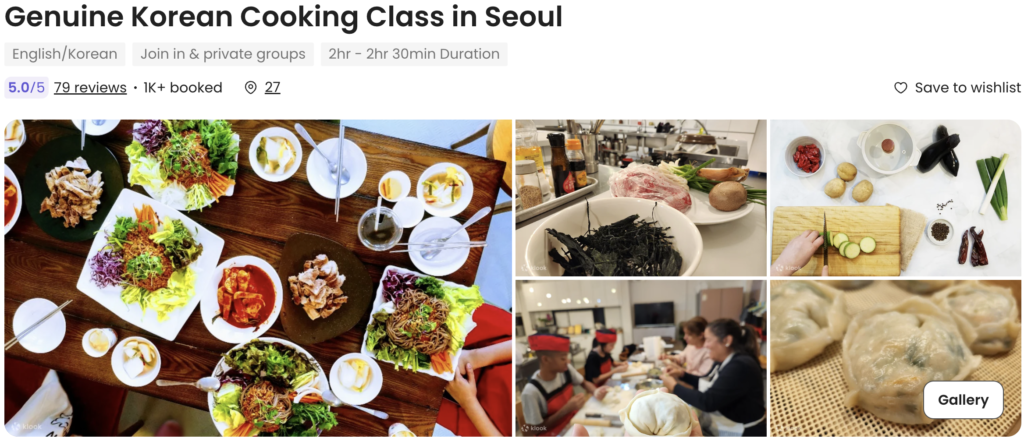
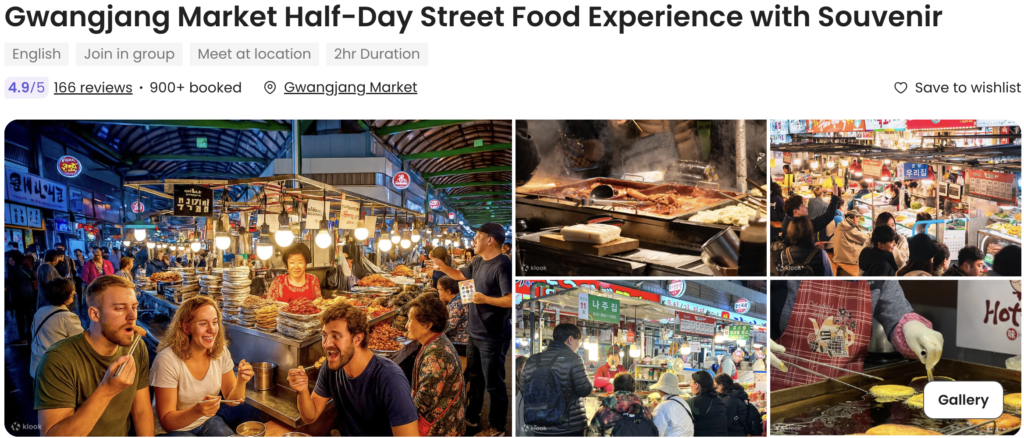
The most efficient way to accelerate Korean acquisition is spending time in Korea, surrounded by the language in context. These experiences are designed for exactly that.

Korea Insider has lived in South Korea for 50 years and worked at international companies for over two decades — explaining Korean culture, food, and society to colleagues from the US, Europe, and Australia.
Internationally married with a Japanese spouse, Korea Insider brings both an insider’s depth and an outsider’s perspective to every topic on My Korea Tip.