
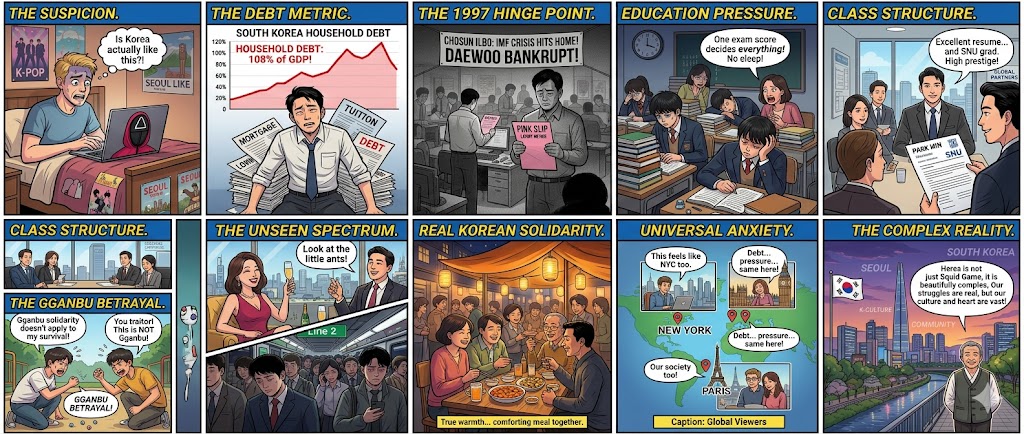
Squid Game made the world uncomfortable in a very specific way. Not the violence — audiences have seen far worse. What made people pause was the suspicion, halfway through the first episode, that the desperation driving 456 people to risk their lives for prize money might not be as fictional as it looked. Foreign viewers started asking Korean friends: is this real? Is Korea actually like this?
I was born in Seoul in 1975. I lived through the 1997 IMF financial crisis in my early twenties — the period that sits just offscreen as the backstory for almost every character in the show. I’ve spent over 23 years inside multinational corporations in Korea, which means I’ve seen the class system operate from multiple vantage points simultaneously. When Squid Game came out in September 2021 and became the most-watched Netflix series in history within weeks, my reaction wasn’t surprise at the global response. It was recognition. The show is not a perfect document of Korean society. But it’s a more accurate one than most people outside Korea expected.
What Squid Game Is Actually About
For the small number of readers who haven’t seen it: 456 people, all drowning in debt with no visible exit, are recruited to play a series of children’s games. Winners advance. Losers die. The prize is ₩45.6 billion — enough to eliminate the debt of every contestant with enough left over to rebuild a life.
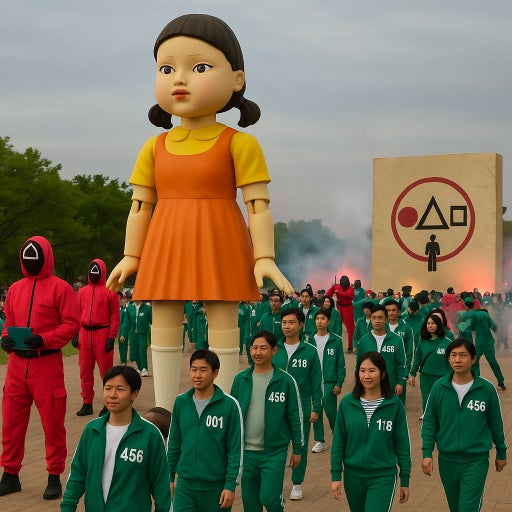
The games themselves — Red Light Green Light, Tug of War, Glass Bridge — are real Korean children’s games. That detail is not incidental. Director Hwang Dong-hyuk chose them deliberately: the games everyone played as children, now played again as adults in a system that treats human life as disposable when it has no economic value. The metaphor is not subtle. It is not trying to be.
The Debt Crisis: How Real Is It?
The financial desperation of the contestants is the most documentable element of the show, and the numbers are stark.
South Korea’s household debt ratio stands at approximately 108% of GDP — one of the highest in the developed world. The average Korean household carries debt that exceeds its annual income. Credit card debt, personal loans, mortgage debt on apartments whose prices have risen beyond most earners’ ability to service — the structural conditions that produce the show’s contestants are real and current.
The 1997 IMF crisis is the historical hinge point. I was 22 years old when it hit. The won lost half its value in weeks. Major chaebols collapsed. Daewoo — once the second-largest conglomerate in Korea — went bankrupt. Hundreds of thousands of people lost jobs that had previously felt permanent. The concept of lifetime employment at a single company, which had defined Korean working life for a generation, ended almost overnight.
The IMF crisis produced a generation of Koreans — my generation — who internalized financial precarity in a way that the preceding generation, which had experienced only the upward trajectory of the economic miracle, had not. The show’s protagonist Gi-hun is explicitly a product of that moment: a former auto worker who lost his job in a labor strike during the crisis period and never fully recovered. That backstory is not dramatic invention. It is a biography shared by hundreds of thousands of real Koreans.
The Education Pressure That Produces the Desperation
Squid Game’s characters are adults, but their formation happened in Korea’s education system — one of the most pressure-intensive in the world. The connection matters because the financial desperation shown in the series doesn’t emerge from nowhere. It is the downstream consequence of a system that trains young Koreans to believe their entire life trajectory depends on a single exam score, then releases them into a job market that cannot accommodate everyone who performed as instructed.
The logic runs like this: study intensively from early childhood, sacrifice adolescence for academic performance, attend a top university, secure a position at a major chaebol or government institution. For the people this path works for, it works extraordinarily well. For those it doesn’t — and statistically, it cannot work for everyone — the consequences are severe. The debt is often accumulated in the gap between what the system promised and what the economy delivered.
I went through this system. I remember the specific quality of pressure that surrounded university entrance exams — the family stakes attached to individual performance, the social meaning of which university you attended. The show captures that pressure as context, not as subject, and is more accurate for it.
The Class System: More Invisible Than the Show Suggests
Squid Game presents Korean class hierarchy in heightened, literal form — the wealthy watch from above while the poor kill each other below. The real Korean class system is less theatrical and more structural, which makes it in some ways harder to see and harder to escape.
Korea presents itself, and largely experiences itself, as a meritocracy. Hard work and education lead to advancement. The data suggests a more complicated picture. Intergenerational wealth mobility — the probability that a child born into the bottom income quintile will reach the top — has declined measurably in Korea over the past three decades. The apartments in Gangnam that now define upper-middle-class Seoul life have appreciated at rates that have permanently priced out anyone who didn’t own property before 2010.
Having spent 23 years inside multinational corporations in Korea, I’ve observed the class system operate through mechanisms that are perfectly polite and entirely effective. Which university you attended is information that Korean colleagues extract within minutes of meeting, and it shapes every professional interaction that follows. The Korean work culture that produces 52-hour work weeks and chronic sleep deprivation is not irrational behavior — it is a rational response to a system where the consequences of falling behind are severe and the safety net is thin.
The Gganbu Concept: What the Show Understands About Korean Loyalty
One of the most culturally specific elements of Squid Game is the concept of gganbu — a childhood term for a close friend with whom you share everything, including marbles. The marble episode, in which contestants are paired and must compete against their chosen partner, is the show’s emotional core precisely because it weaponizes a Korean concept of loyalty that has no direct Western equivalent.
Korean social relationships operate on a spectrum from complete in-group (가족, family; 우리, us) to complete out-group (남, strangers) with relatively little comfortable middle ground. The obligations to in-group members — to gganbu — are substantial, and betraying them carries moral weight that the show exploits deliberately. The horror of the marble episode is not just that people are forced to compete. It’s that the competition requires them to choose between a Korean value system and their own survival.
This dynamic plays out in less extreme forms in Korean corporate life constantly. The obligations of loyalty, hierarchy, and in-group membership create a social architecture that is genuinely different from anything I’ve encountered working with international colleagues — and more demanding in ways that are difficult to articulate without sounding either critical or romantic about it.
What the Show Gets Right — and Where It Exaggerates
Gets right:
- The scale and texture of household debt and its psychological consequences
- The class resentment that sits just beneath Korea’s high-functioning surface
- The way Korean social hierarchy shapes every interaction, including life-or-death ones
- The specific generational damage of the 1997 IMF crisis
- The role of education pressure in producing financial desperation
Exaggerates or simplifies:
- Korean society is not on the verge of literal violent class war — the show is metaphor, not journalism
- The ultra-wealthy “VIPs” are cartoonish in ways that obscure how Korean wealth actually operates (quietly, institutionally, through property and inheritance rather than theatrical sadism)
- Real Korean social solidarity — the genuine care that Koreans extend to in-group members — is mostly absent from the show’s portrait of the society
Hwang Dong-hyuk has said in interviews that he wrote the original script in 2009, immediately after the global financial crisis, when he himself was in debt and considering whether he would participate in a similar game. The show is personal before it is sociological. That context matters for understanding both its power and its limits as a portrait of Korea.
Why the World Recognized It
The reason Squid Game became the most-watched Netflix series in history is not that Korean society is uniquely brutal. It’s that the anxieties the show dramatizes — debt, precarity, the feeling that the system is rigged, the sense that survival requires betraying your values — are not uniquely Korean. They are the anxieties of every advanced economy that has simultaneously generated significant wealth and distributed it with significant inequality.
Korea just dramatized them first, more honestly, and with better production design than anyone else had managed. That is, ultimately, what the Hallyu Wave is — not the export of Korean specificity, but the discovery that Korean specificity happens to speak to universal conditions. The best Korean films and dramas have always done this. Squid Game did it at a scale that collapsed the distinction between “Korean content” and “global content” permanently.
FAQ
Is Squid Game based on a true story? No — it is entirely fictional. However, the social and economic conditions it depicts — household debt, class inequality, the consequences of the 1997 IMF crisis, education pressure — are real and documentable. The games are based on real Korean children’s games.
How bad is household debt in Korea really? South Korea’s household debt to GDP ratio is approximately 108% — among the highest in the OECD. The issue is structural and has been the subject of sustained government concern for over a decade. It is one of the most significant economic risks facing the Korean economy.
Did Squid Game change anything about Korean society? The show generated significant domestic conversation about debt, inequality, and working conditions. It did not produce measurable policy change. Korean media noted the irony of a show about economic desperation generating substantial wealth for Netflix and its Korean creators — a dynamic that itself resembles the show’s themes.
Is Season 2 worth watching? Season 2 expanded the world and raised the political stakes of the original’s class commentary. Whether it matched Season 1’s impact is a matter of genuine debate among Korean viewers, who tended to find the social critique sharper in the original.
Should I feel differently about Korea after watching Squid Game? Korea is not Squid Game. It is also not the frictionless, beautiful country that tourism photography presents. It is a complex, high-functioning, deeply pressured society that has achieved extraordinary things at significant human cost — which is, when you think about it, the honest description of most successful countries. Visit with that complexity in mind and you’ll find it more interesting, not less.
Experience the Real Seoul Behind the Show



Korea Insider has lived in South Korea for 50 years and worked at international companies for over two decades — explaining Korean culture, food, and society to colleagues from the US, Europe, and Australia.
Internationally married with a Japanese spouse, Korea Insider brings both an insider’s depth and an outsider’s perspective to every topic on My Korea Tip.